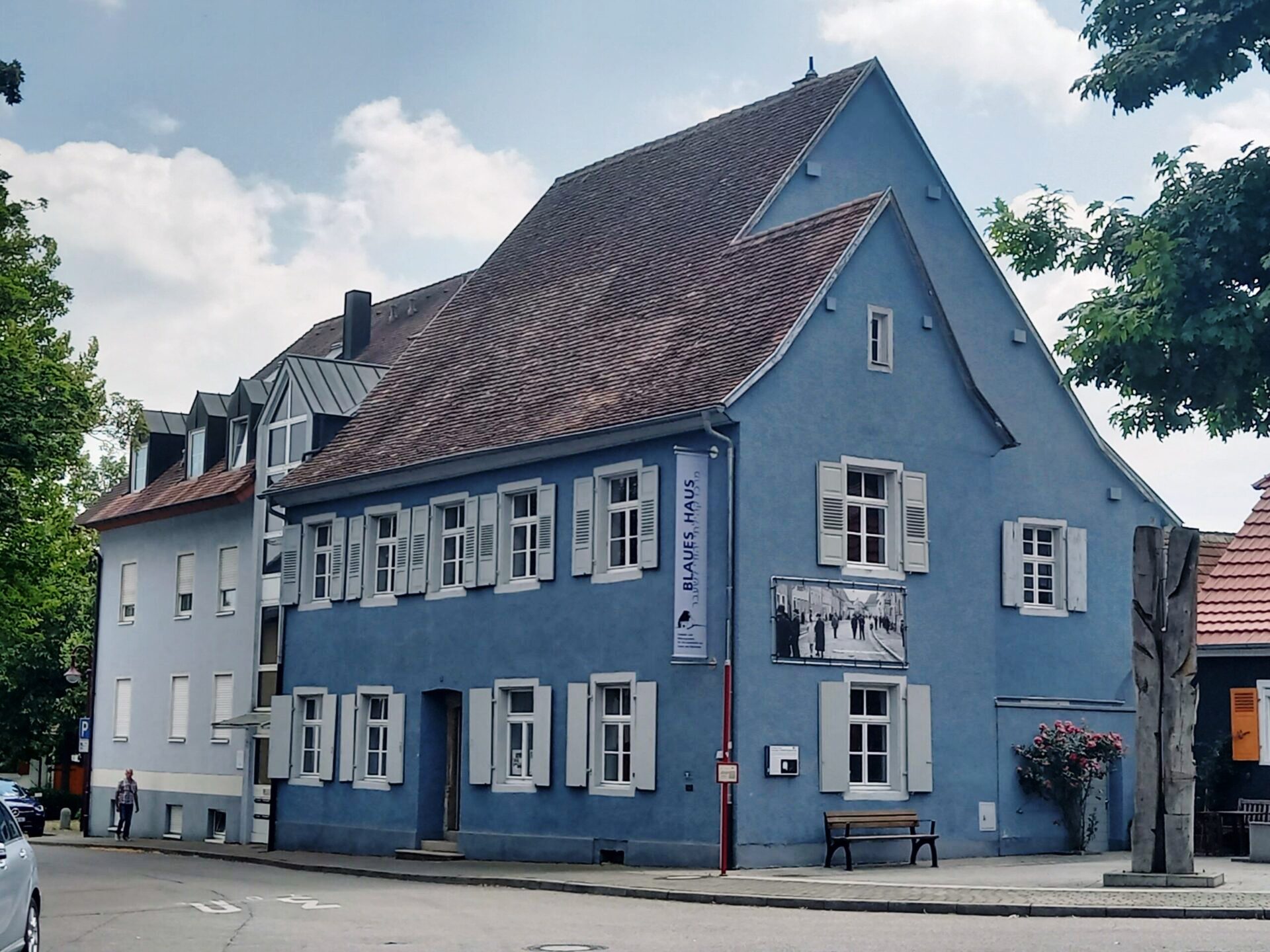
In Breisach am Rhein, only a few kilometres from the Rhine and the French border, an apparently discreet house carries traces of several centuries of local history.
The Blaues Haus, or Blue House, is not simply an old building preserved within the urban landscape.
It served as a Jewish school, community house and residence for cantors. It witnessed the destruction of Breisach’s Jewish community under National Socialism, a forced transfer of ownership, post-war restitution and, much later, its gradual transformation into a place of memory, research, education and encounter.
This trajectory gives the site its particular significance.
The Blue House makes it possible to observe how local history can be reconstructed through a building, archives, biographies, photographs, testimonies and relationships with descendants of former Breisach families.
It therefore raises a broader question:
how does a place become an infrastructure of transmission when the community whose traces it preserves was itself destroyed?
A house before it became a memorial site
The history of the building first reminds us that a heritage site did not always serve the function we associate with it today.
A structure already existed close to Breisach’s former town wall before the end of the seventeenth century.
From 1691, the enlarged building served for around 140 years as the St. Peter inn and belonged to Christian owners.
Only in 1829 did Breisach’s Jewish community acquire the building in order to establish a school for its children.
For a period, it also provided assistance to poorer Jewish residents.
Its uses changed again over time.
By the late nineteenth and early twentieth centuries, it served among other things as a community house and as accommodation for cantors and their families.
The building now associated with Jewish memory is therefore not a memorial constructed retrospectively.
It is itself part of the history it transmits.
Jewish history in Breisach predates the house
Jewish memory in Breisach did not begin with the acquisition of this building.
Evidence of Jewish presence in the town reaches back to the Middle Ages.
Over the centuries, different Jewish communities lived in Breisach within changing political and territorial contexts.
After the Thirty Years’ War, Jewish families settled in the town again from the seventeenth century onwards.
This history belongs to an Upper Rhine region whose borders, sovereignties and patterns of circulation changed repeatedly.
Breisach itself belonged to different political formations at different times.
Its local history therefore cannot be understood solely through present-day national borders.
It also belongs to a wider historical geography of the Upper Rhine.
Coexistence did not mean an absence of conflict
Relationships between Jewish and Christian populations need to be described carefully.
The word “coexistence” can suggest a continuous and harmonious past.
The history was more complex.
People lived in geographical and economic proximity, developed social relationships and shared aspects of urban life.
Yet this proximity also existed alongside legal restrictions, exclusion, violence and rupture.
A memorial site should therefore not transform the past into a simplified narrative of living together.
Its role is also to make contradictions visible.
Through individual and family histories, the Blue House allows local belonging, proximity, exclusion and persecution to be examined together.
1933: the rupture did not suddenly begin in 1940
The destruction of Breisach’s Jewish community did not begin with the deportation of 1940.
From 1933, the National Socialist seizure of power progressively brought exclusion, prohibitions and persecution.
The building itself passed through this period.
After Breisach’s synagogue was destroyed in November 1938, a clandestine or improvised prayer room was established in the community house.
This gave the building a particularly significant role.
It was no longer only an administrative or residential space.
It also became one of the places in which a persecuted community attempted to maintain part of its religious life.
22 October 1940 and the deportation to Gurs
22 October 1940 represents a major rupture in the Jewish history of Breisach and Baden.
Jewish residents of Breisach were arrested and deported, together with more than six thousand Jewish people from Baden and the Palatinate, to the Gurs camp in southern France.
Several people were arrested directly in the former community house.
The relationship between Breisach and Gurs has therefore become a central dimension of the memory work carried out by the Blue House today.
The geography of persecution extends well beyond German borders.
Local history continues into France and, for many victims, into the wider Nazi systems of internment and extermination.
Memory in Breisach is necessarily cross-border because the historical trajectories it documents were themselves cross-border.
A building caught within the politics of persecution
The building’s history did not end when the community disappeared.
In 1941, the house was subjected to a forced sale to a Freiburg company that used it for production connected with the war economy.
After 1945, this sale was annulled under French occupation law.
The property was returned to the Oberrat der Israeliten Badens.
In 1955 it was sold to Selma Ziehler, a Jewish survivor from Breisach who had escaped deportation with her family.
These changes of ownership show that material memory cannot be separated from the legal mechanisms of dispossession and restitution.
Preserving a building also means reconstructing what happened to it.
Recovering traces of a destroyed community
Transmission does not depend on walls alone.
It depends on documents capable of restoring people, families and individual trajectories to historical understanding.
Since its creation, the organisation behind the Blue House has worked to identify Jewish victims of Nazi persecution from Breisach.
Archives.
Photographs.
Administrative records.
Correspondence.
Testimonies.
Genealogical research.
Relationships with descendants.
These materials transform general history into individualised histories.
Persecution ceases to be only a succession of dates.
It recovers names, faces and life stories.
From saving the building to creating a memorial site
By the late 1990s, the visibility of Breisach’s Jewish history had become an increasingly important local issue.
The Förderverein, founded in 1999, acquired the building in July 2000.
A period of restoration and reflection on its future function followed.
The work was carried out with support from heritage authorities, public institutions and numerous supporters.
In 2003, the restored building was inaugurated under the name Blaues Haus.
This transformation was significant.
The former Jewish community house became a place explicitly dedicated to memory and encounter.
Yet the transformation did not mean freezing the building in an imagined historical state.
It gave it a new social function.
From preservation to mediation
Preserving a building does not guarantee that its history will be understood.
Mediation is necessary.
Exhibitions.
Texts.
Archives.
Listening stations.
Guided visits.
Meetings.
Educational work.
Projects involving young people.
The Blue House has gradually developed around these different practices.
A permanent exhibition installed from 2019 in former living spaces of the Eisemann family and the Jewish community, for example, provides access to the history of the place through family and local experiences.
The goal is no longer merely to state that a Jewish community once existed in Breisach.
It is to make sufficiently precise traces available so that visitors can understand how people lived before exclusion and persecution.
Giving history faces
This approach is particularly important at sites dealing with mass violence.
Numbers are necessary.
But they can become abstract.
Family photographs, portraits, names and biographies create another relationship with the past.
They remind us that historical categories such as “community”, “victims” and “deportees” refer to people whose lives were embedded in family, professional and social networks.
The work in Breisach therefore seeks to connect the history of persecution with the history of life before it.
This prevents local Jewish history from being reduced to its destruction.
Those who were persecuted had previously studied, worked, lived, prayed, maintained relationships and participated in the town.
Memory of catastrophe should not erase memory of that life.
A local site connected to multiple geographies
The Blue House is strongly rooted in its local setting.
Its primary subject is Breisach and the town’s Jewish history.
Yet its networks quickly extend beyond the town.
As early as 2001, the organisation joined Alemannia Judaica, a network concerned with preserving the heritage of German-speaking Jewish communities in Vorarlberg, northern Switzerland, Alsace and south-west Germany.
Meetings and projects also connected Breisach with French partners.
In 2004, a trilingual international conference on early Jewish families in Breisach brought together, among others, Holocaust survivors and descendants of families originating from the town.
The cross-border dimension is therefore not a contemporary label added to the site.
It emerges from the historical trajectories the Blue House seeks to document.
The Upper Rhine as a space of memory
This perspective also offers another way of looking at the Upper Rhine.
Today, the region is frequently described through European mobility, cross-border cooperation and proximity between Germany, France and Switzerland.
But this contemporary geography is also crossed by much older histories.
Families.
Religions.
Trade.
Migration.
Changing borders.
Wars.
Persecution.
Deportation.
Reconstructing Breisach’s Jewish history means placing a local site within these wider movements.
The Rhine therefore appears not only as a border.
It also becomes a space of historical relationships and trajectories.
Memory and encounter
The German description of the Blue House as a site of memory and encounter is significant.
It indicates that transmission does not stop at preserving what belongs to the past.
A memorial site also receives people in the present.
Descendants of Jewish families.
Residents.
Students.
Researchers.
Visitors from other countries.
Partner institutions.
Their encounters do not produce a single interpretation of history.
Rather, they create conditions in which different relationships to the past can encounter documents and surviving traces.
Memory thus becomes a social practice.
The role of younger generations
Educational work represents another central aspect of this transmission.
Over the years, students and young people have participated in research, publications, artistic projects and study trips connected with Breisach’s Jewish history and Nazi persecution.
This participation changes their relationship to heritage.
The past is no longer only presented by specialists to a passive audience.
It becomes something to investigate.
Finding a name.
Reading a document.
Identifying an address.
Reconstructing a trajectory.
Understanding why a family disappeared from a town.
These practices give memory work a methodological as well as commemorative dimension.
Remembering without freezing the past
A memorial site might be understood as a space dedicated to fixing a historical narrative.
The Blue House demonstrates instead that memory remains under construction.
New documents can emerge.
Descendants can make contact.
Research can complete biographies.
New exhibitions can recontextualise known events.
The questions visitors ask also change from one generation to another.
Transmission is therefore not simple repetition.
It requires continuously updating the methods through which the past is made intelligible without reshaping it according to the needs of the present.
The limits of representation
No memorial site can completely reconstruct a destroyed community.
Archives are incomplete.
Some voices were never recorded.
Some families left more traces than others.
Surviving photographs themselves result from particular histories of preservation.
These limits should remain visible.
Memory work does not consist in artificially reconstructing a lost totality.
It consists in making surviving traces accessible, documenting gaps and ensuring that absence of evidence is not mistaken for absence of history.
A small site within a wider cultural geography
The Blue House finally demonstrates that the production of cultural knowledge does not depend only on major national institutions.
A building in a small border town can undertake research, educational and networking work whose reach extends far beyond its physical scale.
This disproportion is significant.
The size of a site does not determine the extent of the historical networks it can make visible.
From one house in Breisach, trajectories can be followed towards Alsace, Switzerland, Freiburg, Gurs, the United States, Israel or Auschwitz.
The local is therefore not the opposite of the international.
It can be one of the most precise points from which to access it.
Conclusion
The Blue House in Breisach should not be understood only as a heritage building or as the surviving remnant of a destroyed community.
Its value lies in the relationship it establishes between several functions:
preserving,
researching,
documenting,
exhibiting,
transmitting,
and connecting people.
The building itself carries part of the town’s Jewish history.
But that history becomes accessible only through the continuous work carried out around it: archives, biographies, exhibitions, educational programmes, relationships with descendants and cross-border cooperation.
The Blue House thus demonstrates how a highly local site can become part of a much wider infrastructure of memory.
It connects the history of one street and one community with National Socialism, deportation, restitution and the historical movements of the Upper Rhine.
Its European significance therefore does not come from an abstract claim to a “shared memory”.
It comes from the concrete trajectories that can be reconstructed across several territories.
It is precisely this capacity to begin with one place and make wider historical relationships visible that gives the Blue House its particular cultural importance.
Editorial note — This article is based on a text by Blaise Puala originally published on Ciel-Bleu.org on 28 July 2023. It has been fully revised, verified and re-edited for the Kultur Insights library in order to correct and clarify several historical elements while preserving its documentary value regarding the Blue House in Breisach and its work transmitting local Jewish history.