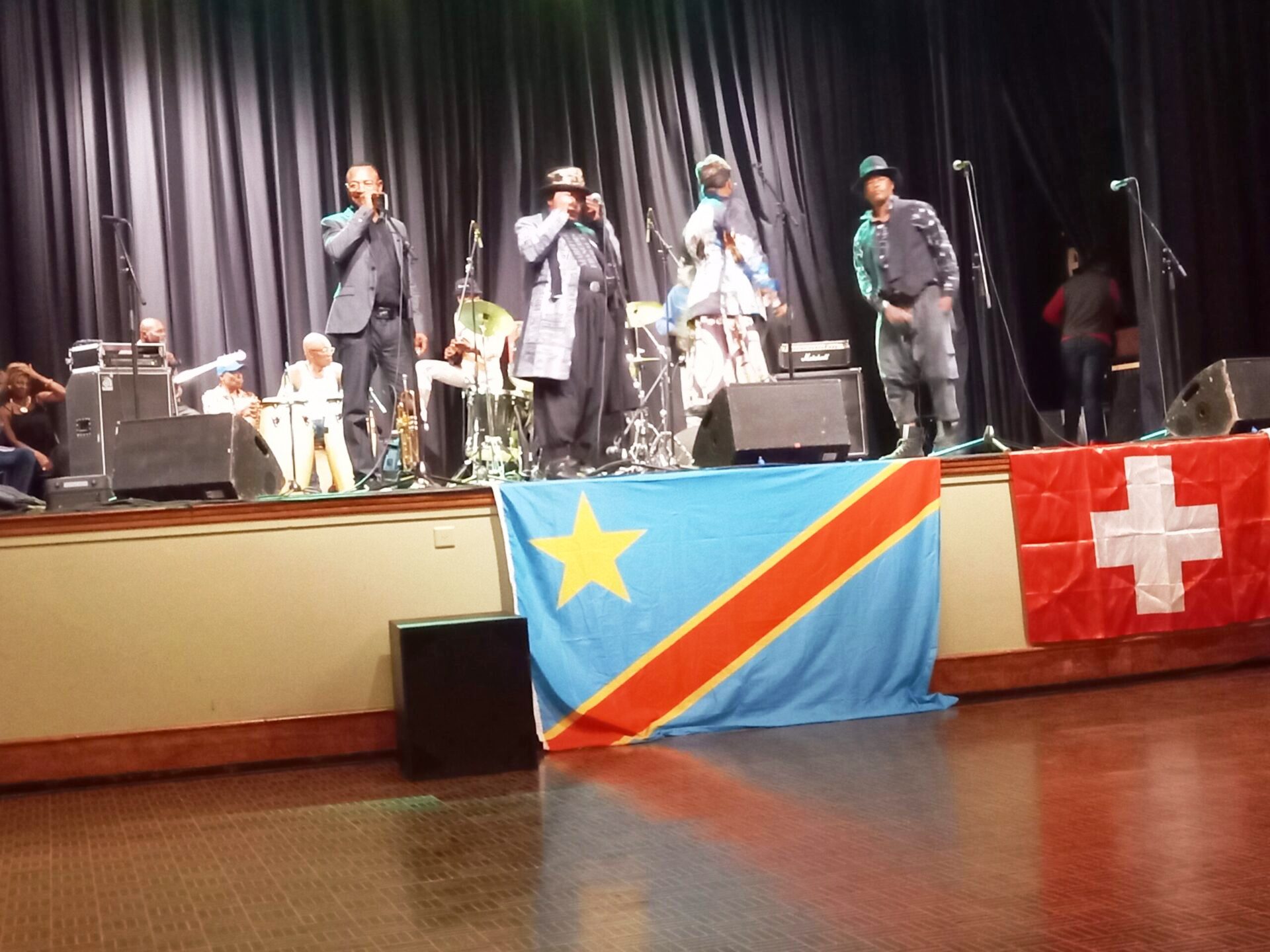
Only a few months after Congolese rumba was inscribed on UNESCO’s Representative List of the Intangible Cultural Heritage of Humanity, the music continued to live where institutional recognition alone cannot sustain it: in practices, celebrations, associations, orchestras, bodies and encounters.
On 27 August 2022, an event entitled Djambo was held at the Salle de spectacles in Renens, in the canton of Vaud. It brought together different cultural expressions around what the organisers described as the idea of “living together”.
Dance.
Food.
Associational encounters.
Rumba.
A Congolese music orchestra.
The evening brought together, among others, a Congolese organisation and the cultural association TEUTA in a programme open to different communities.
At first sight, this might appear to be simply a local festive event.
Yet the presence of Congolese rumba in this setting raises a broader question:
what happens to cultural heritage when it moves beyond its historical territory, circulates with people and becomes part of the cultural life of a European city?
A recent international recognition
In 2021, the Democratic Republic of the Congo and the Republic of the Congo jointly secured the inscription of Congolese rumba on UNESCO’s Representative List of the Intangible Cultural Heritage of Humanity.
This recognition matters.
It affirms that rumba should not be understood only as a popular musical genre or entertainment industry.
It also recognises the practices, knowledge, forms of transmission and social functions associated with it.
UNESCO highlights, among other things, its role in celebrations, social life, intergenerational transmission and the identity of Congolese populations, including those living in diaspora.
But inscription on a heritage list is not enough to keep a cultural practice alive.
Intangible heritage cannot be preserved like a building or an object placed behind glass.
It must continue to be practised.
Played.
Danced.
Heard.
Transformed.
Transmitted.
The essential question therefore begins after recognition.
From recognised heritage to practised heritage
The case of Renens makes this transition particularly visible.
Rumba does not appear there as an exhibit designed to explain Congolese culture.
It is part of a collective event.
It is performed before an audience.
It accompanies encounter.
It makes people dance.
It brings musical references from the two Congos into a Swiss social environment.
This shift is important.
It reminds us that cultural transmission does not take place only within heritage institutions.
It also occurs in municipal halls, associations, neighbourhood celebrations, rehearsals, concerts and local gatherings.
These relatively modest infrastructures can be precisely what allow a cultural practice to remain genuinely alive.
Djambo as a local space of encounter
The event of 27 August 2022 was presented by its organisers as a new Congolese event concept.
The programme combined several registers.
Recorded music.
Dance demonstrations.
Performance.
Rumba.
A Congolese orchestra.
The cultural association TEUTA also took part with a dance demonstration.
This presence matters.
Djambo was therefore not designed simply as a Congolese community celebration for a Congolese audience.
Its stated ambition was to bring different communities together within a shared space.
Culture functions here less as a closed marker of belonging than as a means of entering into relation.
Renens: diversity as an ordinary local condition
The choice of Renens is significant.
In 2022, the city had more than 21,000 residents and 122 nationalities were represented.
Almost half of the population was of foreign nationality.
Cultural diversity is therefore not a marginal phenomenon within local life.
It is part of the structure of the city itself.
In such an environment, an event like Djambo does not take place in front of a supposedly homogeneous society occasionally encountering an “external” culture.
It takes place within a territory already shaped by migration, mobility and multiple cultural references.
This distinction is essential.
It changes what it means to “present” a culture.
Diaspora does not simply carry an intact culture
Diasporic circulation is sometimes represented too simply.
A population leaves a territory, takes its culture with it and then seeks to preserve it abroad.
In reality, the processes are more complex.
A cultural practice changes when it encounters a new environment.
Audiences differ.
Available infrastructures are not the same.
Generations develop different relationships with the country of origin.
New collaborations emerge.
Languages mix.
Expectations evolve.
Rumba practised in Kinshasa, Brazzaville, Brussels, Paris, Geneva or Renens belongs to a shared history, but it does not necessarily take identical forms everywhere.
Circulation is therefore more than geographical movement.
It produces transformation.
A music shaped by circulation itself
This mobility is already embedded in rumba’s history.
Congolese rumba itself emerged from long-standing circulations between Central Africa and the Americas.
Musical and choreographic forms originating in the historical Kongo region crossed the Atlantic through the slave trade.
They were transformed in the Americas, notably in Cuba.
During the twentieth century, recordings of Cuban music circulated back to Central Africa, where musicians appropriated and reshaped them.
From this process gradually emerged what became known as Congolese rumba.
The heritage now recognised by UNESCO is therefore itself the product of movement, transformation and reappropriation.
The idea of a “pure” culture simply leaving its place of origin fits poorly with this history.
Circulation is already at the heart of the practice.
The stage as a space of transmission
At an event such as Djambo, the stage does more than present a performance.
It also creates a situation of transmission.
Someone who already knows rumba may recognise familiar references.
Another person may encounter it for the first time.
Different generations may share the same repertoire.
People with no previous relationship to the Congo may enter into the practice through listening or dancing.
This transmission does not mean that all participants understand rumba in the same way.
For some, it may carry family memories.
For others, national cultural meaning.
For others still, it may first be experienced as dance or festive music.
These relationships can coexist.
Transmission is not reproduction
To speak of transmission does not mean that a practice passes unchanged from one generation to another.
Younger generations do not necessarily reproduce their parents’ cultural practices.
They select.
Combine.
Question.
Transform.
They may listen to rumba while also belonging to musical worlds deeply shaped by hip-hop, Afrobeats, electronic music or other international scenes.
Cultural continuity therefore does not depend on immobility.
It may depend precisely on a practice’s capacity to enter into relation with new references.
Living heritage is not heritage that never changes.
It is heritage whose transformations continue to be carried by people and communities.
Associations as cultural infrastructure
Transmission also requires structures.
Associations play an important role.
They find venues.
Organise programmes.
Mobilise audiences.
Create collaborations.
Bring artists and residents together.
Produce opportunities for encounter.
Their work is often less visible than that of major cultural institutions.
Yet it forms an essential infrastructure for diasporic cultural practices.
Without such networks, many cultural expressions might remain important within private or family life while having fewer opportunities to become visible in collective public space.
From community to public space
Visibility is therefore another important issue.
A cultural practice may exist for many years within a community while remaining barely perceptible at the level of a city.
When it enters a municipal venue, a festival or an open association-led programme, its status partially changes.
It becomes accessible to other publics.
It enters the local cultural calendar.
It can be documented through photographs, articles or association archives.
This does not mean it automatically receives the same recognition as practices already enjoying strong institutional legitimacy.
But its presence becomes public.
Visibility is not integration
Several levels still need to be distinguished.
Organising one evening around Congolese cultural expressions does not necessarily mean that these practices have a lasting place within Swiss cultural institutions.
Event-based visibility is temporary.
A programme begins and ends.
Institutional recognition depends on other mechanisms:
access to funding,
regular programming,
partnerships,
access to stages,
media presence,
documentation,
archives,
professional opportunities for artists.
An event such as Djambo therefore does not resolve the question of the place of diasporic cultures.
It allows that question to be observed.
Who produces cultural visibility?
This distinction leads to another important question.
Who decides what becomes visible within a city?
Municipal institutions?
Programmers?
Associations?
Communities themselves?
Artists?
Audiences?
In the case of Djambo, the association-led initiative shows that communities can create their own spaces of visibility.
They do not necessarily have to wait for a major institution to programme them.
They organise an event.
Mobilise partners.
Occupy a venue.
Build an audience.
This capacity for initiative is already a form of cultural action.
“Living together” as practice rather than slogan
The phrase “living together” accompanies many intercultural projects.
It can easily become vague.
Its significance depends on the concrete mechanisms that make it perceptible.
In Renens, the collaboration between Congolese organisers and TEUTA is more meaningful than the slogan itself.
Different cultural references are placed within the same programme.
Audiences may cross paths.
Dance forms follow one another.
Encounter becomes material.
This does not guarantee mutual understanding or lasting relationships.
But it creates a situation in which encounter can occur.
Avoid reducing diasporic culture to origin
Another challenge is to avoid permanently confining diasporic practices to the representation of a “country of origin”.
A Congolese association based in Renens also belongs to Switzerland’s associational landscape.
The people taking part in its activities have multiple trajectories.
Some were born in the Congo.
Others in Switzerland.
Others move between several countries.
A practice such as rumba therefore belongs simultaneously to several geographies.
It can be Congolese in its history and references while also becoming part of the cultural life of a Swiss city.
This overlap is one of the defining features of contemporary diasporic cultures.
Heritage without folklorisation
Heritage recognition also carries a tension.
It can strengthen the visibility of a practice.
Support transmission.
Create new forms of international recognition.
But it can also encourage an overly fixed interpretation.
Once a practice is labelled “heritage”, there is a risk of treating it primarily as something inherited from the past.
Yet rumba remains a contemporary cultural production.
Artists continue to create.
Styles evolve.
Sounds change.
Modes of distribution transform.
Audiences renew themselves.
Heritage recognition is therefore meaningful only if it does not turn a living culture into static folklore.
From a first edition to an ongoing process
The 2022 evening was presented at the time as a new event concept.
It did not remain isolated.
Djambo would later return in Renens.
This continuity is significant.
It shows how an association-led initiative can gradually become a local cultural rendezvous.
A repeated event produces more than temporary visibility.
It creates memory.
People return.
Collaborations develop.
A name becomes recognisable.
A practice begins to acquire a place in the local cultural calendar.
Circulation therefore gradually produces anchoring.
From Kinshasa and Brazzaville to Renens
The presence of rumba in Renens ultimately illustrates a cultural geography that cannot be reduced to a simple opposition between “here” and “there”.
Kinshasa and Brazzaville remain major historical centres of rumba.
But the practice also exists in the cities where Congolese diasporas live and circulate.
It moves with artists.
Families.
Recorded media.
Digital platforms.
Associations.
Audiences.
Renens becomes, on a modest scale, one of the places where this circulation temporarily takes material form.
Conclusion
The Djambo evening of 27 August 2022 cannot, of course, represent the full range of Congolese cultural practices in Switzerland or the full diversity of diasporic experiences.
Its significance lies elsewhere.
It allows us to observe how a practice recently recognised as intangible cultural heritage continues to exist far from its main historical centres.
In Renens, rumba was not simply heritage named by UNESCO.
It was played.
Heard.
Danced.
Shared.
Placed in relation with other cultural practices.
That distinction is essential.
Heritage recognition produces institutional visibility.
But artists, associations, audiences and local spaces are what allow a practice to continue circulating.
The case of Renens therefore shows that heritage and diaspora are not separate questions.
They meet in the concrete situations where inherited culture becomes practised culture in a new environment.
Rumba appears less as a heritage transported from the Congo than as a cultural form in continuous movement: capable of producing memory, presence, transmission and new forms of local anchoring at the same time.
Editorial note — This article is based on a text by Blaise Puala originally published on Ciel-Bleu.org on 1 September 2022 following the Djambo event held in Renens on 27 August 2022. The author attended the event and documented it photographically. The text has been revised, verified and re-edited for the Kultur Insights library in order to preserve its documentary value while deepening the analysis of the relationships between intangible cultural heritage, transmission, diasporic practices and local cultural anchoring.