A university is not made up only of classrooms, laboratories, examinations and scientific activities.
It also produces moments in which students occupy institutional space differently.
A stage.
A concert.
A dance.
A song.
A performance prepared for other students and teachers.
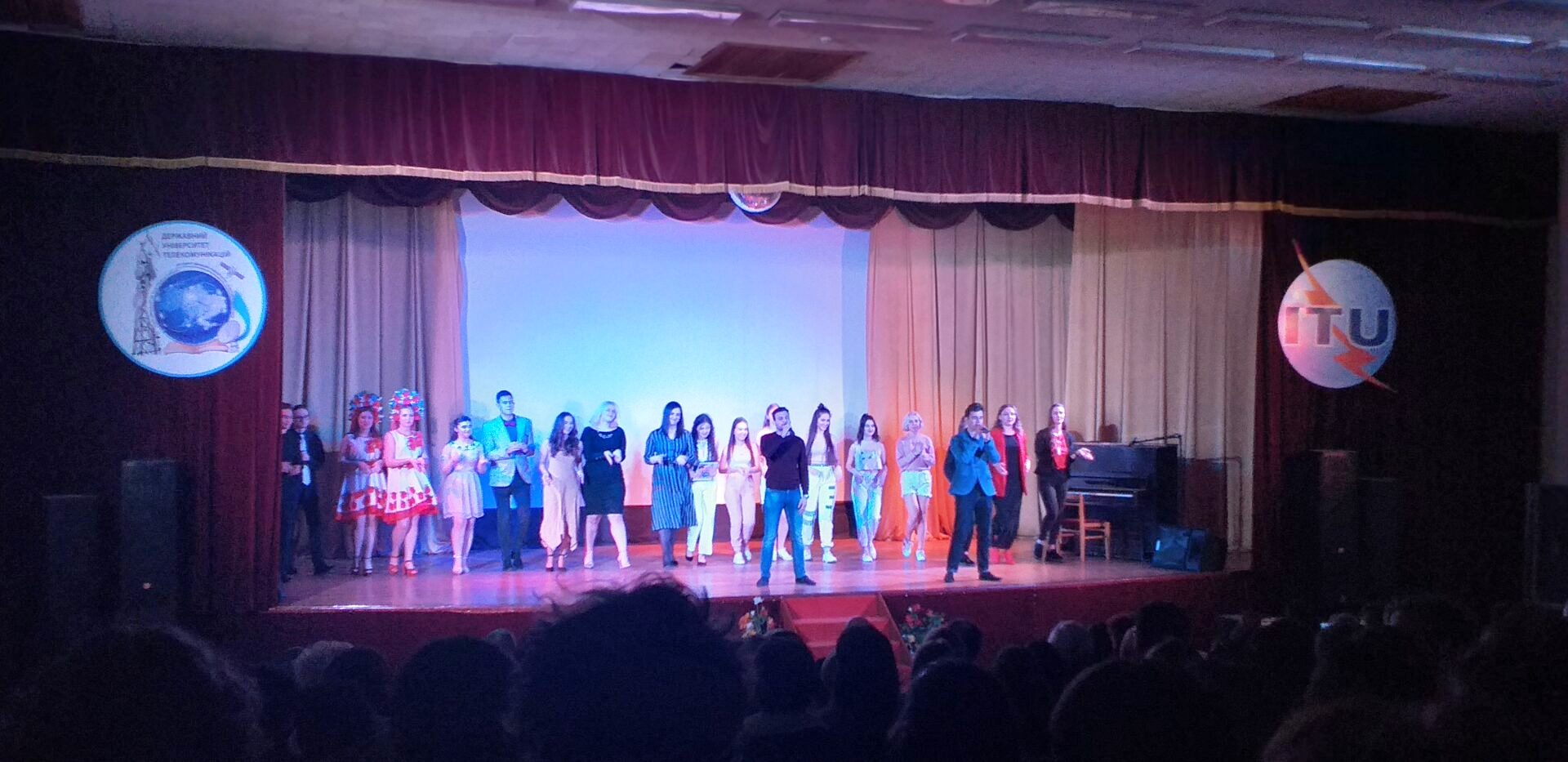
On 5 March 2020, the then State University of Telecommunications in Kyiv held an event marking International Women’s Day.
Much of the programme was based on student performances: singing, dance, piano and other forms of presentation.
Students from different years of study could take part and, according to information gathered at the time, participation was open to both Ukrainian and international students who wished to present their talents.
The event therefore makes visible a dimension of university life that often remains peripheral in institutional representations:
what does an institutional stage produce when students themselves create part of its content?
A stage provided by the institution
The framework is clearly institutional.
The university provides the venue.
Sets the occasion.
Organises the programme.
Brings together an audience.
Creates the material conditions that allow the event to take place.
But this does not mean that everything appearing on stage is directly produced by the institution.
Students bring their practices.
Their skills.
Their choices of performance.
Their presence.
The university stage therefore operates between two levels.
It belongs to the university through its organisation.
Yet much of its content depends on the participants.
Participating rather than simply attending
This distinction matters.
A university can organise many events in which students participate only as an audience.
Here, some of them become producers of the situation itself.
They sing.
Dance.
Play an instrument.
Prepare a performance.
Appear before fellow students and teachers.
The student is therefore no longer only the recipient of a university activity.
For a moment, the student participates in producing it.
This change of role is one of the most interesting features of the observed setting.
Another form of student presence
Being enrolled at a university is one form of administrative presence.
Attending classes is another.
Participating in a collective activity is another again.
These levels are not the same.
A student may follow a degree programme successfully while remaining relatively invisible in the institution’s collective life.
A stage activity, by contrast, creates a moment in which certain people appear differently before the university community.
They are no longer visible only through their degree programme or year of study.
Another skill becomes visible.
Culture as practice, not only programme
In this kind of event, “culture” does not necessarily refer to a structured cultural policy.
It first refers to practices.
Dancing.
Singing.
Playing.
Presenting something before others.
These practices may be individual or collective.
They may draw on very different repertoires.
Their significance lies less in the need to classify them than in the fact that they temporarily find a place within a university environment.
Ukrainian and international students within the same framework
The article published in 2020 stressed that these events were not reserved exclusively for Ukrainian students.
International students could also express an interest in participating.
This openness is worth noting.
It does not in itself prove the existence of a structured intercultural policy.
But it creates a possibility.
A student who has arrived from another country can participate on the same institutional stage as a Ukrainian student.
The framework becomes shared even though the trajectories meeting within it remain different.
Diversity does not automatically produce relationships
A common shortcut should nevertheless be avoided.
The presence of people from several countries does not automatically produce interculturality.
People can share a stage without building a lasting relationship.
One can watch someone perform without knowing their trajectory.
One can applaud a performance without understanding all of its references.
Visible diversity is therefore only a possible condition for encounter.
It is not proof of it.
Visibility produced by the stage
The stage nevertheless changes something.
It makes certain practices visible.
In everyday university life, a student’s artistic abilities may remain entirely private.
A telecommunications, management or computer science class does not necessarily reveal that a classmate sings, dances or plays the piano.
A cultural event temporarily changes this situation.
A previously less visible practice becomes public.
It enters the collective representation of university life.
Temporary visibility
This visibility has limits.
It begins with the event and ends when the event is over.
It does not mean that student cultural practices have a lasting place within university policy.
Nor does it guarantee regular representation of different student populations.
It is therefore important to distinguish event-based visibility from lasting institutional recognition.
One may exist without the other.
The risk of cultural assignment
This distinction is especially important for international students.
When a foreign student appears on stage, external observers may quickly interpret that participation through the student’s origin.
The person becomes “the African student”.
“The foreign student”.
The presumed representative of a country or culture.
Such a reading can reduce individual participation to an identity function.
Yet someone may go on stage simply because they enjoy singing.
Because they can dance.
Because a friend invited them.
Because they want to take part in university life.
Or simply because they want to try something.
Cultural visibility without compulsory representation
Two things therefore need to be distinguished.
A practice can make a cultural reference visible.
That does not mean its performer officially represents an entire culture.
This distinction is essential in international environments.
It preserves the possibility of participation without turning every student into an ambassador of their origin.
A stage can make differences visible without requiring people to embody them permanently.
Mediation that does not need to be declared
Such situations can nevertheless produce forms of mediation.
A student encounters music they do not know.
Another watches a dance.
People talk after a performance.
A practice becomes the starting point for conversation.
Here, mediation is neither a profession nor a formal programme.
It emerges from the situation itself.
Something becomes visible to someone who did not previously know it.
A relationship, even a minimal one, becomes possible.
The audience is also part of the dispositif
A stage does not exist alone.
It requires an audience.
Spectators watch.
React.
Applaud.
Comment.
They may recognise a song or discover an unfamiliar performance.
The relationship between stage and auditorium is therefore essential.
Cultural visibility is not produced only by those who perform.
It also depends on those before whom the performance takes place.
The photograph taken during the event preserves precisely these two dimensions within the same frame: the students on stage and the audience in front of them.
Photographing an ordinary university scene
The photograph associated with this article was taken directly during the activity.
It is not an illustrative image selected years later.
It documents the field itself.
This distinction strengthens its value.
University archives often preserve official events, graduation ceremonies or conferences.
Personal photographs can document the same institutions differently.
They show what a participant chooses to look at.
The framing.
The audience.
The stage.
The general atmosphere.
They therefore constitute another layer of memory within university life.
An academic space temporarily transformed
The significance of the stage also lies in the transformation of the space itself.
A room belonging to a technical university temporarily becomes a performance space.
The building’s permanent function does not change.
But for a few hours, other forms of competence become relevant.
Playing an instrument.
Dancing.
Stage presence.
Collective preparation.
This temporary transformation reminds us that a university can host forms of life that extend beyond strictly academic activity.
What the institution makes possible
It would nevertheless be excessive to attribute the entire dynamic to the students.
Without a room, a schedule, organisation and institutional permission, the stage would not exist in this form.
The university therefore plays a real role.
It creates a possibility for visibility.
But the participants fill that possibility with content.
It is precisely this relationship between institutional framework and individual or collective initiative that makes the event analytically interesting.
Internationalisation experienced at a small scale
Universities often describe internationalisation through numbers.
Numbers of foreign students.
Partnerships.
International agreements.
Mobility programmes.
Conferences.
These indicators matter.
But they do not necessarily show how internationalisation is experienced in everyday life.
A university stage provides another scale of observation.
Who participates?
Who watches?
Who enters into relationships?
Which practices become visible?
Which students appear within the shared space?
Internationalisation then becomes a social experience rather than only an administrative category.
This is not yet cultural diplomacy
The earlier editorial context of Ciel-Bleu could encourage interpretations of this kind of encounter through Ukraine–Africa relations or through the language of cultural diplomacy.
That description would be too strong here.
A student performance during a university celebration does not in itself constitute a diplomatic action.
There is no documented mandate of representation, no demonstrated public strategy and no specifically documented international cultural-relations programme.
The concept of cultural diplomacy would therefore overinterpret the field.
But cultural micro-relations do exist
Moving away from the term cultural diplomacy does not mean the event is culturally insignificant.
On the contrary.
It allows cultural relations to be observed at a smaller and probably more faithful scale.
Different students use the same space.
Practices are presented.
Audiences encounter them.
Forms of recognition emerge.
Conversations may follow.
This is less a matter of diplomacy than of ordinary cultural micro-mediations.
A stage before the disruptions of 2020 and 2022
The date gives the photograph a particular dimension today.
The event took place on 5 March 2020.
Only days later, the Covid-19 pandemic would profoundly alter forms of university presence and accelerate the expansion of distance learning.
Two years later, Russia’s full-scale invasion would transform the conditions of study and international mobility in Ukraine much more profoundly.
The scene should not be read retrospectively only through these crises.
But its temporal proximity to them gives it additional documentary value today.
Preserving normality as archive
What appears in the photograph is precisely an ordinary scene of university life.
An audience.
A stage.
Students.
Performances.
An institution functioning normally.
Such ordinary situations can become particularly important when the context that made them possible has been deeply transformed.
The archive therefore preserves more than an event.
It preserves a form of normality.
Conclusion
The event held in Kyiv on 5 March 2020 was neither a major cultural festival nor a structured programme of international cooperation.
Its significance lies precisely at another scale.
The university made a stage available.
Students chose to participate.
Practices usually outside the academic curriculum became temporarily visible.
Ukrainian and international students could enter the same framework of presentation.
The audience watched, reacted and shared that space for a limited period.
This configuration shows how a university can become, for a few hours, something more than a place of teaching.
A space of participation.
Visibility.
Discovery.
Encounter.
These micro-situations are not sufficient to create a genuine intercultural policy.
But they make it possible to observe the international life of a university from a level that statistics and institutional agreements capture only imperfectly: the level of ordinary practices through which students themselves become actors within a shared collective space.
Editorial note — This article is based on a text by Blaise Puala originally published on Ciel-Bleu.org on 5 March 2020 from an activity directly observed and photographed at the then State University of Telecommunications in Kyiv — today the State University of Information and Communication Technologies. It has been fully reviewed, revised and re-edited for the Kultur Insights library in order to preserve its value as a field archive while refocusing the analysis on student participation, cultural visibility and the forms of mediation produced within the university environment.