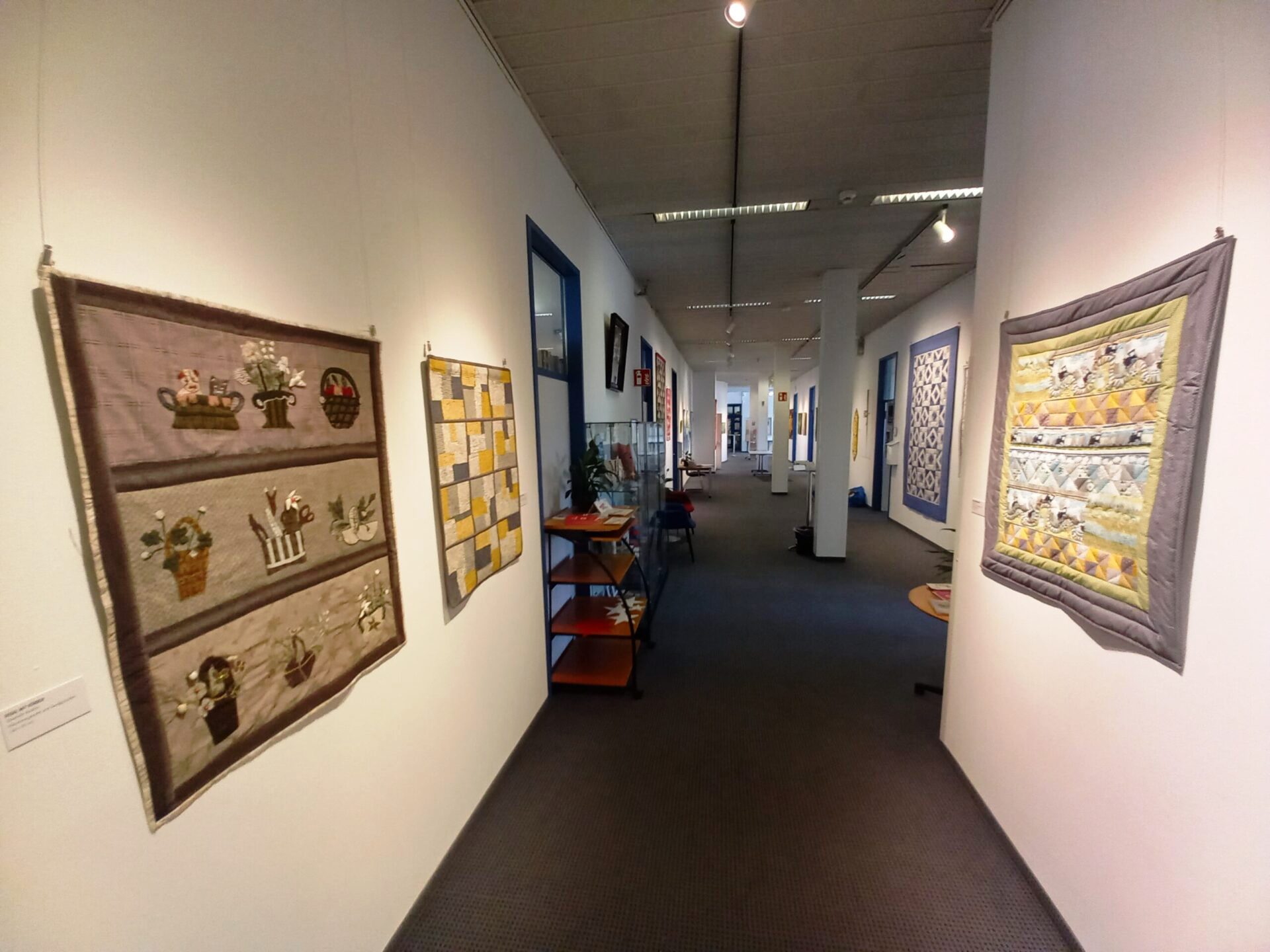
A textile exhibition may appear to occupy a modest place in the cultural life of a city.
A few works hanging on walls.
Pieces of fabric assembled together.
Geometric patterns.
Houses.
Trees.
Abstract compositions.
Yet behind these objects often lies a practice extending far beyond the duration of the exhibition itself.
In Freiburg im Breisgau, the 2022 Quiltclub exhibition at the Carl-Schurz-Haus made visible a collective textile practice that had been developing for several decades.
Founded in 1987, the club regularly brings together people interested in patchwork and quilting. Members work on their own projects, exchange techniques and experiences, and find in these meetings a stable framework in which to continue their practice.
The summer exhibition of 2022, open from 22 July to 1 October, followed two years in which activities had been significantly disrupted by the pandemic.
It therefore raises a broader question:
how does a regular artistic practice developed largely within a small collective acquire a public cultural existence?
A practice that long predates the exhibition
The exhibition is only the visible part of a more continuous process.
Freiburg’s Quiltclub has existed since 1987.
Its members meet regularly at the Carl-Schurz-Haus, bringing the pieces on which they are currently working.
They can compare techniques, ask for advice, share new ideas or simply work alongside others engaged in the same practice.
This regularity is essential.
A creative community is not built only through exceptional events.
It forms through repetition.
Returning.
Showing unfinished work.
Observing someone else’s piece.
Learning another technique.
Noticing progress.
Beginning a new project.
The continuity of the group thus becomes an infrastructure for creative practice.
Textile as artistic practice
Quilting has a long utilitarian history.
By assembling several layers of fabric, it can be used to produce blankets, functional objects and decorative pieces.
Contemporary practice, however, extends well beyond these functions.
Colour.
Texture.
Pattern.
Assemblage.
Contrast.
Sewing techniques.
Composition.
Fabric becomes a material for visual creation.
The works exhibited in Freiburg in 2022 reflected this diversity.
Some drew on more traditional structures.
Others used more contemporary forms and compositions.
Some were conceived primarily as decorative objects.
Others approached the format of a textile image intended to be viewed on a wall.
This diversity makes a simple distinction between art and craft difficult to sustain.
Art or craft: a limited distinction
Textile practices have long been caught within a cultural hierarchy.
Painting and sculpture are readily identified as “art”.
Sewing, patchwork, embroidery and quilting are more often classified as craft, hobby or domestic activity.
The Quiltclub exposes the limitations of this distinction.
A textile work can require precise technical knowledge while also involving complex aesthetic decisions.
Selecting fabrics.
Constructing a composition.
Working with colour relationships.
Creating rhythm.
Assembling blocks.
Deciding on the final function of an object.
These processes belong simultaneously to technical skill and artistic creation.
Rather than trying to determine conclusively whether quilting belongs to “art” or “craft”, it is more useful to examine the cultural situations in which it becomes visible.
Practising together without necessarily producing a collective artwork
The collective dimension of the Quiltclub does not mean that every exhibited piece was made jointly.
Many remain individual works.
But they emerge within a collective environment.
One person develops a piece.
Others observe.
Comment.
Suggest.
Demonstrate a technique.
Share earlier experience.
The collective therefore operates less as a single author than as an infrastructure for mutual learning.
This distinction matters.
Creating together does not always mean several people working directly on the same object.
It can also mean producing individually within an environment in which knowledge circulates.
Blocks as forms of relationship
The 2022 exhibition made this dimension particularly visible.
The original report referred to works assembled from blocks and to pieces associated with the birthdays of club members.
Textile elements could therefore become gifts, signs of attention or traces of relationships among participants.
Technique acquires a social function.
A piece of fabric is not simply incorporated into a composition.
It can become connected to a person, an occasion or a shared memory.
This relational dimension distinguishes some collective practices from forms of artistic production organised entirely around the figure of the individual artist.
Learning through proximity
The Quiltclub is also a space of transmission.
This transmission does not necessarily take place through a formal teaching programme.
It can emerge through proximity.
Someone watches another person assemble pieces.
They ask a question.
A gesture is demonstrated.
They try it.
They repeat it.
A technique mastered for years by one member may thus circulate to another.
This form of learning has a particular quality.
It depends less on a strict separation between teacher and learner than on exchange among people with different levels of experience.
A community of practice
The Quiltclub can therefore be understood as a community of practice.
Members are connected through a shared activity.
Over time they develop vocabulary.
Habits.
References.
Technical knowledge.
Ways of evaluating work.
Networks of suppliers, patterns and information.
Some participants have decades of experience.
Others joined more recently.
The group works because those experiences can circulate.
That circulation constitutes a form of local cultural knowledge that is often difficult to observe from outside.
Thirty-five years in 2022
By 2022, the Quiltclub had existed for thirty-five years.
This duration is significant.
Cultural initiatives are often analysed through their most visible moments: launches, festivals, exhibitions and anniversaries.
Yet what allows a practice to endure often lies elsewhere.
Monthly meetings.
Membership.
Informal transmission.
Access to a room.
People willing to organise.
Members who return.
New participants.
These relatively unspectacular mechanisms produce continuity.
The Quiltclub’s longevity therefore depends not only on individual interest in textile practice.
It also depends on an organisation capable of turning that interest into sustained collective activity.
The pandemic as a break in continuity
The 2022 exhibition had particular significance after the pandemic years.
The report published at the time referred to a two-year interruption in the usual exhibition cycle.
For a practice based on regular meetings, such a disruption means more than cancelled events.
It affects the circulation of knowledge.
Informal encounters.
Mutual observation.
Collective routines.
Opportunities to present work.
The exhibition’s return could therefore also be understood as a resumption of public cultural activity after a period in which familiar infrastructures of cultural sociability had been weakened.
From regular practice to exhibition
Exhibition also changes the status of the objects.
Within the club, a piece may be work in progress.
An exercise.
A gift.
A personal experiment.
Once displayed at the Carl-Schurz-Haus, it enters another situation.
It is viewed by people who may not belong to the club.
It is positioned alongside other works.
It becomes part of a larger ensemble.
It acquires public visibility.
Moving from a place of practice into a place of exhibition is therefore already a form of cultural mediation.
The Carl-Schurz-Haus as an interface
The role of the Carl-Schurz-Haus is particularly interesting in this configuration.
The institution is mainly known for its work around German-American relations, language learning, debate, literature, exhibitions and educational programmes.
But it also hosts regular clubs and groups.
Quilting.
Reading.
Film.
Dance.
Such activities expand the function of the institution.
The Carl-Schurz-Haus does not only produce events for an audience.
It also provides an infrastructure within which groups can develop their own activities.
Space.
Continuity.
Membership networks.
Visibility.
Possibilities for exhibition.
This interface role is essential.
Between private practice and cultural institution
The Quiltclub therefore occupies an intermediate position.
It is neither a strictly private workshop nor a major art institution.
The club connects personal practice with a collective environment and, at certain moments, with public presentation.
It is precisely within this in-between space that an intermediate cultural infrastructure emerges.
It may not possess a large budget.
It may not produce highly publicised events.
But it allows a practice to endure, to be transmitted and to become visible.
Within an urban cultural ecosystem, this intermediate level matters.
Without it, many practices would remain confined to the individual sphere.
Freiburg translated into fabric
Some works displayed in 2022 also contained motifs associated with Freiburg and its surroundings.
Houses.
Trees.
Landscapes.
References to the Black Forest.
These elements are not sufficient to define the whole exhibition as a project about urban memory.
They do, however, demonstrate how a local environment can enter artistic practice.
The city is not simply the place where works are created.
It can become visual material.
An architectural form is simplified.
A landscape becomes a motif.
Local experience enters the composition.
Territory is translated into another visual language.
Representing a place without creating an archive
This distinction should remain clear.
A textile representation of Freiburg is not automatically a historical archive of the city.
It is an interpretation.
A selection.
A perspective.
Over time, however, it may become a trace of how a territory was perceived and represented by particular people at a particular moment.
Textile practice can therefore contribute to a less institutional form of cultural memory.
Not because it documents the city exhaustively.
But because it preserves certain subjective relationships to place.
A free and accessible exhibition
The 2022 exhibition was freely accessible during the opening hours of the Carl-Schurz-Haus.
This may seem like a secondary detail.
It is not.
Cultural visibility also depends on conditions of access.
Work displayed in a venue visited for multiple purposes may be encountered by people who would never have deliberately chosen to visit a quilting exhibition.
A language-course participant.
A library user.
Someone attending a lecture.
A visitor passing through.
The institution thus creates intersections between different cultural practices.
Audiences are not always established in advance
A club already has its own network of members.
An exhibition can potentially widen that circle.
Other people can discover the practice.
The 2022 article even ended with an invitation to those interested in sewing to join the monthly meetings.
The exhibition therefore also functioned as an entry point.
Seeing the work may lead to an interest in the club.
Interest in the club may lead to participation.
The relationship between exhibition and community works in both directions.
The collective produces work for public presentation.
Public presentation can in turn renew the collective.
The quieter cultures of the city
Cultural maps of cities usually foreground their most visible institutions.
Museums.
Theatres.
Concert halls.
Festivals.
Galleries.
These structures are obviously essential.
But they do not describe the full cultural life of a city.
A large amount of cultural production takes place within less visible groups.
Clubs.
Workshops.
Associations.
Choirs.
Photography groups.
Reading circles.
Amateur practices.
Here, “amateur” should not be understood as synonymous with poor quality.
It also describes another economy of practice: activity not necessarily organised around professional career development.
Practising without professionalising
This distinction matters in cultural life.
Not every artistic practice needs to become a profession.
Someone may spend years developing a technique without seeking to sell their work or enter an art market.
They may nevertheless produce sophisticated objects.
Transmit knowledge.
Participate in a community.
Exhibit.
Contribute to local cultural life.
Recognising this contribution broadens our understanding of cultural ecosystems.
Between the professional artist and the passive cultural consumer lies a broad field of active cultural practice.
The Quiltclub belongs to this space.
The cultural value of continuity
The 2022 exhibition ultimately invites a shift in perspective.
Its significance lies not only in the quilts on display.
It also lies in the system of relationships that makes them possible.
An institution provides space.
A club organises meetings.
People develop their practices.
Knowledge circulates.
Works emerge.
Some become gifts.
Others are exhibited.
New people may join the group.
Local culture is also produced through this repetition.
Its value is not only event-based.
It is infrastructural.
Conclusion
The 2022 Quiltclub exhibition at the Carl-Schurz-Haus could have been viewed simply as a presentation of textile works produced by people interested in patchwork and quilting.
A closer look reveals a more complex structure.
Behind the works is a club founded in 1987.
Regular meetings.
Techniques passed from one person to another.
Individual projects developed within a collective environment.
Objects circulating between artistic production, gifts and exhibition.
An institution providing space and visibility.
Audiences encountering a practice while perhaps visiting the building for entirely different reasons.
The significance of the Quiltclub lies precisely in this articulation.
It shows that the cultural life of a city does not depend solely on its most visible institutions or major events.
It also relies on intermediate structures capable of sustaining practices over time, circulating knowledge and connecting creative communities with public spaces of presentation.
In Freiburg, a number of textile works displayed on the walls of the Carl-Schurz-Haus thus provide a way of observing something much larger: how regular practice becomes local cultural continuity.
Editorial note — This article is based on a text by Blaise Puala originally published on Ciel-Bleu.org on 13 August 2022 during the Quiltclub exhibition at the Carl-Schurz-Haus Freiburg. The author visited the exhibition and documented it photographically. The text has been revised, verified and re-edited for the Kultur Insights library in order to preserve its documentary value while deepening the analysis of collective practices, knowledge transmission and the role of intermediate cultural infrastructures in local cultural life.