The Caritas Freiburg Case as a Laboratory of Intercultural Mediation
Across Europe, participatory cultural initiatives are increasingly being used to address questions of social cohesion, diversity and community engagement. Positioned between social work and cultural practice, these initiatives create spaces where people from different backgrounds can interact beyond formal institutional settings.
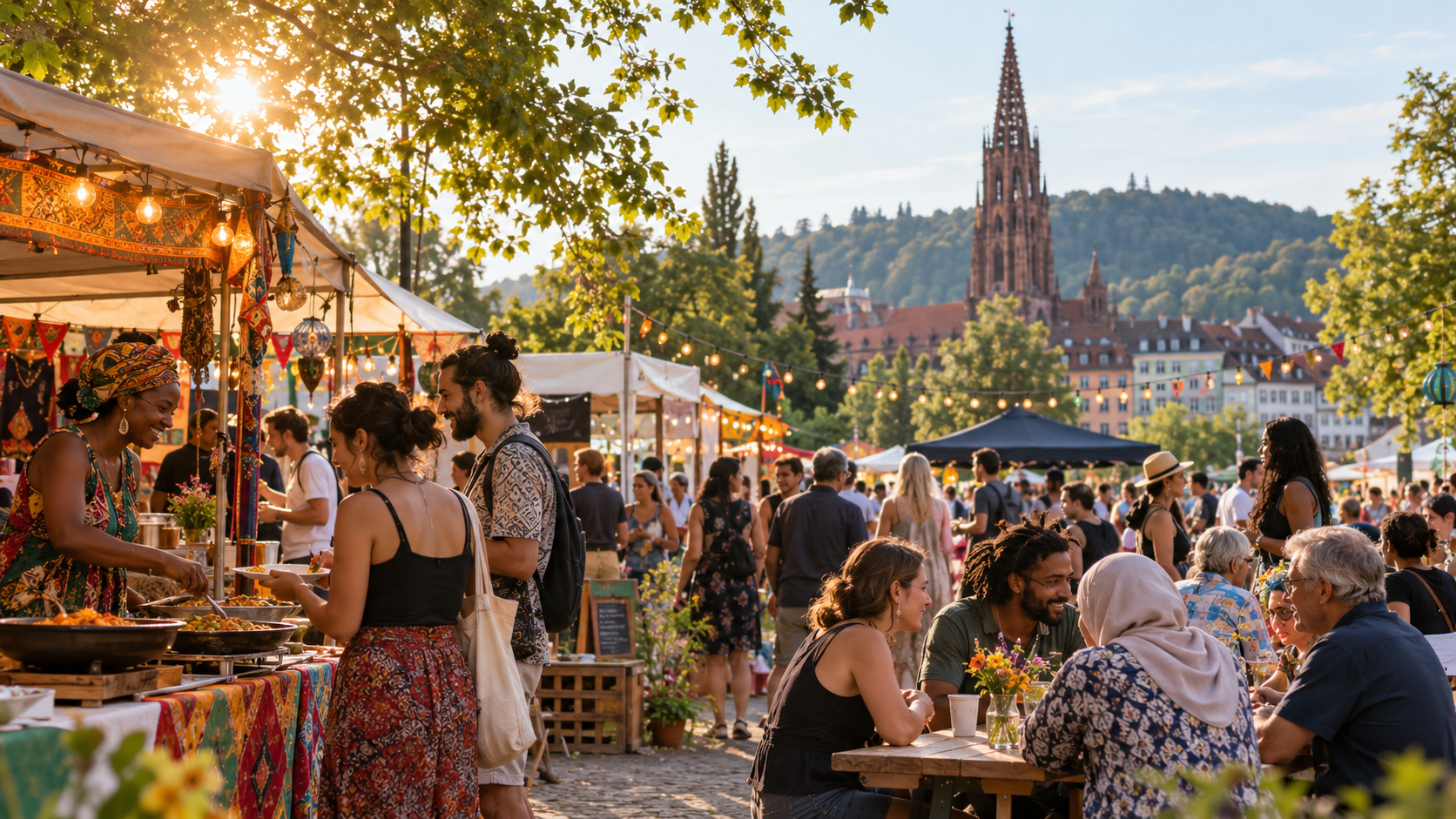
The summer festival organized in 2025 by the Caritasverband Freiburg-Stadt in cooperation with Ciel Bleu Kultur offers an interesting case study of this broader trend.
Rather than functioning solely as a community celebration, the event combined artistic participation, informal interaction and intercultural exchange within a shared social environment.
A Hybrid Space Between Social and Cultural Action
One of the defining characteristics of such initiatives is their hybrid nature.
They operate at the intersection of social support, community development and cultural participation. This position enables them to reach audiences who may have limited engagement with traditional cultural institutions while creating opportunities for interaction through accessible artistic activities.
In this context, culture is not merely a form of entertainment. It becomes a medium through which social relationships can be established and strengthened.
Participation as a Core Principle
A central feature of the festival was the emphasis placed on participation.
Through the collective art project “Kaleidoscope of Diversity,” participants contributed their own ideas, experiences and reflections to a shared creative process. Rather than being passive spectators, they became active contributors to a collective narrative.
This approach reflects broader developments in participatory cultural practices across Europe, where cultural production increasingly involves collaborative meaning-making.
Culture as an Implicit Bridge
From an analytical perspective, the initiative also performed an important intercultural mediation function.
Its significance did not lie primarily in showcasing different cultures, but in creating conditions for meaningful encounters between people who might not otherwise meet in their everyday lives.
In this sense, the event can be understood as an implicit cultural bridge. Culture served less as a representation of identity and more as a framework for interaction and relationship-building.
The Role of Collective Artistic Production
Particularly noteworthy was the creation of a collective artwork.
Installed within the Franz-Hermann-Haus, the final piece transformed a temporary experience into a lasting visual trace. It preserved elements of the dialogue and collaboration that emerged during the event.
Such material outcomes contribute to the symbolic continuity of intercultural encounters beyond the duration of a single gathering.
Opportunities and Limitations
At the same time, the impact of initiatives of this kind should not be overstated.
Their effectiveness depends on local conditions, participant engagement and the quality of facilitation. Cultural projects alone cannot resolve complex social challenges, but they can create environments where dialogue and cooperation become possible.
A Europe–Africa Perspective
From a Europe–Africa perspective, experiences such as this one invite broader reflection.
Across both continents, cultural practices are frequently used to foster community dialogue, social mediation and collective participation. While contexts differ, similar questions emerge regarding how diverse societies create shared spaces of interaction.
Examining such initiatives comparatively can therefore offer valuable insights into the role of culture in contemporary social transformation.
Conclusion
The Freiburg summer festival illustrates a wider shift in the understanding of culture. Beyond artistic expression, culture increasingly functions as a form of social infrastructure that enables encounters, participation and relationship-building.
For researchers, practitioners and policymakers alike, such local initiatives provide valuable opportunities to observe how social cohesion is negotiated and constructed in increasingly diverse societies.
—
📝 Article originally published on the historical platform Ciel-Bleu.org, then editorially revised and harmonized for Ciel Bleu Kultur.