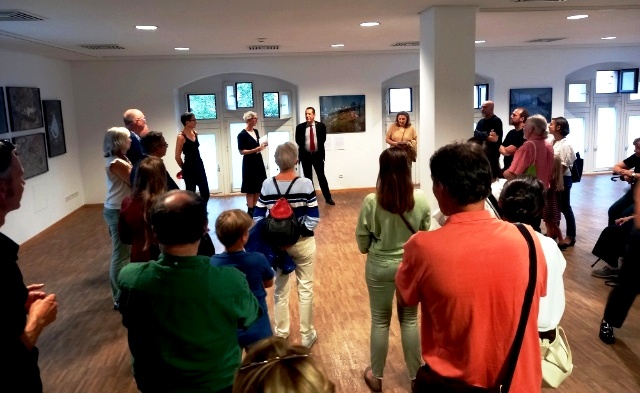
On 15 September 2023, the Centre Culturel Français Freiburg hosted the opening of Archifoto, an exhibition exploring the relationships between architecture, photography and resources.
Photographs displayed on the walls.
Visitors gathered inside an exhibition space.
Artists invited to discuss their approaches.
Cultural institutions involved in a European project.
And a shared question:
How can photography make visible the relationships between human constructions, resources and the transformation of territories?
The exhibition presented a selection of works from the sixth edition of the Archifoto competition, held in 2022 under the theme “Architecture and Resources”.
Following an initial presentation in Strasbourg, the works travelled to Freiburg as part of their circulation through different cultural venues.
The opening, held during the Freiburg Nocturne, included introductions by two photographers, Marco Zanta and Sébastien Wasseler, who were invited to discuss their respective approaches.
Considered in isolation, the event might be described as the opening of an architectural photography exhibition.
Its significance becomes clearer, however, when attention shifts to the relationships it brought together.
Between photography and architecture.
Between construction and the environment.
Between natural resources and human uses.
Between artistic practice and territorial transformation.
Between images produced in different contexts and their reception within a cultural venue in Freiburg.
The exhibition thus became a space for the circulation of perspectives.
An exhibition opening as a space of encounter
The opening brought visitors together around the works presented at the Centre Culturel Français Freiburg.
Photographs occupied the walls.
The audience gathered in front of the speakers.
Presentations accompanied the discovery of the exhibition.
This arrangement deserves attention.
An exhibition is not limited to the works it brings together.
It also creates a cultural situation.
A space is prepared.
Images are selected.
A route through the exhibition becomes possible.
People come together to encounter artistic works.
Artists or cultural mediators contribute explanations.
Exchanges may emerge.
An opening makes this collective dimension particularly visible.
What might otherwise be experienced individually temporarily becomes the subject of a public encounter.
An exhibition that approaches architecture differently
Archifoto is a European competition devoted to architectural photography.
Since 2010, the European House of Architecture – Upper Rhine and La Chambre, a Strasbourg-based organisation dedicated to photography and image education, have collaborated on the initiative.
The competition explores the relationships between photography and the built environment.
This approach goes beyond the aesthetic representation of buildings.
An architectural space can be examined through its forms.
But also through its uses.
Its history.
Its transformations.
Its economic functions.
Its relationship with the landscape.
Or the social conditions within which it exists.
Photography allows these dimensions to be approached from a particular perspective.
It determines what will be shown.
What will remain outside the frame.
The distance from which a place will be observed.
And the moment at which it will be photographed.
The resulting image is therefore not an entirely neutral reproduction of the built environment.
It proposes a visual interpretation.
Architecture and resources: a question beyond building materials
For its sixth edition in 2022, Archifoto selected the theme “Architecture and Resources”.
The subject emerged in a context shaped by environmental concerns, supply pressures and economic and geopolitical transformations.
Yet the question of resources extends beyond the materials required for construction.
A building requires land.
Energy.
Technical knowledge.
Financial resources.
Labour.
Production and transport networks.
It also depends on decisions concerning how spaces are used and transformed.
A building may be abandoned.
An infrastructure may become obsolete.
An industrial site may be repurposed.
A landscape may be transformed by extraction.
A place of residence may develop around a particular economic activity.
Architecture thus appears as the outcome of relationships between matter, territory and society.
The competition’s theme provided an opportunity to examine these relationships through concrete situations.
Photographing resources means examining their effects
A resource is not always directly visible as such.
A quarry can be photographed.
But how can an image represent the succession of activities that have transformed it?
A power station can be photographed.
But how can the relationships between its architecture, energy production and surrounding environment become perceptible?
An abandoned housing development can be documented.
But how might a photograph reveal the economic decisions that preceded its abandonment?
These questions show both the possibilities and the limitations of photography.
An image makes certain elements visible.
It can suggest a history.
Reveal a contradiction.
Draw attention to a transformation.
It does not necessarily contain all the information required to explain that transformation.
Architectural photography can therefore become a starting point for analysis rather than a complete explanation in itself.
Five photographic approaches, different relationships to resources
The 2022 selection brought together five photographers.
Alnis Stakle.
Markel Redondo.
Marco Zanta.
Aljohara Jeje.
Sébastien Wasseler.
Their series addressed different geographical and social situations.
Urban transformations in Chinese metropolitan areas.
Abandoned real estate developments in Spain.
A former marble quarry repurposed as a cultural venue in Italy.
Forms of accommodation linked to salt harvesting in Saudi Arabia.
Energy infrastructures associated with coal-fired power stations.
These subjects do not belong to a single category of architecture.
They reveal different ways in which human societies construct, inhabit, exploit or transform spaces.
The descriptions of these projects, drawn from the competition’s documentation, help explain the scope of the exhibition presented in Freiburg.
They should not be understood as transcripts of the remarks made during the opening.
From changing cities to abandoned buildings
Latvian photographer Alnis Stakle, winner of the main Archifoto 2022 prize, presented a series devoted to the transformation of Chinese metropolitan areas.
His work explored the relationship between older and newer forms of the built environment.
This juxtaposition invites us to understand urban transformation as more than the simple construction of new buildings.
A city does not change only when a new structure appears.
It also changes when uses are reorganised.
When certain elements disappear.
When familiar landmarks coexist with new infrastructure.
Photography can capture a particular moment within this transformation.
It does not necessarily explain the entire process.
But it can make its tensions perceptible.
Markel Redondo’s work approached another dimension.
His series documenting abandoned property developments in Spain examined the visible consequences of the collapse of the property bubble in 2008.
Construction projects had been initiated.
Land had been transformed.
Resources had been mobilised.
Then some developments were interrupted.
The structures remained within the landscape, without necessarily fulfilling the purposes for which they had originally been designed.
Architecture became a material trace of economic decisions.
One series explored the continuing transformation of cities.
The other drew attention to buildings whose development had stopped.
In both cases, the territory retained the marks of human choices.
Marco Zanta: a quarry transformed into a cultural space
Italian photographer Marco Zanta documented Cava Arcari, a former marble quarry in Italy that had been converted into a venue for cultural activities and encounters.
The project introduced a particular dimension of the relationship between architecture and resources.
A quarry is initially a site of extraction.
It exists because a mineral resource can be exploited there.
Extraction transforms the ground.
Creates volumes.
Changes the landscape.
When extraction ends, the site does not simply disappear.
It remains as a material structure.
With its traces.
Its forms.
Its constraints.
And sometimes new possibilities of use.
The transformation of Cava Arcari makes such a change of function visible.
A space formerly associated with the extraction of material becomes a venue capable of hosting cultural activities.
This transformation does not erase the site’s extractive history.
It adds another period to its existence.
A resource can change its function
The case of Cava Arcari allows the question to be approached differently.
What constitutes the resource?
The marble that was extracted?
The transformed land?
The spaces created by the former activity?
The site made available after extraction ended?
Or the new possibilities it offers for occupation and use?
These dimensions can coexist.
The material initially represents an economic resource.
Later, the site itself can become a spatial and cultural resource.
Photography makes it possible to observe this succession without reducing the place to its current function.
It reveals a history inscribed in space.
Yet repurposing should not be interpreted as a universal solution to the consequences of extraction.
The example documents a particular situation in which a transformed environment acquires a new function.
It is precisely this relationship between material history and cultural use that makes the photographic approach significant.
Sébastien Wasseler: looking at energy infrastructure
French photographer Sébastien Wasseler presented a series devoted to the cooling towers of coal-fired power stations.
These structures have a particular presence within industrial landscapes.
Their dimensions can be monumental.
Their forms immediately recognisable.
Yet their function belongs to a much larger technical system.
Energy production.
Supply networks.
Industrial organisation.
Territorial occupation.
Relationships with the environment.
Photographing these towers means directing attention towards an architecture usually approached through its technical purpose.
Infrastructure becomes an object of observation.
It can be examined as a form.
But also as the visible component of a wider material and economic system.
Photography alone cannot provide a full assessment of how a power station operates or of its environmental consequences.
It can nevertheless make the material presence of such infrastructure perceptible within a landscape.
When industrial architecture enters the exhibition space
This approach raises another question.
Why can a cooling tower become a subject of architectural photography?
Because the built environment is not limited to housing, public institutions or cultural facilities.
It also includes industrial equipment.
Technical networks.
Production infrastructure.
Installations that support particular forms of economic and social life.
These structures also organise space.
They influence landscapes.
Mobilise resources.
And establish a lasting presence within territories.
Their inclusion in a photographic exhibition makes it possible to examine them beyond their utilitarian functions.
It creates a space for interpretation.
Living in proximity to a resource
The fifth approach, developed by Aljohara Jeje, examined the working and living conditions of people harvesting salt in Saudi Arabia.
The project focused on temporary shelters built near salt-harvesting sites, including structures made from reused materials.
This introduced another scale of architectural observation.
Not a metropolis.
Nor a major industrial infrastructure.
Nor a repurposed quarry.
But forms of occupation directly connected to an economic activity.
Resources shape not only production, but also particular living conditions.
Available materials.
Proximity to the workplace.
Everyday needs.
Possibilities and constraints of construction.
These situations remind us that architecture exists beyond monumental or institutionally designed buildings.
It can also emerge through precarious structures developed in response to immediate needs.
Photography makes these forms of habitation visible, even though they often remain outside conventional representations of architecture.
One exhibition, several interpretations
The five projects did not offer a single interpretation of architecture.
They revealed different relationships to resources.
Transformation.
Abandonment.
Extraction.
Repurposing.
Energy production.
Housing.
Labour.
Their coexistence within one exhibition created a framework for comparison.
Visitors could move from one territory to another.
From industrial infrastructure to a form of housing.
From an interrupted property development to a former extraction site given a new use.
These situations were not equivalent.
Nevertheless, they could be examined through a common question:
How do resources shape the construction, occupation and transformation of human environments?
This question connected the different approaches without reducing them to a shared aesthetic.
From photographic selection to exhibition
A photograph can exist independently of an exhibition venue.
But its public presentation changes the conditions of its reception.
The image is selected.
Prepared for a particular format.
Placed within an exhibition route.
Associated with other works.
Presented under a title.
And sometimes accompanied by information about its production.
Audiences therefore encounter more than an isolated image.
They encounter a work within an organised presentation.
This framework can establish relationships between photographs produced in different geographical or social contexts.
It can also influence certain interpretations.
Selection itself constitutes an initial mechanism of visibility.
Not everyone who enters a competition is included in the main exhibition.
Some projects are selected.
Others are not.
The transition from application to public presentation thus depends on a series of artistic and institutional decisions.
Different forms of photographic visibility
The 2022 Archifoto programme also envisaged the digital presentation of ten additional submissions recognised by the jury.
This aspect invites reflection on differences between exhibition formats.
A photograph displayed on a wall remains available to viewers as they move through a space.
An image shown in a slideshow appears for a defined period within a sequence.
The relationship to time changes.
The duration of observation may differ.
The opportunity to move freely between images is also different.
These decisions influence how works are received.
However, the general exhibition programme of 2022 must be distinguished from its presentation in Freiburg.
The available documentation does not establish precisely how each of these ten additional contributions was displayed during the opening on 15 September 2023.
The analytical question nevertheless remains relevant.
Photographic visibility also depends on formats and curatorial decisions.
From Strasbourg to Freiburg: making an exhibition circulate
Archifoto was initially presented at La Chambre in Strasbourg in autumn 2022.
The exhibition reached Freiburg in September 2023.
This movement deserves particular attention.
Exhibitions do not travel on their own.
Works must be prepared.
Their reception organised.
Spaces made available.
Schedules coordinated.
Partners mobilised.
Communication directed towards new audiences.
These activities belong to the cultural infrastructure of an exhibition.
They allow works to leave their initial venue and reach visitors elsewhere.
The circulation of images therefore depends on more than their ability to be reproduced or transported.
It relies on institutions and individuals capable of organising their presence in new places.
The same exhibition in different contexts of reception
When an exhibition travels from one city to another, its artistic content may remain largely unchanged.
Yet its environment changes.
The hosting venue.
The audience.
The cultural references.
The languages used to present the works.
The events with which the exhibition is associated.
A photographic series about an Italian quarry or an energy infrastructure may reach visitors in Freiburg who are unfamiliar with its original context.
This distance does not prevent engagement with the work.
It changes the conditions under which the work can be interpreted.
The exhibition becomes an intermediary between a photographed place and an audience situated elsewhere.
It establishes a relationship that did not necessarily exist before.
The Centre Culturel Français Freiburg as a venue for cultural mediation
Within this process of circulation, the Centre Culturel Français Freiburg fulfilled a specific function.
It hosted the exhibition.
Provided a space for the works.
Integrated them into its cultural programme.
Enabled local audiences to discover them.
And organised an encounter around the photographic approaches.
This function must be distinguished from that of the organisations that originally developed the competition.
The CCFF did not need to be the initiator of Archifoto to play an important role in its circulation.
It acted as a hosting and mediating institution.
This distinction is essential for understanding how a cultural network operates.
One institution may develop a project.
Another may select the works.
Another may host them.
Others may contribute to their dissemination.
The visibility of a cultural initiative often depends on the combination of these different functions.
The role of artists in cultural mediation
The opening on 15 September 2023 included introductions by Marco Zanta and Sébastien Wasseler.
Their presence added another dimension to the encounter with the photographs.
An image can be observed without explanation.
It can raise questions.
Generate an emotional response.
Draw attention to a particular situation.
But the artist’s words may introduce additional elements.
Their working method.
Their choice of subject.
The context in which a project was produced.
Their relationship with the photographed location.
The questions that guided a series.
Audiences can therefore move from observing an image towards understanding a creative process.
Mediation does not replace individual interpretation.
It creates additional conditions in which different perspectives can encounter one another.
Between photography, speech and audiences
The opening brought several forms of mediation together.
Photographs represented particular situations.
Speakers offered explanations.
The exhibition venue organised the presentation of the works.
The audience participated through its presence and attention.
These elements did not perform identical functions.
An image does not necessarily explain the institutional arrangements underlying its circulation.
An oral presentation cannot replace the experience of looking.
A cultural venue does not automatically determine the meaning of a work.
But their interaction creates a situation in which different forms of understanding become possible.
This relationship was precisely what the Freiburg opening made visible.
Cultural cooperation across the Upper Rhine
The exhibition’s presentation in Freiburg also took place within a cross-border institutional environment.
The European House of Architecture – Upper Rhine and La Chambre had developed the competition.
The Centre Culturel Français Freiburg hosted the exhibition.
The Italian Consulate in Freiburg was among the partners involved in the presentation.
These institutions operated from different positions.
Their cooperation helped connect cultural spaces in France and Germany while involving other European actors.
This arrangement reflects a particular characteristic of the Upper Rhine region.
Cultural relationships frequently cross national borders.
Programmes may involve several cities.
Institutions can work in different languages.
Projects developed in one country can be presented in another.
Archifoto offers a concrete example of this cooperation.
Local circulation, international perspectives
The geography of Archifoto was not limited to Strasbourg and Freiburg.
The photographs referred to much more distant places.
China.
Spain.
Italy.
Saudi Arabia.
European industrial landscapes.
The project thus connected several spatial scales.
The locations represented in the photographs.
The artists and their practices.
The institutions responsible for selection.
And the venues in which the works were exhibited.
A cultural organisation based in Freiburg could thereby enable local audiences to encounter representations of territories far beyond their immediate region.
Local cross-border cooperation became the basis for the international circulation of images.
Architectural photography as environmental mediation
The theme of resources also gave the exhibition an environmental dimension.
Construction materials have an origin.
Their extraction can transform landscapes.
Energy infrastructure occupies territory.
Property developments may mobilise resources without delivering their intended uses.
Industrial sites may undergo several phases of occupation.
Living conditions may depend directly on locally available resources.
The photographic series made different manifestations of these relationships perceptible.
They approached complex issues through concrete environments.
This function matters.
Debates about resources can appear abstract when expressed only through statistics, policy measures or general principles.
An image can give them a visible dimension.
A place.
A form.
A trace.
A human situation.
Photography can therefore serve as an entry point into a broader reflection.
Making something visible does not mean resolving it
It is nevertheless important not to attribute effects to photography that it cannot demonstrate.
Documenting a quarry does not remove the consequences of extraction.
Photographing an abandoned building does not resolve the economic problems that produced it.
Representing a power station does not change how it operates.
Showing precarious housing conditions does not automatically improve them.
Photography operates at another level.
It makes certain realities perceptible.
It can raise questions.
Suggest connections.
Introduce perspectives.
Create opportunities for discussion.
Its representational capacity should not be confused with a direct capacity to bring about material change.
Recognising this distinction allows its cultural function to be understood more precisely.
A photographic archive of the exhibition opening
The photograph taken during the opening in Freiburg now holds particular documentary value.
It does not directly show the five territories examined by the selected photographers.
Nor does it allow the entirety of the exhibited works to be reconstructed.
It documents another situation.
The encounter between those works and an audience.
The image shows a room inside the Centre Culturel Français Freiburg.
Photographs are displayed on the walls.
People are gathered together.
An area is being used for presentations.
Visitors are looking towards the speakers.
The image therefore documents the exhibition setting in which the works were made accessible and presented.
It is an archive of cultural mediation.
Not a comprehensive reproduction of the exhibition’s artistic content.
This distinction is particularly important for its present use within Kultur Insights.
Photography as a trace of a cultural situation
An exhibition opening is a temporary event.
The presentations come to an end.
Visitors leave the room.
The exhibition remains accessible for a limited period, then closes.
But documentary traces may survive.
A photograph.
A programme.
An article.
An exhibition note.
An institutional document.
These sources cannot reconstruct the entirety of the experience.
They nevertheless make a partial reconstruction possible.
The photograph taken on site records aspects that official programmes do not necessarily show.
How the space was occupied.
The presence of the audience.
The arrangement of the works.
The collective situation created around their presentation.
It thus complements institutional information with direct observation.
Ciel Bleu as an observer on the ground
On 15 September 2023, Blaise Puala attended the Archifoto opening at the Centre Culturel Français Freiburg.
He photographed the event and published an article on Ciel-Bleu.org that same day.
The original report fulfilled an immediate journalistic function.
Informing readers about the exhibition.
Presenting its theme.
Situating the event within Freiburg’s cultural programme.
Identifying the photographers who spoke at the opening.
Documenting the encounter.
In this situation, Ciel Bleu was not an organiser of the competition or the exhibition.
Its documented role was that of an on-site editorial observer.
This distinction respects the actual distribution of responsibilities among the different actors.
It does not diminish the value of the material.
Rather, it clarifies the position from which the event was observed and described.
From cultural news to an analysis of mediation
Read today, the September 2023 article serves a different purpose.
The question is no longer simply:
Which exhibition was presented at the Centre Culturel Français Freiburg in September 2023?
It becomes:
How does photography enable representations of architecture and resources to circulate between artists, institutions, territories and audiences?
This shift changes the significance of the archive.
The opening is no longer merely an event that was announced or reported.
It becomes an occasion for examining the conditions under which artistic works become publicly visible.
Architectural photography is no longer considered only as an artistic discipline.
It becomes a means of representing and questioning the built environment.
The exhibition is no longer simply a collection of photographs.
It appears as a framework for selection, circulation and mediation.
An archive situated in Freiburg
This publication occupies a particular place within the documentary history of Ciel Bleu.
Other historical materials document cultural activities in Kinshasa and different cities across the Democratic Republic of the Congo.
Archifoto records an event in Freiburg, within a different institutional and territorial context.
The situations are not identical.
The actors are different.
The artistic disciplines and frameworks for cooperation vary.
The aim is not to construct an artificial historical continuity between these events.
Yet one analytical question connects them:
What conditions allow cultural practices, works and actors to become visible in public spaces?
The answers depend on the context.
An open stage.
A festival.
An exhibition.
A hosting institution.
A professional network.
A communication framework.
Archifoto illustrates a particular configuration of this question: a photography exhibition circulating within a cross-border cultural environment.
Conclusion
The Archifoto exhibition presented in Freiburg in September 2023 allows us to examine the relationships between photography, architecture, resources and cultural circulation.
Its significance extends beyond the selection of five artistic approaches.
It also lies in the conditions that make their presentation possible.
Photographers work with different territories.
Their images examine architectural forms and relationships to resources.
A competition organises their selection.
Institutions create a framework for exhibition.
The works circulate between different places.
A cultural centre hosts them in Freiburg.
Artists discuss their approaches.
Audiences encounter the images within a new context.
These processes are not simply administrative stages surrounding artistic production.
They contribute to the public life of the works.
Photography can make visible situations that remain distant from everyday observation.
A city undergoing transformation.
An abandoned real estate development.
A repurposed quarry.
An energy infrastructure.
Forms of housing connected to a particular activity.
The exhibition brings these realities together without imposing a single interpretation.
It creates conditions for comparison.
Perception.
Discussion.
And circulation.
It does not resolve the environmental, social or economic problems that the works explore.
But it makes it possible to approach them through new perspectives.
The photograph taken during the opening, in turn, documents this cultural infrastructure in action.
It captures the moment when works produced elsewhere become the subject of a public encounter in Freiburg.
This is the dual dimension that the archive now allows us to examine:
Photography as a means of interpreting territorial transformations, and the exhibition as an infrastructure through which images, perspectives and the questions they raise can circulate.
It is through this relationship between architecture, resources, photographic representation, cultural mediation and cross-border cultural cooperation that Archifoto finds its place within Kultur Insights.
Editorial note — This article is based on a report by Blaise Puala originally published on the historical Ciel-Bleu.org website on 15 September 2023, following the opening of the exhibition “Archifoto: Architecture et ressources” at the Centre Culturel Français Freiburg. Blaise Puala attended the event and documented it through his own photography. Presented in Freiburg from 11 to 29 September 2023, the exhibition featured works from the sixth edition of the Archifoto competition held in 2022. The article has been fully reviewed, revised and re-edited for the Kultur Insights library in order to preserve its value as a field archive while distinguishing direct observation of the opening, institutional documentation of the competition and the present analytical interpretation. This version examines photography as a means of representing architectural transformations, the circulation of artistic works and the role of cross-border cultural infrastructure in their mediation.