The Olympic Games are, first and foremost, a sporting competition.
Their international significance, however, is not based solely on performances in stadiums, arenas or swimming pools.
Around the competitions sits a wider system of representation: ceremonies, flags, anthems, uniforms, delegations, infrastructure, television images, narratives of the host country and cultural programmes.
For a few weeks, territories, affiliations and collective identities become visible within a shared global framework.
The Olympic Games therefore offer a particularly revealing setting in which to examine how sport, culture and international systems of representation interact.
The question is not whether sport becomes secondary.
It is rather what is built around it.
How does a sporting competition also become a space of cultural and territorial representation?
A sporting competition organised on a global scale
Everyday language often speaks of “participating countries”.
The Olympic structure is more precise.
Athletes take part through National Olympic Committees recognised by the International Olympic Committee.
This institutional distinction matters.
It reminds us that the Games are not simply a diplomatic gathering of states.
They belong to an international sporting architecture that includes the IOC, National Olympic Committees, international federations and organising committees.
Yet when the competitions become visible to the public, national symbols occupy considerable space.
Flags.
Anthems.
Uniforms.
Medal tables.
Delegation names.
Protocol ceremonies.
A transnational sporting structure therefore produces a stage on which national affiliations remain highly visible.
The Parade of Nations as a temporary map of the world
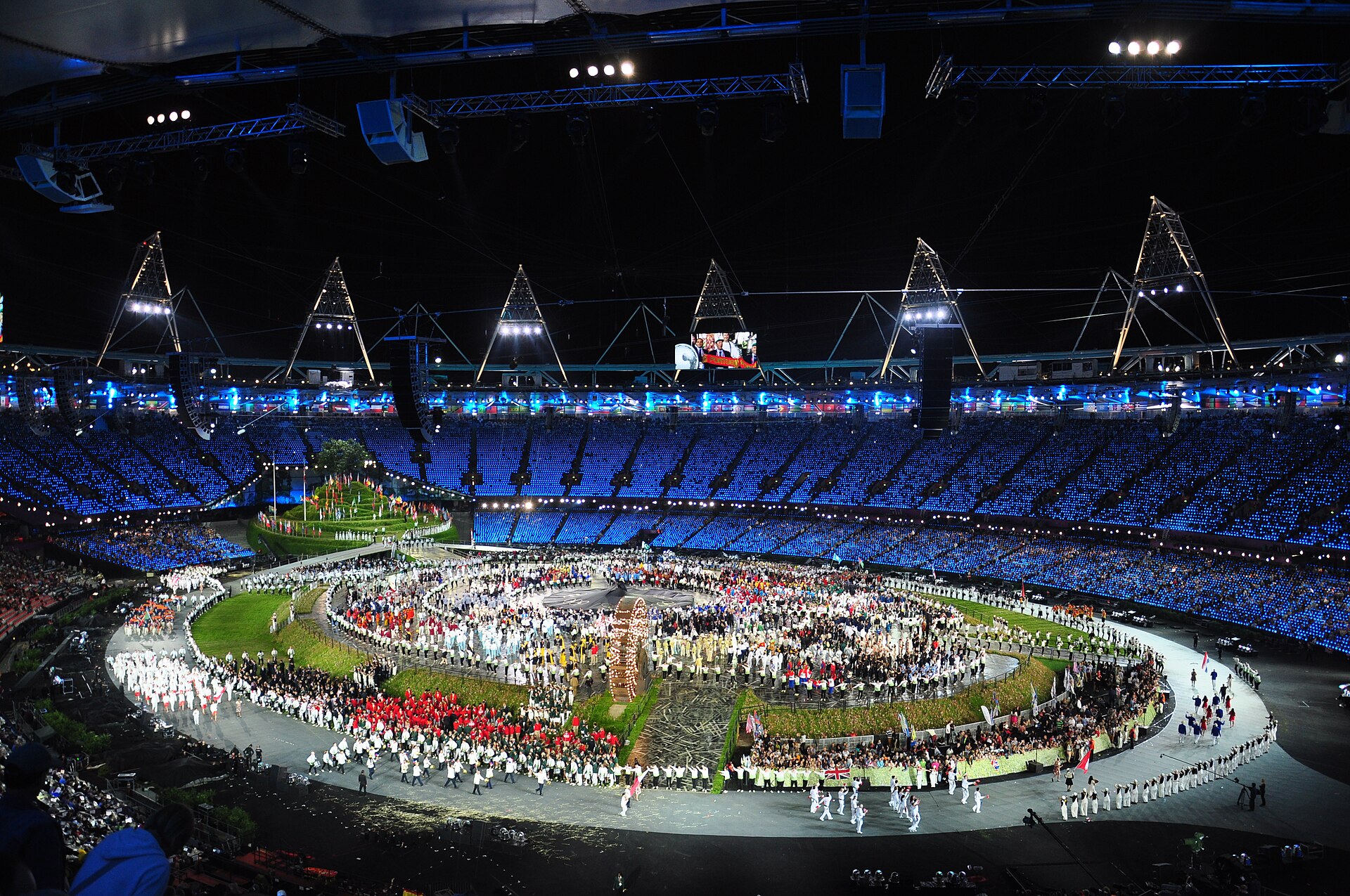
The opening ceremony makes this mechanism particularly clear.
Delegations enter behind their flags and names.
They appear one after another within a shared space organised according to a precise protocol.
This produces an unusual form of mapping.
The world is not represented through geographical borders or a conventional map.
It appears as a sequence of delegations.
Each group becomes temporarily identifiable through a small number of signs:
a name,
a flag,
clothing,
flag bearers,
athletes.
This representation is necessarily simplified.
An entire society cannot, of course, be reduced to a sporting delegation.
The parade nevertheless functions as a visual ordering of the world.
It translates an extremely complex political, cultural and territorial plurality into a sequence that can be read by an international audience.
Representing without reducing a society
This simplification needs to be taken seriously.
A flag does not tell the whole story of a country.
A uniform does not summarise a culture.
A sporting delegation does not represent every social, linguistic or political trajectory within a territory.
The Games nevertheless rely on condensed signs.
Their purpose is to make affiliations quickly recognisable within an event followed simultaneously by very different publics.
Olympic representation therefore rests on a continuing tension.
Belonging has to be made recognisable without its full complexity being represented.
This applies both to delegations and to the host country.
The ceremony as a narrative of the host country
The opening ceremony adds another layer of representation.
Alongside Olympic protocol, an artistic programme gives the host country an opportunity to present selected elements of its history, culture and collective imagination.
Music, dance, architecture, costume, heritage, technology and popular culture can all be incorporated into a narrative designed for an international audience.
A ceremony, however, is never a comprehensive portrait of a society.
It selects.
It prioritises.
It condenses.
Some references are emphasised.
Others remain absent.
What appears as the “culture of the host country” is therefore the result of choices and composition.
The ceremony becomes a cultural narrative produced on a global scale.
Who decides what represents a territory?
This leads directly to the question of mediation.
Who chooses the images?
Which historical episodes are narrated?
Which cultural practices appear in the ceremony?
Which artists are invited?
Which landscapes or monuments become symbols of a particular edition?
International representation never emerges spontaneously.
It passes through institutions, artistic teams, producers, scenographers, broadcasters and many other intermediaries.
The Olympic Games therefore make a wider mechanism particularly visible:
every cultural representation is also a selection.
What appears on the global stage is the outcome of mediation.
Host country and host city
The Games do not only stage national affiliations.
They also generate a particular visibility for the host city.
Sports venues, urban landscapes, architecture, monuments and infrastructure enter the media narrative of the event.
The city temporarily becomes more than a lived territory.
It also becomes a globally circulating setting.
This transformation can be considerable.
A monument familiar to residents can become internationally associated with the Games.
A neighbourhood may appear in broadcasts followed far beyond the local area.
Infrastructure can become a visual sign of a particular edition.
Olympic visibility therefore temporarily transforms urban spaces into elements of a global narrative.
Showing a city does not mean showing the whole city
This projection also has limits.
The city visible through the Games is selected.
Cameras show certain spaces.
Ceremonies use particular landscapes.
Official communication privileges certain images.
Visitor flows concentrate around specific sites.
There is therefore a difference between the city as experienced by residents and the city produced for the event.
This distinction matters.
It prevents Olympic representation from being treated as a neutral reflection of territory.
It is better understood as a temporary construction of visibility.
Sport and culture are not separate worlds
The Games also demonstrate that sport and culture do not operate as entirely separate fields.
Artistic ceremonies are the most obvious example.
But the relationship extends further.
Design of Olympic objects.
Architecture.
Music.
Fashion and uniforms.
Graphic design.
Photography.
Audiovisual production.
Heritage.
Cultural programming around the event.
These practices all contribute to the environment in which sporting competition becomes a collective and media experience.
Preparations for Paris 2024 made this relationship particularly explicit.
The Cultural Olympiad, launched before the Games themselves, developed projects connecting art, culture, territories and the Olympic movement.
Sport therefore provided the framework for a much wider cultural mobilisation.
A Cultural Olympiad before the competitions begin
This timing matters.
The cultural dimension of the Games does not necessarily begin on the night of the opening ceremony.
It can be produced months or years earlier.
Exhibitions.
Performances.
Residencies.
Participatory projects.
Territorial programmes.
Partnerships with cultural institutions.
Such initiatives extend the event beyond sporting venues.
They gradually inscribe the Games across different territories and among publics whose primary interest may not be sporting competition.
Culture becomes one of the ways through which a mega-event spreads into the society hosting it.
A global stage produced by media
The reach of the Olympic Games also depends on media circulation.
Most of the global audience does not attend the competitions in person.
It encounters the event through screens, photographs, commentary, video clips, digital platforms and journalism.
The Olympic stage is therefore both physical and mediated.
A stadium gathers a situated audience.
Broadcasting turns what happens there into an event accessible to many other publics.
Framing, commentary, editing and distribution all contribute to visibility.
The Games seen by audiences are always, in part, mediated Games.
Visibility is not distributed equally
Being present at the Games does not necessarily mean receiving the same degree of visibility.
Some sports attract far more attention.
Certain athletes become global media figures.
Some delegations receive greater coverage across different countries.
Certain stories become central narratives of an edition while others remain relatively marginal.
The Olympic stage is shared, but it is not uniform.
It brings many actors into a common system while generating different levels of visibility.
This distinction complicates the idea of a simple “global showcase”.
A showcase never displays everything in the same way.
The medal ceremony as a device of representation
Medal ceremonies particularly condense the relationship between individual performance and collective representation.
The performance belongs to the athlete.
It is based on training, personal trajectory and the sporting conditions of competition.
Yet the ceremony immediately relocates that performance within a set of collective signs.
Flag.
Anthem.
Delegation name.
Ranking.
Individual and collective become visible at the same time.
This overlap helps explain the symbolic force of international sport.
A victory can be read on several levels:
as individual achievement,
as sporting result,
as personal story,
but also as a moment of collective representation.
National narratives are never completely stable
The Games can give the impression of highly stabilised national identities.
A flag.
A name.
A delegation.
An anthem.
Behind this apparent stability, however, are societies shaped by mobility, migration, diasporas, multiple affiliations and complex individual trajectories.
An athlete may be born in one country, raised in another and developed within a third sporting system.
Members of the same delegation may have very different cultural and linguistic experiences.
The simplicity of Olympic signs should therefore not be confused with the real complexity of belonging.
It is precisely this tension that makes the event culturally significant.
Between Olympic universality and plural forms of belonging
The Olympic movement is built around a universalist imaginary.
Athletes associated with numerous National Olympic Committees compete within a shared framework of rules, competitions and ceremonies.
This universality does not eliminate differences.
On the contrary, part of the spectacle depends precisely on making them visible.
Delegations are distinguished.
Flags are identified.
Languages coexist.
Sporting traditions vary.
National narratives circulate.
The Games therefore stage two ideas simultaneously:
a shared global space
and a plurality of communities represented within that space.
An economy of visibility rather than automatic redistribution of prestige
An important qualification is needed here.
The Games do not automatically “redistribute” symbolic positions among nations.
They create an exceptional space of visibility in which different actors seek to be seen, recognised or associated with particular narratives.
Athletes.
Delegations.
Cities.
Institutions.
Sponsors.
Media.
Cultural organisations.
Each operates according to different logics.
Speaking of an economy of visibility therefore describes the scarcity and distribution of attention without assuming that visibility automatically produces prestige, influence or a lasting transformation in the image of a territory.
A temporary event with longer-lasting traces
The Games are limited in time.
The images, infrastructure and narratives they produce can outlast them.
Some ceremonies remain in audiovisual archives.
Certain buildings continue to organise sporting or urban life.
Some images become durably associated with a city.
Specific sporting moments enter collective memory.
The event therefore has a double temporality.
It is temporary in its performance.
Its traces may be considerably longer-lasting.
This distinction between event and memory constitutes another dimension of its cultural significance.
Reading the Games as a device of representation
To treat the Olympic Games as a cultural object does not mean minimising sport.
It means examining everything that enables sport to become a globally shared event.
Competition remains at the centre.
Around it develop ceremonies, images, narratives, symbols and spaces of mediation.
Several scales therefore intersect:
the athlete,
the delegation,
the host city,
the national context,
the Olympic movement,
the media
and international publics.
These scales are not identical.
For a limited period, however, they become visible within the same event.
Conclusion
The Olympic Games can be analysed simultaneously as sporting competition and as a global system of representation.
Sport provides their organising principle.
Around it circulate signs that make affiliations, territories, narratives and images of self visible.
Ceremonies condense this logic.
The Parade of Nations turns delegations into a temporary map of the world.
The artistic programme constructs a representation of the host country.
Media broadcasting expands this stage to audiences elsewhere.
The host city itself becomes an object of representation.
This visibility is never complete or evenly distributed.
It rests on selection, protocol and mediation.
That is precisely what makes the Olympic Games interesting for cultural analysis.
They do not simply show the world.
They show one temporary way of ordering, narrating and making it visible through sport.
Editorial note — This article is based on a text by Blaise Puala originally published on Ciel-Bleu.org on 29 July 2023. It has been revised, verified and re-edited for the Kultur Insights library in order to preserve its documentary value while placing it within the current editorial framework of Ciel Bleu Kultur.