A cultural institution cannot be measured by longevity alone.
Its history becomes especially meaningful when it allows us to examine what a place continues to make possible: encounters, debate, learning, the circulation of knowledge and the confrontation of different perspectives.
From 13 to 16 October 2022, the Carl-Schurz-Haus / German-American Institute in Freiburg marked its 70th anniversary with a festival entitled “Democratic Vistas.”
Lectures, a photography exhibition, transatlantic discussions, encounters, music, an open library and activities aimed at different audiences formed a programme that went far beyond an institutional commemoration.
The anniversary therefore offered an opportunity to ask a broader question:
what does an international cultural institution produce today when it no longer simply represents a country, but actively creates spaces in which ideas can circulate between different publics?
From the Amerika-Haus to the Carl-Schurz-Haus
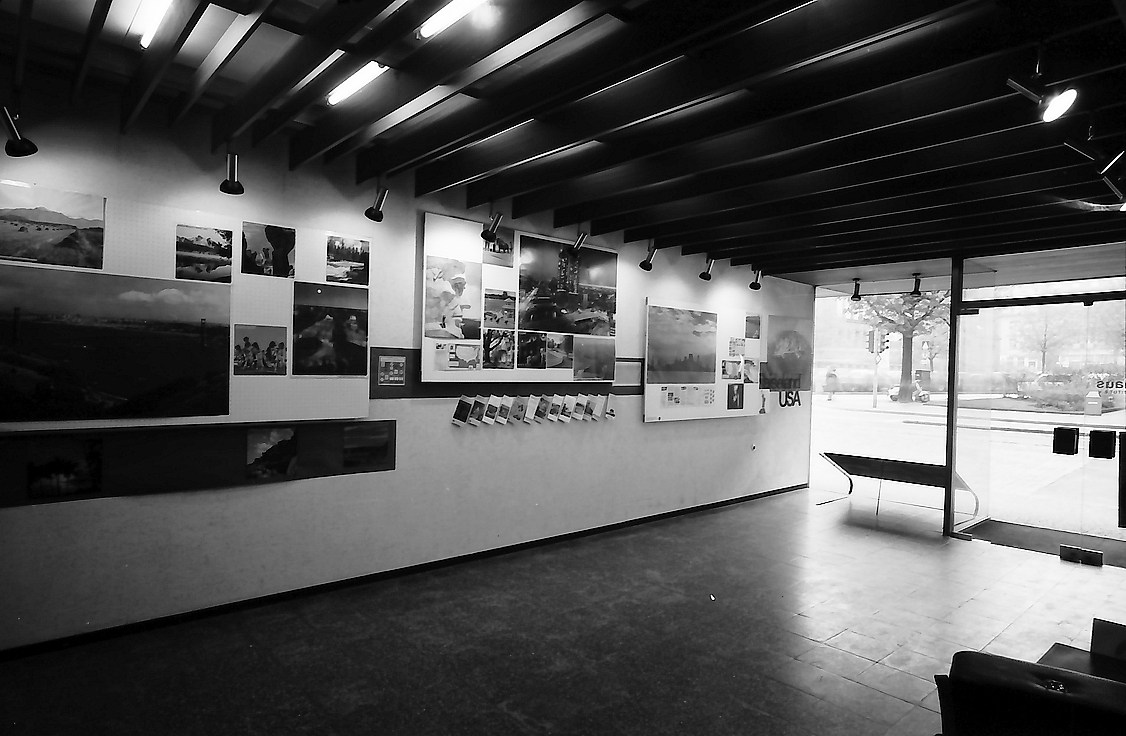
The history of the Carl-Schurz-Haus begins in 1952.
Founded in Freiburg as an Amerika-Haus, it belonged to the post-war institutional landscape through which access to American culture, information, education and democratic ideas was promoted.
One of the emblematic initiatives of this early period was a Bookmobile, a travelling library that brought English-language books to schools in Freiburg and surrounding communities.
The image is revealing.
From the outset, cultural circulation did not depend only on people entering an institution.
The institution itself circulated resources among different publics.
In 1962, the house became a binational centre supported by German and American partners.
In 1969, it took the name Carl-Schurz-Haus.
This trajectory already reveals an important transformation: from a site initially associated with American cultural presence towards an institution of German-American dialogue increasingly embedded in Freiburg’s cultural landscape.
An anniversary oriented towards the present
Seventy years later, Democratic Vistas was not simply an exercise in institutional memory.
Much of its programme addressed contemporary questions.
The opening lecture by Amy Gutmann, then United States Ambassador to Germany, focused on shared responsibilities for the future.
The following day, Barbara Peacock’s photography exhibition Hometown opened another register: the representation of an American community through several decades of everyday life.
On Saturday, a “Pop-Up Think Tank” brought together academics, journalists, political actors and intellectuals around questions concerning democracy, representation, racial inequality, the war against Ukraine and political narratives in the United States.
On Sunday, an open day widened the programme to include families, children, readers and visitors less directly connected with academic debate.
This diversity of formats matters.
It shows that a cultural institution does not produce a single type of audience.
An institution as an infrastructure for circulation
The expression “circulation of ideas” remains abstract unless we look at the devices that make it possible.
A lecture creates a particular relationship between an invited speaker and an audience.
A photography exhibition organises an encounter between images, narratives and visitors.
A panel discussion brings different positions into the same space.
A library allows for a more autonomous and sustained engagement.
An activity for children creates yet another form of cultural appropriation.
These formats do not perform the same function.
Yet together they transform an institution into an infrastructure of circulation.
Ideas do not simply move from one country to another.
They also move between media, generations and publics.
Transatlantic dialogue is more than a celebration of friendship
The phrase “German-American dialogue” can easily become a diplomatic formula.
A space for dialogue becomes more significant when it can also address disagreements, crises and contradictions within the societies concerned.
The 2022 anniversary programme offered a clear example.
The discussions did not focus solely on relations between Germany and the United States.
They addressed democracy, political representation, inequality, war, historical narratives and tensions within democratic societies.
This shifts the function of the institution.
It is no longer only about introducing the culture of another country.
It is also about making discussions possible around problems that different societies share or interpret differently.
“Democratic Vistas”: making democracy an object of discussion
The festival title was not accidental.
Democratic Vistas refers to Walt Whitman and to a long American tradition of reflecting on the promises and contradictions of democracy.
The programme on 15 October explicitly developed this question.
A discussion on Thomas Mann, Walt Whitman and democracy opened the day.
Further contributions addressed women’s political representation, the relationship between law and racial equality, Russia’s war against Ukraine and historical narratives within American political culture.
The cultural value of such a programme lies precisely in the connections it creates.
Literature.
History.
Law.
Journalism.
Politics.
International relations.
These fields become parts of a shared space of discussion.
A cultural institution does not produce consensus
The language of “dialogue” can sometimes suggest that a cultural institution is expected to reconcile every position.
That is not necessarily its role.
A cultural space can be useful precisely because it allows disagreement to become visible without reducing encounter to sterile confrontation.
A lecture does not require everyone to reach the same conclusion.
An exhibition does not impose a single interpretation.
A discussion does not automatically produce consensus.
The institution instead organises the material and intellectual conditions in which disagreement can take place.
A room.
A time.
An invitation.
Moderation.
An audience.
Documentary resources.
These concrete elements are what make dialogue possible.
Culture as mediation between different registers
The anniversary festival also demonstrated that dialogue does not take place only through political discourse.
Barbara Peacock’s Hometown exhibition provided another entry point.
Over several decades, Peacock photographed everyday scenes, celebrations, families and community transformations in her hometown of Westford, Massachusetts.
Moving from a discussion about democracy to an exhibition about everyday life in a small American town is not incidental.
It demonstrates that political culture cannot be understood solely through institutions.
It is also formed through ways of life, representations, social practices and ordinary narratives.
Photography thus becomes another means of circulation between American experiences and German audiences.
International exchange also takes place beyond capital cities
The Carl-Schurz-Haus is located in Freiburg.
That matters.
International cultural relations are often narrated through capitals, embassies and major national institutions.
Yet a significant proportion of cultural exchange develops in medium-sized cities.
Freiburg is home to universities, cultural institutes, associations, researchers, international students and cross-border networks.
The Carl-Schurz-Haus is embedded within this geography.
It shows that transatlantic dialogue does not exist only in Berlin or Washington.
It can also be built over time at the scale of a city.
A local site within an international network
This relationship is one of the distinctive features of cultural houses.
They are physically highly localised.
An address.
A library.
Rooms.
A team.
A local audience.
But the people, texts and debates passing through them may come from distant contexts.
During Democratic Vistas, perspectives associated with the United States, different universities and international media entered a programme accessible to the public in Freiburg.
The local therefore becomes an entry point into international questions.
Distance is not eliminated.
It is worked through.
Different publics within the same institution
The anniversary programme also makes it possible to observe how publics are produced.
An opening event with the US ambassador does not necessarily attract the same people as a photography exhibition.
A full day of academic discussion creates different expectations from a family event.
A library enables yet another form of engagement.
The diversity of an institution therefore lies not simply in the number of activities it organises.
It also lies in its capacity to create different points of entry.
Some publics may overlap.
Others may remain distinct.
The institution can nevertheless create a shared cultural space without assuming that its audience is homogeneous.
The library as a cultural space
The place of the library also deserves attention.
It points to a quieter but fundamental dimension of cultural work.
An institution does not exist only through the events it organises.
It also exists through the resources available between events.
Books.
Periodicals.
Archives.
Reading spaces.
Advice.
Language learning.
A lecture lasts a few hours.
A library builds a much longer relationship.
This continuity also contributes to the circulation of ideas.
Language and access to exchange
Language is another central dimension.
The Carl-Schurz-Haus combines culture, information and English-language learning.
This creates a particular relationship between language and cultural participation.
Understanding another society often depends on access to its texts, debates, works and forms of expression in their original language.
At the same time, mediation requires making those materials accessible to people with different levels of linguistic competence.
Cultural institutions therefore constantly work between several levels:
original language,
translation,
explanation,
contextualisation
and language learning.
This linguistic function is not separate from cultural exchange.
It is one of its infrastructures.
Transmission between generations
Activities for students, children and families also remind us that international dialogue has a generational dimension.
An institution founded in 1952 does not transmit exactly the same content today, nor does it use the same methods.
Audiences change.
Media change.
Political relationships change.
The questions addressed to cultural institutions also evolve.
Transmission therefore does not mean preserving an old model unchanged.
It requires a continual reinterpretation of what a place is for.
This capacity to adapt may contribute more to institutional longevity than administrative continuity alone.
From cultural representation to a space for debate
The history of the Amerika-Häuser offers a particularly clear example of this evolution.
Originally, these places were closely associated with information about the United States, libraries, education and post-war cultural diplomacy.
The Carl-Schurz-Haus gradually developed into a binational centre with greater local autonomy.
This transformation changes the type of cultural relationship being produced.
It is no longer simply about transmitting an image of the United States to Germany.
Exchange becomes increasingly reciprocal.
German, American and European perspectives can be brought into relation.
Dialogue gradually replaces a one-directional model of cultural transmission.
Institutional continuity does not mean immobility
Celebrating 70 years might suggest an institution that has remained stable in form.
Its history shows otherwise.
Its status changed.
Its name changed.
Its location changed.
Its funding model changed.
Its programmes changed.
Its publics changed.
This ability to transform while maintaining a broader mission of dialogue offers another way of understanding institutional longevity.
What endures is not necessarily a fixed form.
It may instead be a capacity to continually reconfigure the means through which a mission is pursued.
What an institution makes possible
The central question may therefore not be how many events a cultural institution organises.
The more important question is what kinds of relationships those events make possible.
Between artists and audiences.
Between researchers and students.
Between languages.
Between generations.
Between history and the present.
Between a city and international networks.
From this perspective, the institution is not merely a programme producer.
It becomes an intermediary.
It organises situations in which certain forms of circulation can take place.
Conclusion
The 70th anniversary of the Carl-Schurz-Haus in Freiburg offers a particularly useful case for understanding the contemporary role of an international cultural institution.
Over several days, the Democratic Vistas festival brought together functions that the institution had developed over the course of its history:
transmitting,
documenting,
educating,
exhibiting,
debating,
connecting people,
and opening spaces for participation.
The significance of the institution therefore lies not simply in its longevity.
It lies in the continuity with which a local infrastructure can accommodate questions extending far beyond its immediate territory.
In Freiburg, transatlantic dialogue takes a concrete form: people gather in a room, look at photographs, use a library, compare understandings of democracy or encounter other cultural references.
The “circulation of ideas” then ceases to be an abstract phrase.
It becomes a set of situations, media and relationships organised by a place.
It is precisely this capacity that allows a cultural institution to remain relevant beyond the anniversary itself.
Editorial note — This article is based on a text by Blaise Puala originally published on Ciel-Bleu.org on 17 October 2022 following the “Democratic Vistas” festival held in Freiburg to mark the 70th anniversary of the Carl-Schurz-Haus. It has been revised, verified and re-edited for the Kultur Insights library in order to preserve its documentary value while placing the event within a broader analysis of cultural institutions as spaces of mediation and the circulation of ideas.