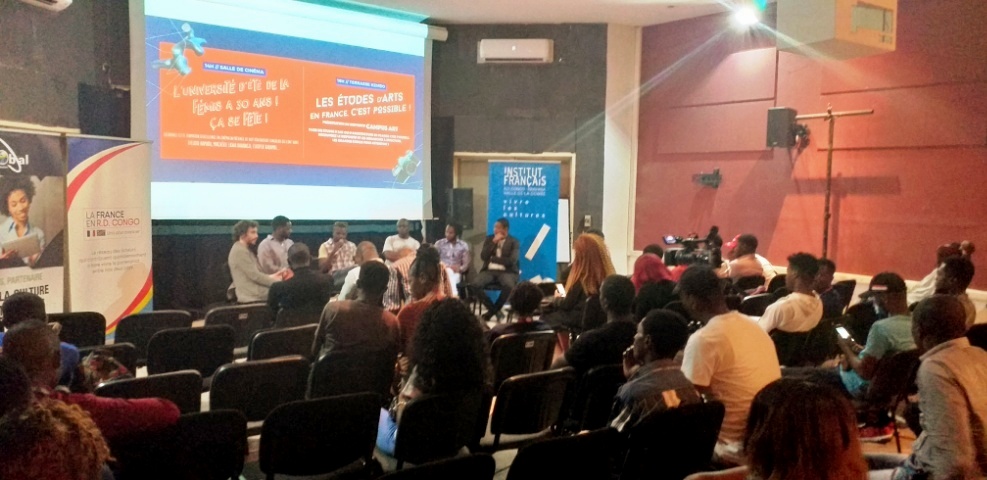
On 19 October 2019, the Institut français in Kinshasa organised an event marking the 30th anniversary of the Summer University of La Fémis, France’s national film school.
Several Congolese filmmakers who had participated in this international training programme gathered to share their experiences.
Directors.
Producers.
Professionals working in different filmmaking environments.
Educational journeys.
Film projects.
Experiences of collective work.
Professional networks extending beyond national borders.
And a question running through their accounts:
What does an international training experience change in the career of a filmmaker already working within their own cultural environment?
The event was not solely about opportunities to study in France.
It also offered an opportunity to examine relationships between education, professional recognition, the circulation of knowledge and the development of filmmaking practices.
La Fémis provided a common reference point for the experiences presented.
Yet the participants’ accounts showed that the effects of the same training programme did not necessarily take the same form.
For some, it strengthened their technical abilities.
For others, it transformed their understanding of how a film could be conceived and produced.
The experience also made it possible to meet other professionals, establish new networks or develop greater confidence in skills already acquired.
The significance of this archive lies precisely in these differences.
One event in Kinshasa, several professional trajectories
The event took place at the Institut français in Kinshasa.
The discussions brought together former participants of the La Fémis Summer University.
Filmmakers mentioned in contemporary accounts included Abraham Mohindo, Machérie Ekwa Bahango, Tshoper Kabambi, Michée Sunzu and David Masamuna.
The original Ciel Bleu report also mentioned Moimi Wezam among the former participants associated with the gathering.
These names represent different professional paths and different years of participation in the programme.
Professionals based in Kinshasa.
Others from Goma or Lubumbashi.
Filmmakers already involved in directing, production or the transmission of filmmaking knowledge.
International experiences acquired at different stages of their careers.
This geographical and professional diversity matters.
International film education does not simply connect a French institution with an undifferentiated group of Congolese beneficiaries.
It intersects with existing professional trajectories rooted in different cities, networks and production conditions.
An international programme devoted to documentary filmmaking
Established in 1989, the La Fémis Summer University is an international programme of film education and professional development.
It is distinct from the school’s regular degree courses.
Organised over approximately two months, the programme welcomes participants from different countries who wish to deepen their knowledge and filmmaking practices, particularly in documentary cinema.
The training combines several dimensions.
Theoretical instruction.
Practical workshops.
Technical exercises.
Professional encounters.
Film screenings.
And the production of a documentary short film.
Collaborative work is an important part of this approach.
Participants are encouraged to confront their methods with those of other filmmakers in an environment that may differ from their usual production conditions.
This introduces an essential distinction.
Taking part in an international training programme does not necessarily mean learning filmmaking for the first time.
Participants may already be making films.
Organising workshops.
Developing projects.
Working in production teams.
Building professional networks.
Experimenting with filmmaking methods in their own environments.
The training therefore enters an existing trajectory.
It is not necessarily its starting point.
Abraham Mohindo: accessing training from Goma
Abraham Mohindo’s testimony made the question of access particularly visible.
The filmmaker, based in Goma, explained that he had benefited from advice and encouragement from former participants in the Summer University.
The experiences of those who had already completed the programme thus became a resource for new applicants.
They helped clarify expectations.
The necessary procedures.
How to present a film project.
The conditions of application.
Abraham Mohindo also referred to the support he received from Samuel Pasquier, then deputy director of the Institut français in Kinshasa, with certain administrative procedures relating to his journey to Paris.
This assistance was particularly significant because Goma did not have a local Institut français at the time he described.
The challenge was therefore not exclusively artistic.
It was also geographical.
Administrative.
Institutional.
The invisible conditions of professional mobility
Having a film project is not enough to access an international training programme.
Applicants must first know that the programme exists.
Understand its selection criteria.
Prepare an application.
Identify relevant contacts.
Gather the required documents.
Communicate with the institutions involved.
And, if selected, organise the practical conditions of travel.
Professional mobility therefore begins before the journey itself.
It depends on an infrastructure of information and support.
In Abraham Mohindo’s experience, former participants and institutional intermediaries appear as actors within this infrastructure.
They do not replace the selection process.
But they can make information and procedures more accessible.
This distinction becomes particularly important when examining inequalities between territories.
An applicant based in a capital city where several cultural institutions are concentrated may not have the same access to contacts as a professional working in a more distant city.
The international circulation of skills therefore begins with a local question of access.
Knowledge transfer can begin between former participants
One of the most revealing aspects of this experience concerns the role of filmmakers who had already taken part in the programme.
A former participant can share practical information.
Explain how to present a project.
Describe the organisation of workshops.
Discuss difficulties encountered.
Recommend a contact.
Encourage someone to apply.
Training therefore produces a form of circulation that extends beyond its official teaching period.
Knowledge acquired within one institution can be passed on to other professionals in a different setting.
This process does not necessarily take the form of an independent institutional programme.
It may develop through personal relationships.
Advice.
Informal exchanges.
Professional solidarity.
Nevertheless, it is an important dimension of the circulation of skills.
The educational role of cinematic references
Abraham Mohindo also referred to the documentary Maman Colonelle, directed by Dieudo Hamadi.
According to his account, the film had changed his perception of cinema.
This reference deserves attention.
A film can play an educational role independently of formal institutional training.
It can inspire someone to become a filmmaker.
Introduce a particular form of storytelling.
Transform an understanding of directing.
Or reveal new possibilities within documentary cinema.
Professional learning does not necessarily begin in a classroom.
It may emerge from encountering a work.
From a discussion between filmmakers.
From the exchange of cinematic references.
Or from an experience of watching a film that later influences one’s own creative practice.
The circulation of films as references is therefore another dimension of learning.
Learning through different ways of working
The Summer University places participants in a collective and international working environment.
This experience was a recurring theme in the accounts shared in Kinshasa.
Working with people from different contexts requires individuals to confront their own habits.
A method can be discussed.
An artistic decision questioned.
A way of preparing a shoot transformed.
Participants do not necessarily share the same references.
The same technical experience.
Or the same professional conditions.
Yet they must develop work together.
This confrontation can itself become a learning resource.
It introduces alternative ways of organising a team, approaching a project or solving a production problem.
Machérie Ekwa Bahango: understanding filmmaking through collaboration
The testimony of Machérie Ekwa Bahango, director of Maki’la, placed particular emphasis on this dimension.
She explained how working as part of a team had broadened her understanding of filmmaking.
The programme had allowed her to take on different responsibilities.
Working behind the camera.
Experimenting with sound.
Understanding the responsibilities of other crew members.
Participating in several stages of production.
Moving between these roles does not mean that every participant becomes a specialist in every filmmaking profession.
It does, however, make their interdependence easier to understand.
Cinema emerges as a collective practice in which an artistic decision also depends on the skills and choices of others.
Machérie Ekwa Bahango’s experience therefore illustrates how training can change not only what a filmmaker knows, but also how they understand relationships within a film crew.
Understanding cinema through sound
Machérie Ekwa Bahango attached particular importance to the training devoted to sound.
Her account raised a question that often receives less attention than the visual dimension:
How can a film tell a story through sound?
Sound is not merely a technical accompaniment.
It can create an atmosphere.
Suggest a presence.
Establish a sense of space.
Evoke something beyond the frame.
Change the meaning of an image.
Shape the perception of a situation.
This attention shifts the understanding of directing.
A film is not constructed only through what is shown.
It is also constructed through what is heard.
Learning to listen can therefore become another way of learning to tell stories.
Learning one role while understanding others
Moving between responsibilities during collaborative training can produce another effect.
It makes the constraints faced by other members of a production team more visible.
A director who experiments with sound recording may better understand the requirements of capturing audio.
Someone working with images may become more aware of the demands of editing.
A participant involved in several stages discovers how individual decisions can influence the entire process.
This experience does not replace professional specialisation.
It can nevertheless support a more comprehensive understanding of filmmaking.
Training then becomes a space in which different competencies are coordinated, rather than simply a process of acquiring isolated technical skills.
Tshoper Kabambi: structuring filmmaking practice
Tshoper Kabambi placed particular emphasis on organising knowledge and developing technical confidence.
His testimony highlighted the difference between accumulating information and being able to use it within a coherent approach.
A filmmaker may know the different stages of production without always having a systematic method for connecting them.
Training can help establish these relationships.
Preparing.
Anticipating.
Making choices.
Experimenting.
Revising.
Bringing a project to completion.
Experience with professional technical equipment was another important dimension of his account.
Using such tools in a training environment helps filmmakers understand both their possibilities and their limitations.
But the value is not limited to access to equipment.
It also concerns the ability to integrate technical resources into a creative process.
Michée Sunzu: organising ideas before production
Michée Sunzu emphasised the structuring of ideas and the importance of collective work.
His experience showed that an artistic project does not depend solely on an individual’s intention.
It requires shared decisions.
Working methods.
Organisation.
The exchange of different skills.
And sometimes the willingness to change established habits in order to develop a common approach.
This dimension is particularly relevant in an international programme involving participants from several countries.
Each person brings their own references.
Their own working methods.
Their professional routines.
Collective creation therefore requires an effort to bring these experiences together.
Learning is not just about mastering a tool.
It can also transform the way people think through projects with others.
Professional networks as an extension of training
Abraham Mohindo also emphasised the importance of contacts established during his time at La Fémis.
According to his testimony, certain relationships had facilitated opportunities to attend film festivals in China and Senegal.
This experience changes how international training can be understood.
Its significance is not limited to what is taught in workshops.
It may also lie in the people participants meet.
Another filmmaker.
A producer.
A technician.
Someone who can pass on relevant information.
A contact who facilitates access to a festival.
Training thus becomes a place where professional networks can develop.
From the training room to other filmmaking environments
These networks have their own geography.
People from different countries meet temporarily within the same institution.
They work together.
Exchange experiences.
Then return to their respective professional environments.
The relationships formed may continue to circulate after the programme ends.
An encounter in Paris can lead to an exchange with a filmmaker working elsewhere.
Information passed on by a former participant can reach a director in Goma.
A professional connection can create an opportunity to participate in an international festival.
Such developments are never guaranteed.
They depend on the people involved.
Available resources.
And the continuity of relationships.
Yet they show that training can contribute to a professional infrastructure extending beyond its own timetable.
Moimi Wezam: collaboration beyond the programme
The professional trajectory of Moimi Wezam offers another perspective on this circulation.
A former Summer University participant from 2015, he is among the Congolese filmmakers whose work is documented in the institutional records of La Fémis.
His activities include editing the film Kitendi, involvement in the production of Nelson Makengo’s short film Théâtre urbain, and directing the documentary Zéro in 2018.
These elements are significant.
They illustrate how a filmmaker’s activities can extend across different roles.
Editing.
Production.
Writing.
Directing.
They also reveal professional collaborations between people who participated in different editions of the same programme.
Nelson Makengo himself attended the Summer University in 2016.
Their documented professional connection through Théâtre urbain therefore provides a concrete example of collaboration between former participants.
This does not mean that every such collaboration can automatically be attributed to the training programme.
Professional trajectories, artistic choices and production conditions also play a role.
The original Ciel Bleu report mentioned Moimi Wezam among the former participants associated with the Kinshasa event, without reproducing a detailed individual testimony from him.
His career can therefore inform an analysis of professional networks without attributing statements to him that were not documented during the event.
From training networks to production networks
Moimi Wezam’s case allows the question to be examined more broadly.
A professional network is not simply a collection of contacts.
It can become a framework for working together.
A director collaborates with an editor.
A producer supports a project.
A former participant passes on information.
Two filmmakers develop a new production.
These relationships do not all have the same duration or intensity.
Some remain occasional.
Others extend across several projects.
International training can encourage their development by temporarily bringing professionals together.
But their continuation depends on further conditions.
Available projects.
Financial resources.
Complementary skills.
A willingness to collaborate.
And an environment in which activities can actually be implemented.
A network does not therefore guarantee film production.
It creates a set of possibilities.
David Masamuna: the question of professional recognition
The experience described by David Masamuna, from Lubumbashi, raised another issue.
Before taking part in the La Fémis programme, he had already been involved in training and supporting younger filmmakers.
He was organising workshops within his professional environment.
The international training had therefore not created his educational activity.
It entered a trajectory that was already underway.
In his testimony, David associated the experience with a strengthening of his professional legitimacy.
This dimension deserves particular attention.
Recognition acquired through an international institution
In some professional environments, experience gained at an internationally recognised institution can change how a person is perceived.
Someone already organising workshops may return with additional recognition.
Their skills did not necessarily originate with that training.
But the perception of those skills may change.
Institutional recognition then becomes a symbolic resource.
It can strengthen personal confidence.
Facilitate professional exchanges.
Make an existing career more visible.
Or reinforce the credibility of work already being carried out.
Yet recognition must be distinguished from the skills a person actually possesses.
An institution does not create the value of a filmmaker on its own. It can, however, influence the social and professional conditions under which that value is recognised.
Recognition is not the same as professionalisation
This distinction is essential.
Participation in a recognised programme does not automatically guarantee employment.
Or funding.
Or the possibility of making a feature film.
Or sustained participation in festivals.
Or the transformation of local production conditions.
Training may strengthen a professional’s abilities without immediately changing the environment in which they work.
David Masamuna’s account therefore raises a central question:
How can recognition gained through an international programme be translated into concrete opportunities within a local professional environment?
This translation is never automatic.
It also depends on the capacity of the professional environment to receive, use and recognise the skills involved.
From individual training to local knowledge transfer
The question of returning to one’s professional environment extends this reflection.
An international experience can broaden a participant’s knowledge.
But its influence on a filmmaking scene also depends on what happens afterwards.
Does the filmmaker have the resources to develop new projects?
Can they pass on what they have learned?
Are there spaces in which workshops can be organised?
People with whom new productions can be developed?
Institutions capable of supporting their work?
Individual learning does not automatically become a collective resource.
Additional conditions are needed for knowledge to be shared.
This distinction helps explain why the international mobility of individuals is not, by itself, sufficient to bring about lasting structural development within a cultural sector.
Territorial inequalities do not disappear in Paris
The experiences of filmmakers from Goma, Lubumbashi and Kinshasa remind us that participants do not work under identical conditions.
Their access to information may differ.
Their professional networks do not necessarily have the same connections.
Available equipment varies.
Their production environments may impose particular constraints.
During training, participants may share equipment and a common working environment.
But after returning home, they encounter different conditions once again.
International mobility therefore does not eliminate territorial inequalities.
It can provide participants with new resources.
The question remains under what conditions those resources can be used within their respective professional environments.
La Fémis as an infrastructure of circulation
Through these accounts, La Fémis appears in several dimensions.
A place of education.
A space for practical experimentation.
A framework for collective work.
An institution associated with professional recognition.
An international meeting point.
A potential network of former participants.
The Summer University thus organises the circulation of people, methods and relationships.
This circulation is not limited to travel from the Democratic Republic of the Congo to France.
It also includes connections between professionals from different countries.
Then returns to local working environments.
Collaborations.
Knowledge transfer.
Further professional mobility.
The programme can therefore be examined as an infrastructure of education and mobility.
Institutions shape the conditions of access
This mobility remains institutionally structured.
It depends on application procedures.
Selection criteria.
Institutional partnerships.
Scholarship arrangements.
Contacts responsible for communicating information.
And resources that make travel and participation possible.
French embassies and cultural cooperation services are part of this environment.
Campus France also plays a role within the international mobility and scholarship arrangements associated with the programme.
These functions raise several questions.
Which applicants know about the opportunities?
Who receives support?
Which projects are considered eligible?
What kinds of experience are recognised during selection?
Which professionals already possess the resources needed to prepare an application?
Access to cultural mobility is shaped before selection even begins.
International training and institutional relationships
This organisation also creates relationships between institutions with different levels of resources.
An international film school defines a teaching framework.
Institutional partners contribute to application and mobility procedures.
Participants arrive with their own projects and experiences.
These actors do not necessarily possess equal decision-making authority.
The institution determines conditions of admission.
Applicants must present their projects within those requirements.
Selected professionals may subsequently gain access to particular resources.
This does not mean that the relationship is exclusively one-directional.
Participants also contribute to exchanges through their knowledge and practices.
Nevertheless, the circulation of skills cannot be separated from the institutional frameworks that organise it.
Filmmakers are not merely recipients of knowledge
It would be reductive to attribute filmmakers’ professional trajectories entirely to the institutions that train them.
Participants arrive with their experiences.
Their projects.
Their references.
Their skills.
Their difficulties.
Their networks.
They contribute to the richness of the training environment themselves.
A Congolese director may introduce cinematic references that other participants have never encountered.
A professional accustomed to working under particular technical conditions may share methods developed in that environment.
A filmmaker may contribute a distinctive approach to documentary storytelling.
Knowledge therefore does not circulate exclusively from the institution towards participants.
It also moves between participants themselves.
Filmmakers are not simply recipients of instruction.
They help create a shared space for producing and exchanging knowledge.
Campus France and opportunities for further study
The gathering on 19 October 2019 also included a presentation of opportunities to study in France, particularly through Campus France.
This second part broadened the scope of the event.
It was no longer exclusively about reflecting on a filmmaking training experience.
The gathering also became an information space for prospective applicants.
Professionals who had benefited from international training could share their experiences with people considering similar paths.
This relationship between former participants and potential applicants matters.
An individual testimony becomes a source of guidance.
A career path can serve as an example.
An experience can clarify procedures.
An exchange can encourage the preparation of a project.
Information no longer circulates solely through institutional documents.
It also passes through people who have already navigated the programme.
Training, departure and return: different questions
The original report also recorded advice encouraging applicants not to lose sight of their initial educational goals.
This raises the relationship between educational mobility and professional plans.
Studying abroad.
Developing skills.
Building a network.
Pursuing an international career.
Returning to work in one’s home country.
Maintaining collaborations across different territories.
These possibilities are not necessarily mutually exclusive.
But they are not identical either.
A professional career may combine activities in several places.
Someone can participate in international projects while maintaining connections with their original environment.
Collaboration can continue without requiring an immediate physical return.
The advice shared during the event must therefore be understood within its 2019 context, rather than treated as a general rule for every professional trajectory.
The more important analytical question concerns the circulation of skills and resources between different working environments.
The effects of international cooperation need to be examined
International training programmes are frequently presented as opportunities for professional development.
The accounts shared in 2019 reveal several benefits perceived by participants.
A better understanding of collective work.
New methods.
Greater technical confidence.
Encounters.
Institutional recognition.
Opportunities for professional networking.
These experiences are significant.
Yet they are not sufficient to measure the programme’s overall effects on the Congolese film sector.
Such an assessment would require examining what happened after training.
The films actually produced.
Collaborations that continued.
Knowledge-sharing activities.
Production opportunities.
Resources mobilised.
And obstacles that remained.
The Kinshasa gathering was not a comprehensive evaluation of these outcomes.
It was primarily a space for sharing experiences.
A conference that becomes a space of knowledge transfer
The gathering at the Institut français in Kinshasa was not simply an anniversary celebration.
It produced a new circulation of experiences.
Professionals who had participated in a training programme in Paris discussed their journeys before a Congolese audience.
Information was shared.
Difficulties described.
Methods discussed.
Educational opportunities presented.
The photographs taken during the event document precisely this situation.
Speakers.
An audience.
A projection screen.
Institutional information materials.
A space devoted to discussion and exchange.
The training itself had taken place elsewhere.
But the experiences gained through that training were now being communicated in Kinshasa.
Photography as an archive of the framework
The photographs taken during the gathering hold a particular documentary value.
They do not document the classes attended in Paris.
Nor the participants’ shoots.
Nor the films made during the programme.
They show another moment.
The moment when training experiences are publicly shared.
One photograph presents a closer view of the discussions.
Another provides a wider perspective of the room, the participants and the audience.
These images reveal the material and institutional conditions of the gathering.
A room.
Rows of chairs.
Participants.
A screen.
Information materials.
People brought together around professional experiences.
The archive therefore does not directly show filmmaking education at La Fémis.
It documents the communication of experiences arising from that education.
This distinction gives the photographs their documentary significance.
Ciel Bleu as an observer of the gathering
In October 2019, Blaise Puala attended the event at the Institut français in Kinshasa and documented it for Ciel Bleu.
The article published the following day presented the filmmakers’ accounts and the information shared during the gathering.
It fulfilled an immediate journalistic function.
Reporting on the event.
Identifying the participants.
Presenting their experiences.
Informing readers about the training opportunities discussed.
The photographs extended this coverage.
In this context, Ciel Bleu was not an organiser of the Summer University or the institutional event.
Its documented role was that of an on-site editorial observer.
Read today, this documentary work takes on another value.
It allows us to examine mechanisms of knowledge transfer, professional recognition and mobility reflected in the participants’ testimonies.
From an anniversary to a question about cultural ecosystems
The recovery of this article for Kultur Insights rests precisely on this shift.
The question is no longer simply:
How did the Institut français in Kinshasa celebrate the 30th anniversary of the La Fémis Summer University?
It becomes:
How can international training influence filmmaking careers that are already underway, and under what conditions can the experiences acquired circulate between different professional environments?
This perspective moves beyond the report of a commemorative event.
It reveals the relationships needed to support education and mobility.
Film schools.
Cultural and cooperation services.
Former participants.
Professional networks.
Filmmakers.
Production environments.
Spaces for sharing knowledge.
And the territories in which these actors continue to work.
Another dimension of cultural circulation
This archive also belongs to a broader series of observations devoted to cultural infrastructure.
The European Film Festival in the DRC, documented several months earlier, made it possible to examine the circulation of works between cities, institutions and audiences.
The gathering around La Fémis reveals a different movement.
It is no longer only films that circulate.
People do too.
Methods.
Skills.
References.
Professional relationships.
And forms of recognition.
These two situations did not belong to the same institutional programme.
Yet they offer complementary perspectives on filmmaking ecosystems.
The distribution of works.
And the development of the professional conditions needed to create them.
This relationship does not imply a direct historical or institutional continuity between the events.
It shows instead that cultural circulation can take different forms depending on the actors and infrastructures involved.
Conclusion
The gathering held in Kinshasa in October 2019 to mark the 30th anniversary of the La Fémis Summer University allows us to examine film education beyond its immediate teaching content.
The testimonies of Congolese filmmakers reveal several functions.
Learning a method.
Discovering a tool.
Understanding teamwork.
Developing a filmmaking approach.
Meeting other professionals.
Accessing new networks.
Strengthening recognition.
Sharing experiences.
These dimensions do not automatically produce the same outcomes for every participant.
Training guarantees neither a career.
Nor funding.
Nor the transformation of a cultural sector.
It can nevertheless constitute an important moment in a professional trajectory.
And sometimes a starting point for new relationships.
The issue therefore extends beyond the opportunity to study at a recognised institution.
It concerns the conditions under which acquired skills and experiences can continue to circulate.
Between Paris and Kinshasa.
Between Goma and other filmmaking environments.
Between Lubumbashi and international networks.
Between former participants and prospective applicants.
Between individual practices and the professional settings in which they operate.
The 2019 gathering thus documents something more precise than an institutional anniversary:
How an international training programme can become a space for the circulation of skills, professional networking and recognition, without replacing the local conditions necessary for filmmaking.
It is through this relationship between education, mobility, knowledge transfer, networks and professional recognition that the archive finds its place within Kultur Insights.
Editorial note — This article is based on a report by Blaise Puala originally published on the historical Ciel-Bleu.org website on 20 October 2019, following a gathering held the previous day at the Institut français in Kinshasa to mark the 30th anniversary of the La Fémis Summer University. Blaise Puala attended the event and documented it through his own photographs. The article has been fully reviewed, revised and re-edited for the Kultur Insights library to preserve its value as a field archive while distinguishing the testimonies documented in 2019, complementary information from institutional archives and the present analytical interpretation. This version focuses on the professional trajectories of Congolese filmmakers, access to international training, the circulation of skills, professional networks and mechanisms of recognition.