
Cultural practice does not take place only in museums, theatres, galleries or festivals. It also emerges in neighbourhood centres, social organisations, associations and other local spaces where people come together.
These settings offer particularly useful opportunities to observe how cultural activity can intersect with forms of social participation.
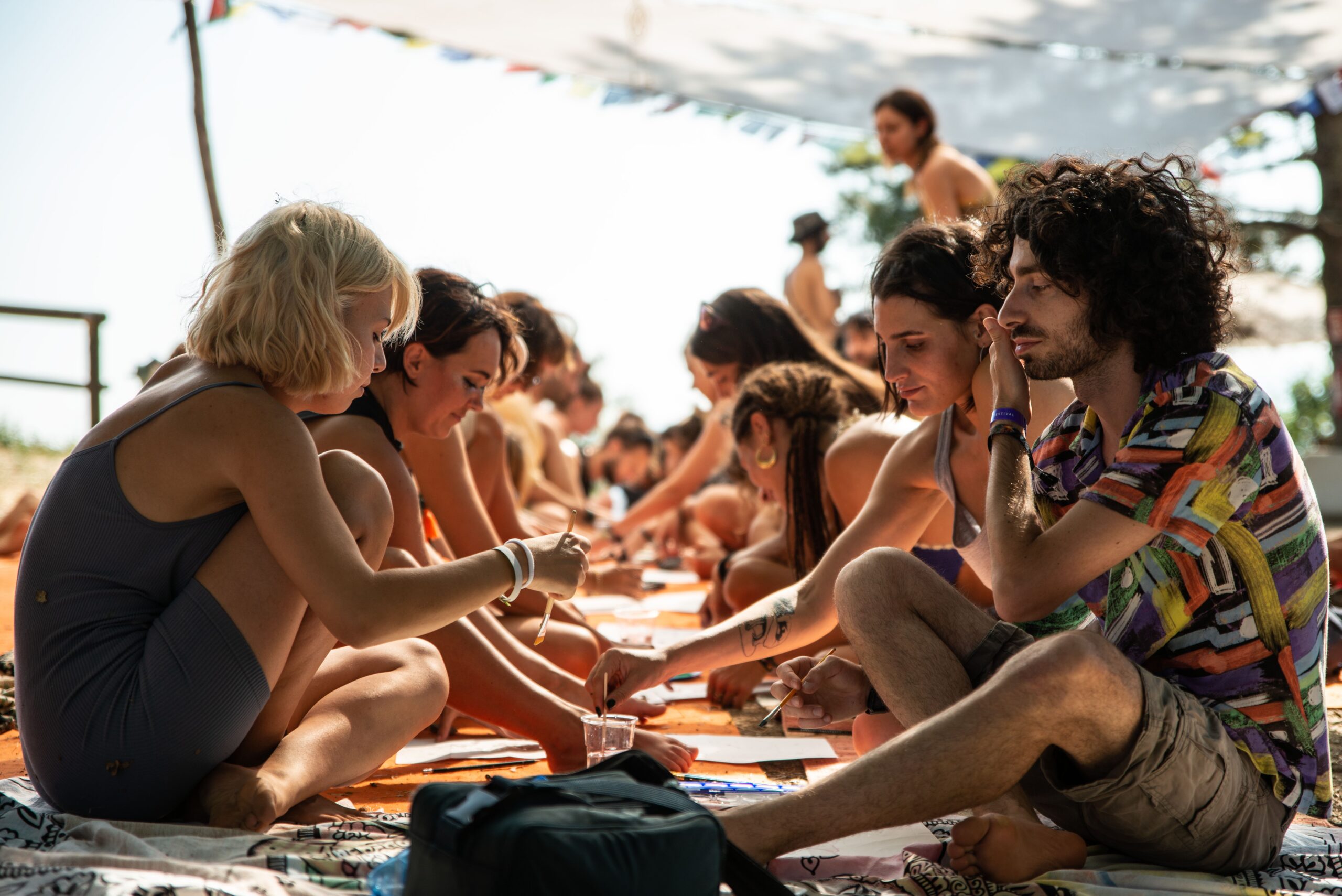
A Sommerfest organised by Caritasverband Freiburg-Stadt in 2025, with Ciel Bleu Kultur contributing to its organisation, provides one concrete example. Alongside the social character of the event, the participatory project “Kaleidoskop der Vielfalt” invited visitors to contribute to a shared artistic creation.
The analytical value of such a format does not lie in attributing far-reaching social effects to it.
A more precise question is more useful: what happens when cultural production is integrated into a social space of encounter?
A social event with a cultural dimension
A Sommerfest is not, in itself, a cultural programme in the classical institutional sense.
It is first of all an occasion for people to meet, creating opportunities for informal interaction and bringing different activities together within a shared space for a limited period of time.
This openness can nevertheless create the conditions for a cultural experience.
Artistic activity no longer necessarily appears as a separate programme presented to an audience. It can become part of a broader social situation in which conversation, food, movement, spontaneous encounters and creative participation coexist.
The function of cultural practice changes accordingly.
It is no longer limited to presenting a finished work.
It can also help create a situation in which people enter into relation with one another.
From audience to participation
A central feature of “Kaleidoskop der Vielfalt” was that those attending could contribute directly to a shared creation.
Reception became participation.
This distinction should, however, be treated carefully.
Taking part in an activity does not automatically mean that every participant has equal influence over the project. Nor does collective artistic activity necessarily produce lasting forms of social participation.
It nevertheless changes the position of those involved.
Someone who adds, modifies or leaves a trace within a shared creation no longer relates to the cultural object solely as a spectator.
Artistic production becomes a vehicle for interaction.
In the case observed, individual contributions were brought together within a shared spatial and temporal process.
It is precisely this change in the relationship between participants and the format that makes the experience analytically significant.
Creating encounters without assigning identities
When people with different life trajectories take part in the same event, it can be tempting to describe the situation immediately as an “intercultural encounter” or an expression of “cultural diversity”.
Such terms can be useful.
They also carry a risk: assigning cultural identities to participants that may not actually be central to the interaction taking place.
Not every encounter between people with different biographies is automatically an exchange between clearly bounded “cultures”.
At the Sommerfest, relationships first emerged through a shared situation: being in the same place, participating in activities, observing others, talking or contributing to a common object.
The mediating function of the format therefore lies less in making cultural differences visible.
It lies more in creating a framework in which different people can act together without first having to define their relationship through origin or belonging.
Culture as social infrastructure
This observation broadens the meaning of cultural infrastructure.
Infrastructure usually refers to material conditions such as buildings, technical systems or transport networks.
In a cultural context, however, the term can also describe the conditions that make certain kinds of relationships possible.
A place, available time, materials, an activity and forms of mediation can together create a social situation that might not otherwise emerge in the same way.
Culture does not thereby become a solution to social problems.
It can, however, function as an infrastructure for encounter.
This distinction is important.
An artistic project cannot eliminate social inequalities on its own or resolve structural conflicts by itself.
It can nevertheless create conditions in which people do something together, share an experience or come into contact with one another.
The value of such a format therefore lies less in broad promises of impact than in the quality of the situation it makes possible.
Mediation as a condition of participation
Participatory formats do not emerge simply because materials are provided or people are invited to “take part”.
They require mediation.
Someone develops the format, explains how it works, creates points of access, responds to uncertainty and connects individual contributions to the wider process.
This work is often less visible than the final result.
Yet it is central to whether participation actually becomes possible.
Mediation is not only about conveying information.
It is also about organising the practical conditions of participation.
Is the invitation understandable?
Can someone join spontaneously?
Are particular artistic skills required?
How much time does participation demand?
Are different levels of involvement possible?
These apparently practical decisions directly influence who can actually access a project.
An analysis of cultural participation should therefore consider not only the visible outcome but also the conditions under which participation is organised.
The collective work as a trace of the event
Another interesting aspect of the project concerns what remained after the event itself.
The work created through “Kaleidoskop der Vielfalt” remained visible at the Franz-Hermann-Haus.
Part of the Sommerfest therefore continued beyond the day of the event.
In this context, the collective work can be understood as a trace.
It does not fully document what happened. Conversations, encounters, atmospheres and individual experiences can only be partially contained within an object.
It nevertheless recalls that several people took part in a shared process.
A temporary experience thus acquires a material form of continuity.
This persistence distinguishes the project from an activity that disappears entirely once the event ends.
Between social work and cultural practice
The case also shows that the boundaries between social work and cultural practice are not always clear-cut.
A social organisation may use artistic methods without becoming a cultural institution.
Likewise, a cultural initiative may operate within a social context without taking on the professional responsibilities of social work.
This distinction should be preserved.
Cultural practice can create opportunities for expression, participation and encounter.
Social work, by contrast, relies on its own professional competencies, institutional responsibilities and forms of long-term support.
The relationship between the two can be productive as long as their respective functions are not confused.
The Sommerfest can therefore be understood less as a fusion of cultural and social work than as a point of contact between different professional logics.
What can actually be learned from a local case?
A single Sommerfest cannot support general conclusions about how cultural participation operates across contemporary urban societies.
The case is limited.
That limitation is precisely what allows for a more rigorous analysis.
What can be observed concretely is narrower: a social setting, a temporary event, a participatory artistic activity, different forms of involvement and a shared outcome.
These elements do not amount to a universal model.
They do, however, show how cultural mediation can be organised locally.
Small-scale formats therefore provide valuable sites of observation.
They reveal that cultural participation is not produced only through major programmes or established institutions, but also through more ordinary settings in which concrete opportunities to take part are created.
Freiburg as a local context
The location itself also matters.
The event did not take place in an abstract “intercultural space”, but in Freiburg im Breisgau and within a specific social organisation.
This local embeddedness is analytically important.
The people present, institutional resources, spatial conditions and existing social relationships all influence how such a format can function.
At this level, the idea of cultural infrastructure becomes particularly useful.
A city’s cultural life is not made up only of museums, theatres or major events.
It also includes associations, social organisations, independent initiatives, everyday local spaces and temporary events in which people can experience or actively shape cultural activity.
The Sommerfest points to this less visible layer of urban cultural life.
Avoiding exaggerated claims of impact
Participatory cultural formats should nevertheless be approached with analytical caution.
A shared artistic activity does not automatically create lasting relationships.
A single event does not remove social barriers.
Participating in a creative process does not necessarily mean that those involved will subsequently become more engaged in institutional or social structures.
Such effects would require longer-term observation and additional evidence.
What a format like this can immediately produce is more limited, but still meaningful.
It can create an opportunity for encounter.
It can offer an accessible form of participation.
It can temporarily bring people into a shared process of creation.
And it can leave a material trace of that experience.
This deliberately measured perspective helps prevent cultural work from being burdened with promises it cannot fulfil on its own.
Conclusion
The 2025 Sommerfest in Freiburg shows, on a modest scale, how cultural practice can function as an infrastructure for participation and encounter within a social context.
Its significance does not lie in providing a model for integration or intercultural dialogue.
The more relevant point is the concrete mechanism involved: an existing social space is temporarily extended through a participatory artistic activity. Visitors can move from observation to contribution, while individual interventions produce a shared trace.
In this configuration, culture is neither decorative programming nor an instrument expected to solve social problems.
It operates as a mediating practice.
It creates conditions for shared action.
This is precisely why small local formats such as this one provide useful sites of analysis: they show how social relationships can emerge not only through major institutions and programmes, but also through concrete situations of collective participation and creation.

