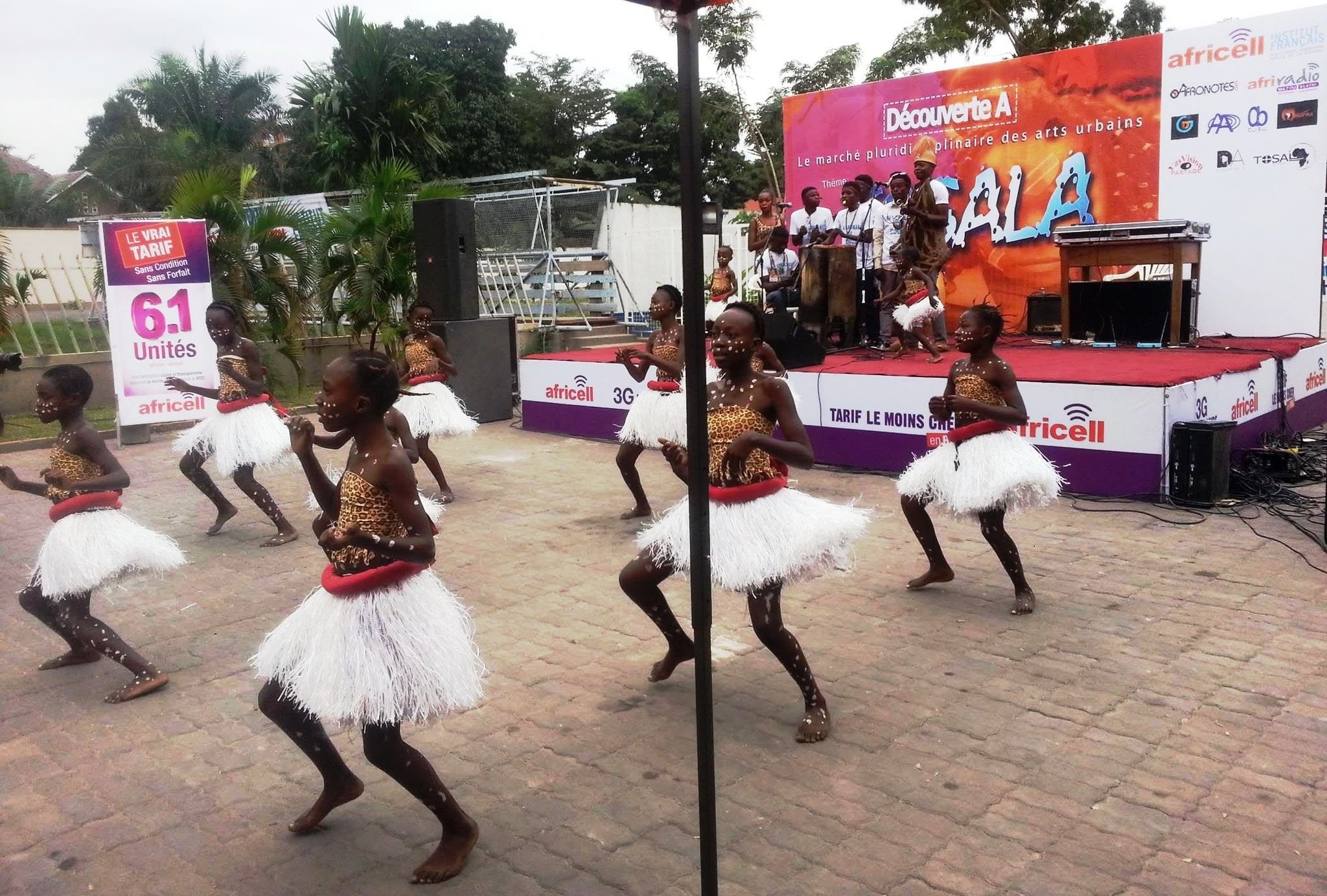
On 26 August 2017, the Institut français de Kinshasa hosted Découverte A, a full day devoted to different forms of artistic creation and performance.
Music.
Dance.
Painting.
Photography.
Sculpture.
Fashion.
Performance.
Comics.
Urban arts.
The programme combined an open stage, exhibition and sales spaces, and a musical programme bringing together artists at different stages of their trajectories.
Ciel Bleu was among the organisations involved in supporting and organising the initiative, alongside cultural and artistic actors including the Tosala collective, the Institut français de Kinshasa and other partners within Kinshasa’s cultural scene.
Taken in isolation, Découverte A might be read as a one-day multidisciplinary festival.
Its significance becomes clearer, however, when attention shifts to the way it operated.
Young creative practitioners were given public space.
Different practices were brought together in one location.
Institutions, collectives and partners contributed to producing visibility for the event.
Emerging artists and others already more widely recognised could appear within the same programme.
The festival therefore raises a broader question:
how does a cultural scene create spaces in which practices that are still relatively invisible can encounter audiences, networks and other actors in the sector?
One day, several spaces of visibility
Découverte A did not rely on a single format.
Part of the programme took place in the outdoor spaces of the Institut français.
Performances occupied the car park.
Creators and exhibitors had spaces in which to present their work.
Other parts of the programme took place in the Grande Halle.
This arrangement allowed several forms of engagement with the public to coexist.
Watching a performance.
Discovering an object.
Looking at an artwork.
Meeting a creator.
Attending a concert.
Moving from one practice to another.
The festival therefore operated less as a sequence of performances than as a temporary space of circulation.
The open stage as a threshold of entry
The open stage played a particular role.
It offered a space of presentation to artists who did not necessarily have the same degree of recognition or access to professional circuits.
This kind of framework temporarily reduces a common difficulty within artistic scenes:
how can someone become visible when they do not yet possess the networks that provide access to spaces of visibility?
An open stage does not solve this question on its own.
It creates a threshold.
A possibility of public appearance.
An opportunity to test a proposal.
To encounter an audience.
To be seen by other actors within the sector.
Visibility is not the same as becoming professional
This distinction is essential.
Participating in a festival does not automatically turn a young artist into a professional.
A public performance guarantees neither a contract, an income nor future programming.
An exhibition does not automatically create a sustainable market.
Découverte A can therefore be understood as a space of visibility and networking, rather than as a professionalisation programme in the strict sense.
It makes certain trajectories perceptible.
It may produce contacts.
It may expand a network.
It may allow work to be seen.
What follows depends on other conditions.
The art market as another form of exposure
The art market organised alongside the performances introduced a different relationship to creative production.
On stage, a practice exists for a limited period of time.
A song.
A dance.
A performance.
On a stand or within an exhibition, an object can remain visible for longer.
The public can stop.
Observe.
Speak with its creator.
Potentially purchase it.
The art market therefore creates another mode of encounter between creation and public.
Artistic visibility is no longer exclusively performative.
It also becomes relational and, in some cases, economic.
Several disciplines within the same framework
One of the most interesting aspects of Découverte A was its multidisciplinary character.
Musicians, visual artists, photographers, performers, dancers, fashion designers and other practitioners could share the same event.
This proximity does not mean that their working conditions were identical.
A musician does not build a career in the same way as a photographer.
A fashion designer does not depend on the same infrastructures as a dancer.
A visual artist does not necessarily encounter the same markets.
But their presence within the same event temporarily made the diversity of a creative scene perceptible.
Making a scene visible
A cultural scene does not become visible simply because artists exist.
There also need to be moments when their coexistence can be perceived.
A festival can perform this function.
It gathers.
Concentrates.
Brings into contact.
What is usually dispersed across workshops, neighbourhoods, schools, collectives or networks appears for several hours within a shared space.
Découverte A therefore made visible not only individual artists, but part of the cultural environment in which they were working.
The Institut français as hosting infrastructure
The choice of the Institut français de Kinshasa matters.
An institutional cultural venue provides particular resources.
Identifiable spaces.
Programming.
An existing audience.
Equipment.
Communication capacity.
Symbolic legitimacy.
Hosting an event devoted to emerging artistic practices in such a venue therefore changes the context.
A practice developed elsewhere in the city temporarily enters an institutional cultural space.
This encounter between emerging practices and established infrastructure is one of the event’s most significant dimensions.
The institution does not produce the scene alone
This configuration should not, however, lead us to attribute the entire dynamic to the host institution.
Découverte A depended on several actors.
Collectives.
Organisers.
Cultural organisations.
Media.
Partners.
Creators.
Artists.
The institutional venue provided important infrastructure.
But the programme existed because several networks converged there.
The cultural scene therefore appears here as the result of cooperation between actors with different roles and statuses.
Ciel Bleu as an actor of mediation
Ciel Bleu participated in this construction.
Its involvement did not consist merely of publishing information after the event.
The organisation was among the actors mobilised around its organisation and visibility.
This position corresponds to a function that several archives from the same period now make increasingly visible.
Connecting actors.
Communicating.
Supporting projects.
Mobilising networks.
Facilitating access to spaces of visibility.
Ciel Bleu was operating within an environment in which cultural action and mediation frequently overlapped.
Organising without producing everything
This experience also shows that a cultural organisation does not need to produce every artwork or activity itself in order to play an important role within an event.
It can contribute by creating relationships.
Facilitating coordination.
Providing communication.
Connecting interlocutors.
Participating in the construction of a collective framework.
This intermediary role is an important part of how cultural ecosystems function.
The collective as an intermediate level
Between the individual artist and the large institution lies another level:
the collective.
Découverte A demonstrates the importance of these intermediate structures.
A collective can identify artists.
Create solidarities.
Develop projects.
Share skills.
Negotiate more easily with institutions.
Give collective visibility to several practices.
Such structures often play an important role in artistic emergence precisely because they can transform individual practices into collective presence.
From talent to infrastructure
The expression “young talent” is frequently used in cultural programming.
It places emphasis on individual qualities.
Talent.
Creativity.
Potential.
Yet an artistic trajectory does not depend on those qualities alone.
It also depends on access to infrastructure.
A rehearsal space.
An exhibition venue.
A stage.
A network.
Someone who transmits information.
An organisation able to organise an event.
A media outlet that documents a practice.
An audience.
Découverte A therefore shifts the question slightly.
It is not enough to ask:
who has talent?
We also need to ask:
which infrastructures allow that talent to become visible?
Visibility as a constructed condition
A photograph of the festival now makes this infrastructure visible in action.
Performers occupy the space.
A stage has been installed.
Technical equipment is present.
The event’s visual identity can be seen.
Partners appear in the background.
The public can circulate around the performances.
The photograph therefore documents more than a choreography.
It shows the material and institutional conditions of its visibility.
That is what gives it value today as a field archive.
The role of media
The event was also conceived as an object of communication.
Its association with the cultural programme “Culture A” and the announced media coverage potentially extended its audience beyond those physically present at the Institut français.
This dimension matters.
A contemporary artistic scene exists both in places and through the media that make it visible.
Television.
Radio.
Press.
Cultural websites.
Photography.
Communication networks.
The media therefore produce a second stage.
A stage of representation.
Seeing the event after the event
This second stage has another temporality.
A performance disappears when it ends.
A photograph can remain.
A video can circulate.
An article can be found many years later.
Communication therefore serves not only to attract an audience before or during an event.
It also produces traces.
It is through these traces that part of Festival Découverte A 2017 can now be reconstructed.
One day is not enough to structure a sector
It is nevertheless important not to ask more of the event than it can deliver.
A one-day festival does not transform an artistic scene by itself.
It does not solve funding problems.
It does not guarantee the continuity of collectives.
It does not automatically create employment.
It does not give every participant a professional trajectory.
Its contribution operates at another scale.
Creating a moment of visibility.
Connecting people.
Bringing several practices together.
Testing a format.
Producing traces.
Potentially opening further possibilities.
Emergence and continuity
The idea of cultural emergence itself contains a difficulty.
We readily speak of “emerging artists”.
But emerging towards what?
Regular programming?
A market?
Critical recognition?
A career?
Economic autonomy?
A professional network?
These dimensions are not the same.
An event such as Découverte A can constitute one stage within a trajectory.
It cannot guarantee its outcome.
This caution allows the value of the framework to be recognised without attributing effects to it that cannot be documented.
A scene composed of different levels of recognition
The festival programme also brought young creative practitioners together with artists already more widely recognised by the public.
This coexistence creates another kind of relationship.
It brings different levels of visibility into the same space.
A young participant may perform at an event where more established artists also appear.
This does not remove the differences between their trajectories.
But it places their practices within the same public cultural space.
From discovery to recognition
The very name “Découverte A” places discovery at the centre of the event.
To discover means that something already existed before it was seen.
The artist is not created by the stage.
A practice does not begin at the moment it becomes public.
The event intervenes at another moment:
when a practice encounters an external gaze.
This distinction matters for understanding cultural visibility.
Making someone visible is not the same as producing their existence.
It changes the conditions under which that existence can be recognised.
An archive of Kinshasa’s cultural ecosystem
Almost a decade later, the day carries a different significance.
In 2017, the task was to promote an event and the artists taking part.
Today, the archive allows us to observe a fragment of Kinshasa’s cultural ecosystem.
An Institut français.
Collectives.
An organisation such as Ciel Bleu.
Media.
Partners.
Artists from several disciplines.
Audiences.
Technical infrastructures.
Mechanisms of visibility.
The significance no longer lies only in the programme.
It lies in the relationships.
A stage in the trajectory of Ciel Bleu
This archive also documents a particular phase in the trajectory of Ciel Bleu.
After experiences in education, training, network building, cultural cooperation and artistic mobility, the organisation appears here within a framework devoted to the visibility of emerging scenes.
The common thread is not a particular artistic sector.
It is relational.
Creating connections.
Facilitating passages.
Producing visibility.
Circulating information.
Bringing actors into contact.
These functions now form one of the threads through which Ciel Bleu’s historical trajectory can be reread without reducing it to a succession of events.
Conclusion
Festival Découverte A allows a cultural scene to be observed through its infrastructures of visibility.
A performance exists because artists create it.
But its public appearance also depends on a venue.
Programming.
Partners.
Technical resources.
Collectives.
People responsible for coordination.
Media capable of extending its visibility.
And an audience willing to encounter what is presented.
The festival did not automatically transform its participants into professionals.
Nor did it resolve the structural fragilities facing emerging artistic practices in Kinshasa.
But it produced something more precise and documentable:
a temporary space in which practices, actors and institutions could become visible to one another.
It is within this relationship between artistic emergence, visibility, intermediaries and networking that Découverte A now finds its place in Kultur Insights.
Editorial note — This article is based on a text by Blaise Puala originally published on Ciel-Bleu.org on 27 August 2017 following Festival Découverte A, held the previous day at the Institut français de Kinshasa. Ciel Bleu was among the organisations involved in supporting and organising the event, in which Blaise Puala was directly involved and which he also documented photographically on site. The present version has been fully reviewed, verified and re-edited for the Kultur Insights library in order to preserve its value as a field archive while refocusing the analysis on the mechanisms of visibility, networking and mediation that contribute to artistic emergence.