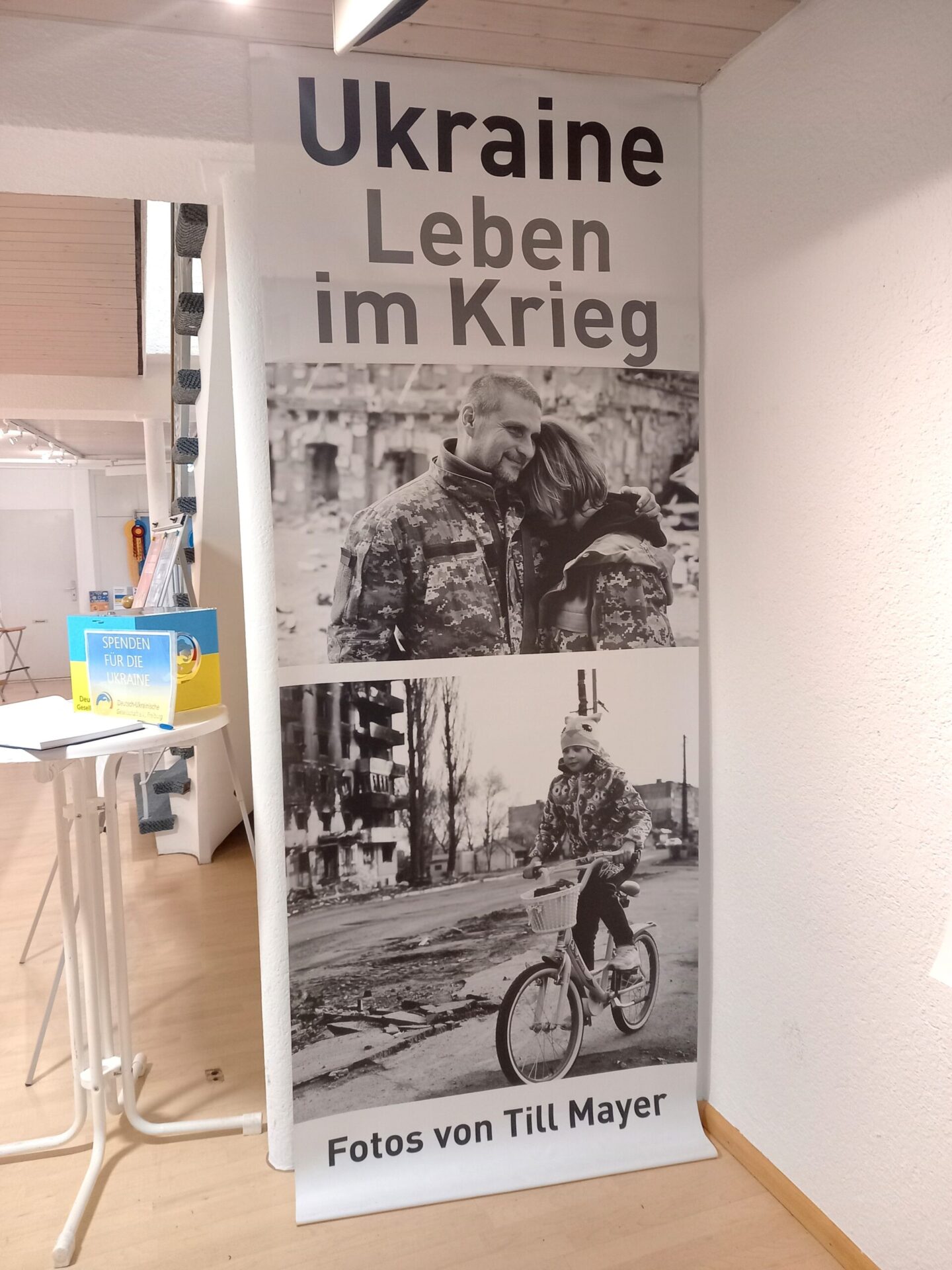
A photograph of war never circulates on its own.
Before reaching an audience, it has been produced in a particular situation, selected from among other images, perhaps accompanied by a story or caption, and placed within a framework that shapes how it is interpreted.
An exhibition adds another stage to this documentary circulation. Images leave the immediate context of reportage and enter a space where they are viewed differently: more slowly, alongside one another, in relation to texts, personal narratives, spatial arrangements and an audience situated at a distance from the conflict.
The exhibition “Ukraine – Leben im Krieg”, presented in December 2023 at the Ukrainian Cultural Centre in Freiburg, provides a particularly revealing case for examining this transition. Built around the work of photojournalist Till Mayer, it brought together photographs and personal accounts of people confronted with the war in Ukraine.
The central question is therefore not only what these images show. It is also: what happens to them when they move from reportage into an exhibition and encounter an audience in another city, another country and another social context?
An exhibition marking the opening of a new space
The exhibition occupied a particular place within Freiburg’s Ukrainian cultural life.
The Ukrainian Cultural Centre at Salzstraße 37 opened on 2 December 2023 and presented “Ukraine – Leben im Krieg” as its first exhibition. It was open to visitors from 3 to 23 December.
This context matters. The photographs were not simply displayed in an established exhibition venue. They accompanied the opening of a new space intended to host cultural activities, encounters and different forms of Ukrainian presence in Freiburg.
The exhibition therefore fulfilled both a documentary and an institutional function. It made the war visible while also helping to shape the first public identity of the place in which it was shown.
Photographing lives shaped by war
Till Mayer has documented the human consequences of conflict for many years and has worked regularly in Ukraine.
In “Ukraine – Leben im Krieg”, photographs were presented alongside personal stories of soldiers and civilians affected by different phases of the war.
This relationship between image and narrative is crucial. A photograph may show a person, a destroyed landscape, a shelter or an everyday situation without necessarily explaining what happened before or after the moment captured.
A narrative can restore elements that the image cannot fully contain: a personal trajectory, a family situation, an experience of displacement, an expectation, a loss or the conditions under which someone continues to live.
The exhibition therefore did not depend solely on the visual force of documentary images. It established a relationship between photography and narrative.
From reportage to exhibition space
This transition also alters the status of the photograph.
In a newspaper or on a digital platform, an image is often embedded within a continuous flow of information. It appears alongside other events, texts and competing demands for attention.
In an exhibition, the experience of time changes. Visitors can stop in front of an image, return to it, read an accompanying text, compare several photographs or move between different stories.
The exhibition therefore slows part of the media flow. It transforms looking into a journey through space.
This shift does not automatically make interpretation deeper or more accurate. It does, however, create different conditions of attention.
Showing war from a distance
Presenting photographs taken in Ukraine to an audience in Freiburg also raises the question of distance.
The conflict represented is taking place elsewhere. The people shown are experiencing situations that visitors may not themselves have lived through.
The image therefore becomes an intermediary between different spaces. It carries a visual trace of one situation towards a geographically distant audience without eliminating that distance.
On the contrary, this circulation can make the separation between the photographed event and its reception more apparent.
An exhibition does not allow visitors to “experience” war by proxy. It provides access to documentary fragments that must be interpreted while acknowledging this distance.
This distinction is essential if visual proximity is not to be confused with shared experience.
The role of the exhibition venue
The meaning of a photograph also depends on where it is shown.
Presented at the Ukrainian Cultural Centre in Freiburg, Till Mayer’s images entered a space associated with a community directly affected by the war, yet located in Germany.
This changed their context of reception.
For some visitors, the photographs may have evoked places of origin, relatives or personal experiences. For others, they offered access to realities primarily encountered through media coverage.
The same exhibition could therefore bring together very different perspectives.
This diversity reminds us that an exhibition audience is never homogeneous. An image does not produce the same response in everyone who sees it; its reception is also shaped by individual experiences and life trajectories.
Photography and testimony
Documentary photography has a particular relationship to testimony.
It shows that a person, place or situation stood before the camera at the moment the image was made. This gives photography considerable documentary force, but it does not turn the image into a complete explanation.
A frame selects part of reality, a moment is isolated and other elements remain outside the picture.
Photography therefore bears witness while remaining partial.
An exhibition can make this limitation more apparent when photographs are accompanied by names, texts, personal stories or other contextual material.
The task then becomes not only to show, but to help audiences understand what they are looking at and what cannot be inferred from the image alone.
Between document, memory and narrative
An exhibition devoted to a contemporary war occupies a particular temporal position. It presents events that are still unfolding while already producing forms of memory.
The photographs document the present. At the same time, their selection, preservation and public presentation begin to influence what will remain visible from this period.
Document and memory are therefore not completely separate. One can gradually become the other.
A photograph produced as a journalistic document may later be shown in an exhibition, reused in a publication, archived or incorporated into historical narratives.
Its meaning evolves through the contexts in which it circulates.
Mediation does not make images neutral
To speak of mediation does not mean that an exhibition makes photographs neutral.
No exhibition is simply a collection of images placed in a room. Photographs must be selected and arranged in a particular order. Formats are chosen, texts are associated with specific images, and decisions are made about what will be shown and what will remain absent.
These decisions create a framework for interpretation.
They do not diminish the documentary value of the photographs. They simply remind us that visibility is organised.
To view a war through an exhibition is always to encounter it through a constructed framework.
Translating without claiming completeness
The idea of translation can be useful here, provided it is not understood only in linguistic terms.
An exhibition translates a reality by moving it from one context into another. Experiences lived in Ukraine are transformed into photographs and narratives. These documents are then presented in Freiburg, enter a cultural space and encounter different audiences.
At every stage, something circulates and something changes.
Yet translation is never a complete reproduction of its subject.
The exhibition does not contain “the war in Ukraine”. It arranges fragments from which an audience may construct a partial understanding.
This interpretive restraint matters. It allows the documentary power of the images to be recognised without denying their limits.
The risk of aestheticisation
Every photographic representation of war raises a difficult question: that of aesthetics.
A photograph can be visually powerful while documenting destruction, loss or violence.
Its formal qualities may attract attention, but they can also create tension between aesthetic appreciation and the reality represented.
There is no simple solution to this problem. Avoiding all visual composition would not automatically make an image more truthful or ethically appropriate. Conversely, a particularly spectacular image can turn suffering into an object of visual consumption.
Mediation therefore also involves keeping this tension visible.
The image must remain open to observation without allowing the situation it documents to disappear behind its form.
The exhibition as a space of encounter
Showing work in a cultural centre introduces another dimension.
Visitors do not encounter images alone. They enter a place where they may meet other people and engage in conversation.
A presentation or an exchange with the photographer can also provide additional context.
At the opening of the Ukrainian Cultural Centre, Till Mayer presented his work in a photographic talk followed by a discussion with the audience.
The exhibition therefore becomes more than a visual arrangement. It becomes a situation of mediation in which photography, oral narrative, questions from visitors and collective presence can interact.
What the exhibition makes visible — and what remains outside the frame
Every exhibition is necessarily fragmentary.
It cannot represent an entire war or account for every individual trajectory, territory and experience.
This limitation must be part of the analysis.
Selecting particular stories gives visibility to some experiences while leaving others outside the frame.
The task is therefore not to demand that an exhibition show everything. It is to understand which part of the conflict it makes visible, through which methods and with what forms of contextualisation.
At this level, the exhibition becomes a cultural object in its own right.
From image to public memory
When photographs of war circulate beyond their original context, they can gradually contribute to a public memory of the conflict.
That memory is not yet settled. It is being constructed while events continue to unfold.
Some images are preserved, while others disappear. Some become emblematic of the conflict; others remain connected to individual stories that are less widely known.
Exhibitions participate in this process of selection and transmission. They make certain traces accessible to audiences and place them within new contexts.
Memory therefore appears less as a fixed body of content than as a process of circulation, selection and reinterpretation.
Conclusion
“Ukraine – Leben im Krieg” allows us to observe what happens when photojournalistic work about a conflict enters a cultural space.
The images retain their documentary function, but their context, temporality and audience also change. They are accompanied by narratives, arranged into an exhibition sequence and encountered by visitors who are geographically distant from the events photographed.
In Freiburg, this transition acquired an additional dimension: the exhibition accompanied the opening of a Ukrainian Cultural Centre, making the venue itself a new space of circulation between Ukrainian experiences and local public life.
The significance of the exhibition therefore lies not only in what it shows of the war. It also lies in the conditions it creates for looking at, contextualising and transmitting its traces.
Analysing such an exhibition framework means asking several questions:
Who produces the images? Who selects them? Where are they shown? Which narratives accompany them? And what happens to their meaning when they move from a context of war into a cultural space elsewhere?
These forms of mediation transform a series of documentary photographs into a space in which public memory is being constructed.
Editorial note — This article is based on a text by Blaise Puala originally published on Ciel-Bleu.org on 14 December 2023 in the context of the exhibition “Ukraine – Leben im Krieg” at the Ukrainian Cultural Centre in Freiburg. It has been revised, verified and re-edited for the Kultur Insights library in order to preserve its documentary value while placing it within the current editorial framework of Ciel Bleu Kultur.