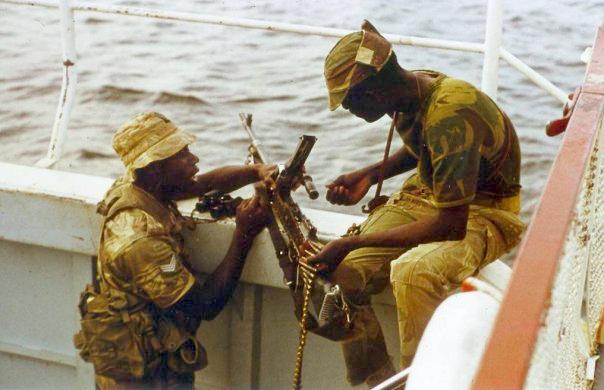
A war does not survive only in archives, dates or historical accounts. It also continues to exist through the stories societies choose to tell about it.
Novels, memoirs, testimonies, films and family narratives all contribute to shaping representations of the past. Yet such representations are never exhaustive: they adopt a point of view, select particular experiences and give greater visibility to certain actors.
Through Vincent Tellier’s novel Le Chant des Collines, which is set against the Rhodesian War, this question becomes particularly visible.
The novel places at the centre of its narrative a character from Rhodesia’s white population who becomes involved in the conflict. This narrative choice does not, in itself, determine the meaning of the work, but it raises a fundamental question wherever literature encounters history: from what position is a war narrated, and what does that position make visible — or less visible?
One war, several ways of naming it
The conflict that shaped Rhodesia from the 1960s to the end of the 1970s does not have a single name.
“Bush War”, “Rhodesian Bush War”, Zimbabwean War of Liberation and “Second Chimurenga” belong to different historiographical and memorial traditions.
These terms are more than linguistic variants.
Naming a war already places it within a particular framework of interpretation.
“Bush War” may foreground the military experience of the conflict. “War of Liberation”, by contrast, places greater emphasis on the struggle against white minority rule and on the process that eventually led to Zimbabwean independence.
This plurality of terms reminds us that the same historical event may be incorporated into several memories that do not assign the same central actors, temporalities or meanings to the conflict.
Point of view as narrative construction
Le Chant des Collines approaches the conflict through an individual trajectory.
This is a common device in historical fiction: a collective event becomes accessible through a character with whom the reader can gradually develop a relationship.
Such proximity carries considerable narrative force.
It can embody the effects of war, give continuity to complex events and introduce the reader to a historical world through an individual experience.
At the same time, it necessarily involves selection.
Following one character means seeing some events from that character’s position, gaining access to particular fears and sharing particular perceptions of the world.
Other experiences inevitably remain outside the main frame.
Point of view is therefore never merely a literary technique. In historical narrative, it also contributes to determining what becomes memorable.
What a narrative makes visible — and what it leaves outside the frame
This question is particularly important in the Rhodesian context.
The conflict involved profoundly different populations and experiences: soldiers in the Rhodesian forces, nationalist movements, rural populations, African combatants, white and Black families, international actors and displaced communities.
No novel can represent all these experiences simultaneously.
The critical question is therefore not whether a work tells the “whole” war.
It is rather to identify the position from which its narrative is constructed.
This distinction makes it possible to read a literary work without expecting it to perform the role of an academic history, while remaining attentive to the representations it produces.
What literature places in the foreground acquires presence. What it leaves at the margins may remain less visible to the reader.
Rhodesian memory as a field of competing narratives
The Rhodesian War generated numerous narratives after the conflict ended.
Former soldiers, nationalist combatants, political actors, historians and writers have all contributed to memories that may diverge sharply from one another.
These narratives are not only sources through which the past can be reconstructed.
They also reveal how different groups have sought to interpret their own place within that past.
Accounts produced by former Rhodesian soldiers may describe the war from within a military and social world that disappeared with the country’s political transformation.
Narratives connected to the liberation struggle may, by contrast, situate the conflict within a history of resistance to minority rule and national emancipation.
Across these different spaces of memory, the same events can acquire very different meanings.
Literature and history: distinct functions
Recognising this plurality also helps avoid asking literature to perform a task it does not necessarily claim.
A historical novel is not a work of academic history.
Historians compare archives, testimonies and different sources in order to construct an argued interpretation of the past.
Novelists build characters, organise a narrative and create a reading experience.
These functions are not interchangeable.
Fiction can nevertheless participate in historical memory because it gives a sensorial and narrative form to periods many readers may never encounter otherwise.
It can generate curiosity, create lasting images or influence the perception of an event.
It is precisely this capacity that justifies a critical reading of historical fiction: not in order to reproach it for being fiction, but to understand the representations of the past that it helps circulate.
Representing a colonial war
This attention becomes particularly important when a narrative concerns a war linked to decolonisation.
In such contexts, the positions occupied by characters are not merely individual. They are also embedded in political, racialised and institutional structures.
Narrating the experience of a white Rhodesian soldier provides access to one particular experience of the war.
But that experience took place within a political system built around the preservation of white minority rule, against which African nationalist movements mobilised, among other demands, for majority government.
Taking this dimension into account does not mean reducing a character to political or racial identity.
It means placing the character’s trajectory within the historical structures that give meaning to the choices, fears and conflicts represented.
Contextualisation therefore does not diminish literature.
It allows us to understand more clearly what a particular point of view produces.
Who can tell a war?
The question “who tells?” does not necessarily lead to deciding who has or does not have the right to write about a conflict.
An author may write about a history they did not personally witness.
But every narrative occupies a position.
The relevant questions then become: what sources were used? Which characters occupy the centre of the story? Which actors remain peripheral? What terms are used to describe the different forces involved? And what representations of the conflict are made possible by these choices?
Such questions move beyond a simplistic opposition between legitimate and illegitimate narratives.
They shift attention towards the construction of representation itself.
Reading absences as well
A critical reading of war literature therefore examines not only what is narrated, but also what is absent.
An absence is not necessarily a flaw.
Every narrative requires selection.
But absences become significant when they recur across multiple works and contribute to making some experiences much more visible than others within collective memory.
The question of representation then meets the question of cultural circulation.
Books that are published, translated, distributed, reviewed or recommended contribute more strongly to shared imaginaries than those that remain difficult to access.
The memory of a war therefore also depends on the infrastructures that allow certain narratives to circulate.
Conclusion
Le Chant des Collines provides an entry point into a question that extends beyond the novel itself: the relationship between literature, memory and narrative position in the representation of historical conflict.
A war can be narrated from several positions.
These narratives may complement one another, contradict one another or produce memories that are difficult to reconcile.
The task is therefore not to search for a single narrative capable of containing every experience, but to recognise the position from which each story is constructed.
In the case of the Rhodesian War, this attention is essential.
It allows literature to be read not only as a way of approaching the past, but also as a space in which memories, visibilities and interpretations of that past continue to be negotiated.
Editorial note — This article is based on a text originally published on Ciel-Bleu.org. It has been revised, verified and re-edited for the Kultur Insights library in order to preserve its documentary value while placing it within the current editorial framework of Ciel Bleu Kultur.