An election does not take place only inside the polling booth.
Before votes are cast, a range of mechanisms must enable citizens to know that an election is taking place, understand when and how they can participate, identify the applicable rules and access the information they need.
Posters, institutional websites, audiovisual campaigns, social media, brochures, signage and civic networks all contribute to this communication infrastructure.
The European elections of June 2024 provide a particularly useful setting for examining this dimension.
Across the European Union, electoral participation had to be made understandable within different national, linguistic and institutional contexts.
The question is therefore not only: how can citizens be encouraged to vote?
It is also: how can the very possibility of participation be made visible, understandable and accessible within a multilingual political space?
Before the vote: making the election perceptible
Voting itself is a punctual act.
The communication preceding it unfolds over several weeks or months.
For an election to enter public awareness, its presence has to be produced.
A date must circulate.
Rules must be explained.
Communication materials must be designed.
Messages must appear in spaces where citizens are likely to encounter them.
This preliminary phase may appear external to democracy itself.
In practice, however, it forms part of the conditions that make participation possible.
An opportunity to participate that remains difficult to identify, understand or locate in time is not as accessible as one that has been clearly communicated.
Electoral visibility does not replace the right to vote.
It helps make the exercise of that right perceptible.
Institutional communication as infrastructure
Ahead of the 2024 European elections, European institutions deployed different information and communication measures designed to raise awareness of the elections and encourage participation.
These included audiovisual communication, digital campaigns, partnerships, community engagement initiatives and practical information about voting procedures.
It is useful to understand these measures not simply as communication campaigns, but as an infrastructure.
Infrastructure creates conditions.
In this case, it enables electoral information to circulate between institutions, media, organisations, platforms and citizens.
It connects spaces that do not necessarily operate according to the same logic.
An institutional website does not reach audiences in the same way as a poster.
A video does not create the same relationship as an explanatory brochure.
A civic network does not circulate information in the same way as a digital platform.
Electoral visibility therefore emerges through the combination of several forms of mediation.
Informing is not the same as partisan persuasion
An important distinction must be maintained.
Institutional communication about electoral participation should not be confused with partisan campaigning.
A political party or candidate seeks to persuade voters to support a particular political position.
An institutional participation campaign is, in principle, intended to provide information about the election or encourage citizens to exercise their right to vote without telling them which political choice to make.
This distinction matters analytically.
It shows that political visibility is not produced only by parties, candidates or electoral campaigns.
Public and electoral institutions also construct an information environment around the vote.
Democratic participation therefore has a non-partisan communication infrastructure of its own.
Translation as a practical condition of participation
This infrastructure becomes particularly visible within a multilingual space.
The European Union does not have a single linguistic public.
Citizens receive, read and interpret information through different languages.
Translation therefore becomes a practical component of access to electoral information.
It is not simply a matter of replacing words in one language with words in another.
Explanations also need to be adapted to different institutional contexts.
Voting procedures can differ between countries.
Election dates can vary.
Administrative conditions are not necessarily identical.
European communication must therefore connect a shared political framework with specific national situations.
Electoral translation is both linguistic and contextual.
One election, multiple national contexts
The European elections provide a particularly clear illustration of the tension between unity and plurality.
Citizens elect members of the same European institution.
Yet the practical organisation of voting remains largely embedded within national systems.
Information for voters must therefore explain both the European nature of the election and the rules that apply in the country in which the vote is being cast.
This is especially significant for EU citizens living in another Member State.
Their situation demonstrates that place of residence, nationality and the administrative conditions of electoral participation do not always overlap neatly.
Access to precise information therefore becomes an important component of the effective exercise of electoral rights.
European mobility creates new information needs
Mobility within the European Union makes this issue even more visible.
People live, work or study in Member States other than those of which they are nationals.
European elections must therefore be understandable to publics that do not fit the simple model of a citizen living in their country of origin and receiving all electoral information in a single national language.
This reality changes communication needs.
Procedures have to be explained.
Information has to be accessible.
Registration requirements may need clarification.
Voting options must be made understandable.
The circulation of people therefore creates a parallel necessity: civic information must also be able to circulate effectively.
#DemokratieVereint: making civic engagement visible in Freiburg
In Freiburg, the relationship between civic participation, communication and public space took a particularly concrete form in spring 2024.
Within a broader local mobilisation around democratic participation, #DemokratieVereint developed different forms of action combining encounter, civic engagement and public communication.
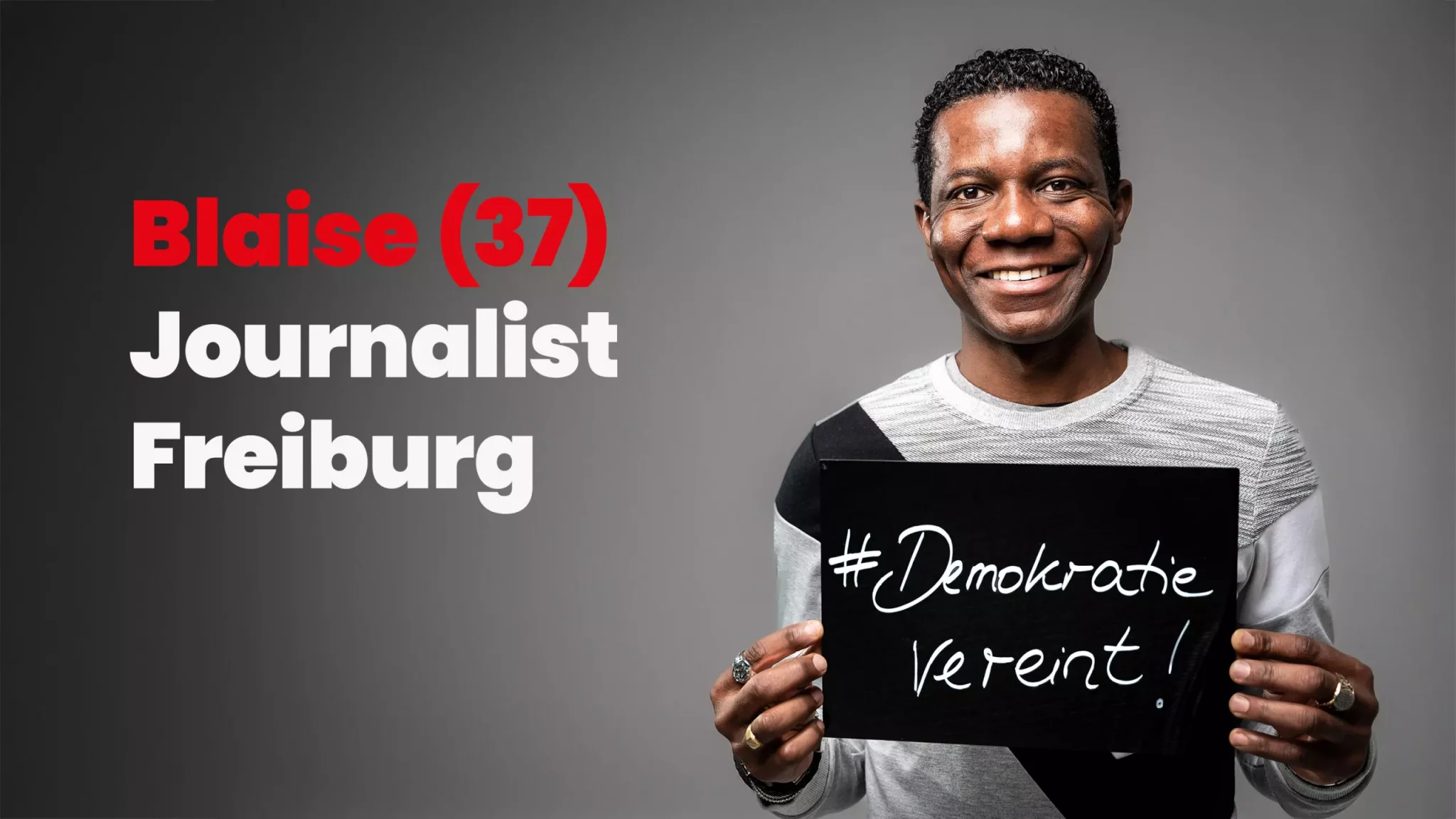
One of these was a photographic initiative involving Freiburg photographer Peter Herrmann, in cooperation with VAG Freiburg and the City of Freiburg.
Residents volunteered to lend their faces to the initiative.
The resulting portraits were subsequently displayed, among other places, in trams and buses across Freiburg’s public transport network.
The author of this article took part in the initiative.
This provides a concrete example of what it means to make a democratic value visible within everyday space.
Civic communication was no longer confined to an election poster or an institutional website.
It entered the public transport system used every day by local residents, associating individual faces with a visible public commitment to democratic values.
The city and its transport infrastructure temporarily became media of civic mediation.
This case also demonstrates that democratic visibility is not produced only by institutions or political parties.
Civil society initiatives can create forms of public presence by combining photography, personal testimony, urban mobility and the circulation of images.
Public space no longer ends in the street
The concept of public space also needs to be broadened.
A poster displayed in a city is a traditional form of electoral presence.
Contemporary campaigns, however, circulate simultaneously through other environments.
Social networks.
Institutional websites.
Apps.
Video platforms.
Media.
Digital screens.
Civic and community spaces.
The environment in which an election becomes visible is therefore both physical and digital.
These spaces are not interchangeable.
A poster can be encountered without prior searching.
A website generally requires more active information seeking.
A video distributed through a platform is shaped by technical systems of circulation.
A message relayed by an association operates through a different relationship of trust.
Contemporary civic communication therefore combines several regimes of visibility.
Seeing a campaign does not mean understanding an election
This distinction matters.
Visibility does not automatically guarantee information.
A message may be highly visible while conveying very little practical content.
Conversely, legally precise information may remain difficult to find or understand.
The effectiveness of civic communication cannot therefore be assessed only through exposure.
Its legibility also matters.
Is the message understandable?
Does it make the expected action clear?
Does it lead to additional information?
Is it available in a language accessible to the intended public?
These questions shift the analysis from visibility alone towards informational accessibility.
Competition for attention
Electoral communication also circulates through already saturated environments.
A political or electoral poster appears alongside advertising, commercial signage, cultural announcements and many other visual demands.
On digital platforms, institutional information sits alongside news, entertainment, commercial content, political commentary and personal communication.
Civic participation therefore also enters a broader economy of attention.
This does not mean that democracy becomes an advertising product.
It means that democratic information also needs to remain identifiable in environments where many forms of content compete simultaneously for attention.
Graphic and editorial clarity therefore become particularly important.
Images also produce representations of democracy
Every institutional or civic campaign also involves representation.
Choices of images, slogans, colours, people and situations contribute to producing a particular image of democracy.
Is democracy represented primarily as a right?
As a responsibility?
As an inheritance?
As a collective practice?
As an individual choice?
Communication campaigns therefore do more than announce that an election exists.
They also give participation a visual and narrative form.
This deserves analysis without confusing representations of democracy with democratic reality itself.
A representation of participation remains a representation.
Civic actors broaden circulation
Communication does not come only from institutions.
Associations, civil society organisations, media, businesses, professional networks and local communities can also relay information or develop their own initiatives around an election.
This plurality expands the routes through which information can reach different publics.
It also creates multiple levels of mediation.
An institutional message may be taken up by an organisation.
Translated.
Reformulated.
Contextualised.
Adapted for a specific network.
The circulation of civic information thus becomes a distributed process.
Participation cannot be reduced to visibility
An important limit nevertheless remains.
A visible campaign does not automatically produce participation.
A poster does not guarantee that someone will vote.
Translation does not remove every obstacle to exercising a political right.
A digital campaign alone cannot demonstrate that citizens feel represented or politically engaged.
The factors shaping electoral participation are multiple.
Communication is only one of them.
The analytical value of these mechanisms therefore lies less in any assumption of automatic effect than in the conditions of access they seek to create.
From visibility to accessibility
This distinction helps clarify the role of civic and institutional communication.
Its purpose should not simply be to make an election visible.
It should make participation sufficiently intelligible for citizens to understand the choices and procedures available to them.
Visibility is one level.
Accessibility is another.
Accessibility requires information to be findable, readable and understandable.
Translation, editorial clarity, adaptation across different media and explanation of procedures therefore become components of democratic mediation.
Public space as an infrastructure of mediation
The 2024 European elections provide an opportunity to understand public space not only as a site of political contestation, but also as an infrastructure of mediation.
Messages circulate through it.
Rights are explained.
Procedures become perceptible.
Different actors intervene.
Multiple languages coexist.
This infrastructure remains imperfect and unevenly accessible.
Yet it reminds us that democratic participation also depends on material and communicative conditions.
Before citizens can exercise a political choice, they must at least be able to identify that a choice is available to them and understand how it can be exercised.
Conclusion
The 2024 European elections show that electoral participation does not begin only when a ballot is placed in a box.
It is preceded by a communication infrastructure.
Dates, procedures, campaigns, translations, websites, posters and civic networks all contribute to making an election perceptible across different spaces.
This visibility guarantees neither participation nor the quality of democratic debate.
It nevertheless represents an important condition of access to information.
Within a European space shaped by mobility, linguistic plurality and the coexistence of different national systems, this mediating function becomes particularly significant.
The experience of #DemokratieVereint in Freiburg also demonstrates how local this mediation can become: citizens lend their faces to an initiative, their portraits circulate through public transport, and urban space temporarily becomes a medium of civic presence.
The analysis can therefore move beyond the broad idea of a “visible democracy” and ask more precise questions:
Who receives the information? In which language? Through which medium? In what context? And with what degree of accessibility?
These concrete conditions help us understand how electoral participation and civic engagement acquire a presence within contemporary public space.
Editorial note — This article is based on a text by Blaise Puala originally published on Ciel-Bleu.org on 7 June 2024 in the context of the European elections. It also draws on the author’s participation in an initiative connected with the Freiburg civic campaign #DemokratieVereint, whose portraits were displayed, among other places, across the VAG public transport network. The text has been revised, verified and re-edited for the Kultur Insights library in order to preserve its documentary value while placing it within the current editorial framework of Ciel Bleu Kultur.