Within international mobility trajectories, an important part of social life develops outside classrooms, administrative offices and official support programmes.
A shared meal.
A gathering among compatriots.
Sport.
A regular meeting.
Such apparently ordinary practices can become spaces in which information, advice, relationships and forms of mutual support circulate.
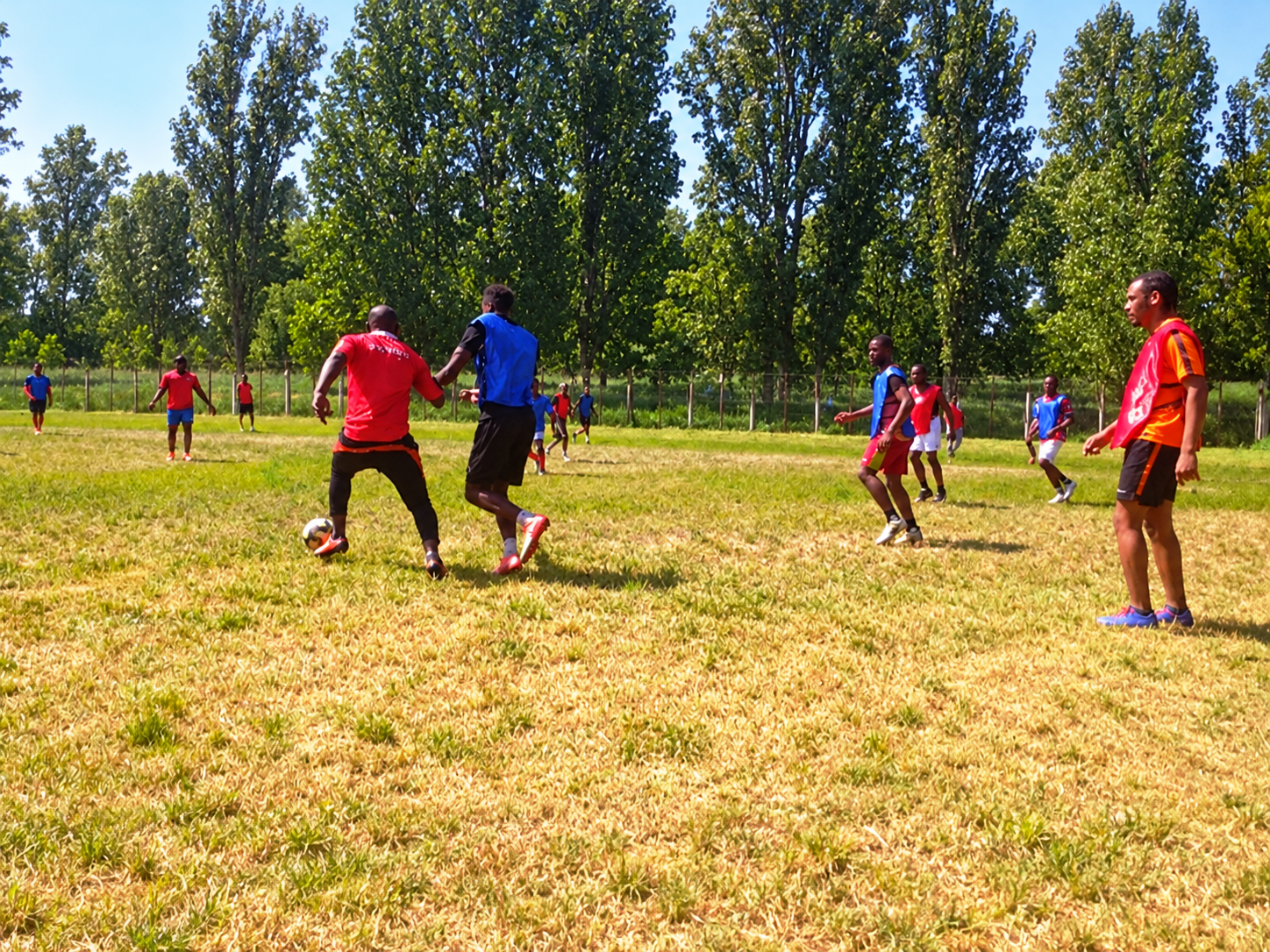
In Kyiv in 2020, these processes could be observed through football gatherings organised particularly around members of the Cameroonian community.
The field was not simply a place to play.
It brought together people who had already lived in the city for several years, newcomers and, depending on the gathering, participants connected to other African networks.
This sporting practice raises a broader question:
how do people in mobility create their own spaces of sociability when the infrastructures they need are not necessarily institutional?
Football as a meeting point
The match first provides a reason to gather.
Some people come to play.
Others watch.
Teams are formed.
Some participants already know one another.
Others meet on the field.
But further interactions develop around the game.
Conversations before kick-off.
During breaks.
After the match.
They do not necessarily concern football.
Studies.
Housing.
Everyday life.
Administrative procedures.
Social relationships.
News.
Information about Kyiv.
The football field gradually becomes a regular point of reference to which several social functions can become attached.
Arriving in a city that others already know
For newly arrived international students, settling in Kyiv meant having to understand several environments simultaneously.
The university.
The city.
Public transport.
Administrative processes.
Housing.
Languages.
Social relations.
Institutions provide some of the necessary information.
But they do not necessarily answer every question that emerges in everyday life.
This is where the experience of people who have already lived in the city becomes valuable.
Someone knows where to complete a procedure.
Another person understands how a process works.
Someone can recommend an area, explain a route or warn about a difficulty.
Such knowledge rarely appears in an official welcome handbook.
It circulates through relationships.
“Old” and “new”
Within the context observed, the informal terms “old” and “new” distinguished different stages of the mobility experience.
They did not describe an institutional hierarchy.
An “old” participant was primarily someone who had already accumulated practical knowledge of the local environment.
A “new” participant was still in an earlier phase of discovery.
But these positions changed over time.
One year’s newcomer could later become the person from whom others sought advice.
Mobility therefore produces positions that evolve.
Accumulated experience becomes a resource that can be transmitted.
Transmission through conversation
This transmission is rarely organised as formal teaching.
It occurs through ordinary conversation.
One question leads to another.
A personal experience becomes advice.
A previous mistake allows someone else to be warned.
Information is passed on, corrected or supplemented by other participants.
Football simply creates the conditions for these encounters.
The game does not need to have been explicitly designed as an integration or support mechanism in order to produce social effects.
A Cameroonian space that is not entirely closed
The gatherings observed were strongly connected to the Cameroonian community in Kyiv.
This precision matters.
It would be excessive to treat them as a direct representation of all African communities in the city.
But the space was not necessarily closed around a single national belonging.
Participants connected to other African contexts could also take part.
For example, one of the matches was refereed by a Congolese participant.
The field therefore allowed different networks to intersect temporarily.
National affiliations remain present
This openness does not mean that national affiliations disappear.
Communities organised around a country of origin maintain their own relationships, references and forms of mutual support.
These can be particularly important during the first stages of settlement.
Speaking a shared language.
Recognising familiar references.
Having comparable migration experiences.
Sharing contacts.
Such forms of proximity can facilitate certain relationships.
But they can also connect to broader networks.
When networks intersect
A Cameroonian student may know a Congolese student.
That person may be connected to other French-speaking students.
Players may invite friends.
Sport therefore creates intersections between networks that might otherwise remain more separate.
These relationships do not necessarily constitute a homogeneous “African community”.
It is more accurate to speak of intersecting networks.
This distinction avoids reducing the diversity of African experiences in Kyiv to a single identity.
Sociability built through repetition
Regularity matters greatly.
A single meeting produces a moment.
Repeated meetings produce habits.
Participants know where they can meet others again.
Faces become familiar.
New people are introduced.
Information circulates more easily.
Relationships continue beyond the field.
Repetition gradually turns an ordinary activity into a point of reference.
This is how an everyday practice can become a small social infrastructure.
An infrastructure without a building
The word “infrastructure” usually evokes buildings, equipment or technical systems.
But some infrastructures are relational.
They depend on a group’s ability to maintain connections regularly enough for certain things to become possible.
Finding help.
Obtaining information.
Meeting someone.
Introducing a newcomer.
Organising another activity.
Sharing a meal.
From this perspective, the football field is only a support.
The real infrastructure consists of the relationships reproduced there.
Sport as a social pretext
This function is not, of course, unique to football.
Many collective practices can play similar roles.
Cooking.
Music.
Religion.
Associations.
Celebrations.
Cultural events.
Football nevertheless has several characteristics that facilitate encounter.
The rules are widely understood.
Relatively little equipment is required.
The game immediately creates a shared activity.
People can participate without first having to build a long conversation.
For individuals coming from different trajectories, this accessibility may be particularly useful.
Participating before knowing one another well
Sport also allows a particular form of socialisation.
Participants do not have to know one another closely before entering the field.
The game temporarily provides roles.
Player.
Goalkeeper.
Referee.
Teammate.
Opponent.
These positions make immediate interaction possible.
Social relationships can then develop around the shared activity.
From the match to the meal
The gatherings did not necessarily end when the football stopped.
Meals, conversations and other collective moments could develop around the game.
This extension is significant.
It shows how a specific practice can become the centre of a broader set of relationships.
Sport produces the meeting.
The meeting produces shared time.
Shared time allows other interactions to emerge.
What institutions cannot produce alone
Universities can organise orientation days.
Administrations can provide information.
Associations can develop support programmes.
These mechanisms matter.
But no institution can organise the entire social life of a newly arrived person.
Part of settlement necessarily depends on more informal relationships.
Friends.
Compatriots.
Fellow students.
Acquaintances.
People met through other people.
The football observed in Kyiv belonged to this second level of reception and support.
Mutual support should not be romanticised
Diasporic networks should nevertheless not be represented as automatically harmonious spaces.
A community may also contain tensions.
Generational differences.
Disagreements.
Hierarchies.
Exclusions.
Unequal relationships.
The fact that a network may support some newcomers does not mean that it meets every need or is experienced in the same way by everyone.
This caution is necessary to avoid romanticising diasporic solidarity.
The field as a space of observation
Football offers a particularly useful entry point for documenting these relationships.
What happens around the match becomes as important as the game itself.
Who arrives with whom?
Who knows the newcomers?
Who explains things?
Who organises?
Who remains after the game?
What other meetings are arranged?
These small interactions reveal mechanisms that university statistics on foreign students cannot show.
A photograph from the field
The photograph associated with this article belongs directly to this experience.
It was taken during one of these football gatherings in Kyiv.
It is therefore not a generic illustration added retrospectively.
It documents the practice from which the analysis begins.
Originally published on Ciel-Bleu.org with a graphic website signature incorporated into the image, it has since been restored to recover a presentation closer to the original photograph.
This continuity between photograph and observation strengthens its value as a field archive.
Photographing the ordinary
The documentary value of the image also lies in its ordinary character.
It is not an official ceremony.
Not a spectacular event.
Not an institutionally staged photograph.
These are precisely the kinds of scenes that are rarely preserved when international student mobility is documented.
Archives tend to retain enrolments, diplomas, conferences and official events.
Everyday life leaves fewer traces.
Yet it forms an essential part of the experience.
Sociability embedded in a city
These gatherings took place in Kyiv.
The city is therefore more than geographical background.
It is the environment in which these diasporic networks took form.
People in mobility develop habits around available spaces.
A football field.
An apartment.
A restaurant.
A church.
A university.
A park.
Through repetition, certain places acquire particular social functions.
A Kyiv before 2022
Seen from the present, these scenes also belong to a specific historical context.
They document a period before Russia’s full-scale invasion of Ukraine in 2022, which profoundly transformed the conditions of study, mobility and international presence in the country.
Yet earlier scenes should not be interpreted solely through the war that followed.
In June 2020, this gathering was first and foremost an ordinary scene of social life.
People met.
Played football.
Exchanged information.
Built relationships in the city where they were then living.
It is precisely this normality that gives the scene additional documentary value today.
When networks have to reconfigure
Political contexts can rapidly transform spaces of sociability.
People leave.
Studies are interrupted.
Cities change.
Networks disperse across other countries.
Some relationships continue at a distance.
Others disappear.
Informal infrastructure is therefore never guaranteed.
It depends on the people present and on the conditions that allow them to continue meeting.
Documenting discreet infrastructures of mobility
The Kyiv experience ultimately encourages a broader understanding of mobility infrastructure.
A university is one form of infrastructure.
A transport network is another.
An administrative service too.
But some essential forms of support have neither a dedicated building nor a formal legal existence.
They are made of relationships.
Meetings.
Knowledge passed on.
Availability.
Habits.
The football gatherings observed in Kyiv belonged to this category.
Conclusion
An informal football match cannot, of course, represent the full experience of African communities or international students in Kyiv.
But it allows us to observe something that institutions document less easily.
How people in mobility create their own spaces of relationship.
How the experience accumulated by those who arrived earlier can circulate towards newcomers.
How a nationally organised community can remain identifiable while also entering into occasional relationships with other networks.
How a sporting meeting can gradually support conversation, mutual assistance and social continuity.
Football is therefore not primarily interesting here as competition.
It is a device for encounter.
The field becomes a place where trajectories intersect and where part of the learning involved in mobility takes place among peers.
Documenting these scenes complements the institutional history of student mobility with another, quieter history: that of the ordinary relationships through which people gradually learn to live within a new environment.
Editorial note — This article is based on a text by Blaise Puala originally published on Ciel-Bleu.org on 9 June 2020 from an experience directly observed and photographed in Kyiv. The text has been fully reviewed, revised and re-edited for the Kultur Insights library in order to preserve its value as a field archive while sharpening the analysis of the relationships between sporting practice, diasporic sociability, mutual support and informal networks within a context of student mobility.