A neighbourhood does not become a community the moment its buildings are completed.
It takes time for places to acquire meaning, for routines to form, for certain streets to become familiar and for individual experiences to begin contributing to a shared memory.
In Rieselfeld, a Freiburg district developed from the 1990s onwards, this process has a particular quality: some of the people who experienced and helped shape the neighbourhood’s early years are still able to tell that story themselves.
Against this background, K.I.O.S.K. im Rieselfeld e.V. launched the audio series “Wir sind Rieselfeld” in 2021 to mark its 25th anniversary.
Long-standing and more recently arrived residents speak about their relationship to the district, their everyday lives, their perceptions and the changes they have observed over time.
These conversations raise a broader question:
how does a relatively young neighbourhood begin to produce its own memory?
A neighbourhood and its social infrastructure growing together
Rieselfeld’s history is distinctive because its urban development can be dated relatively precisely.
Following the urban-planning competition of 1992 and the beginning of development works, the first homes were occupied in 1996.
That same year also saw the first activities of K.I.O.S.K. in the district.
Its name expressed its initial programme:
Kontakt.
Information.
Organisation.
Selbsthilfe.
Kultur.
Contact, information, organisation, self-help and culture.
K.I.O.S.K. was therefore not a cultural or social structure introduced into an already established neighbourhood.
Its history began at the same time as the district itself began to be inhabited.
That simultaneity matters.
It suggests that the construction of housing and the development of social relations were understood, at least in part, as connected processes.
Building homes does not automatically create a neighbourhood
Urban planning can provide housing, streets, schools, green spaces, shops and public transport.
It cannot mechanically produce relationships between the people who will use them.
A residential development gradually becomes a neighbourhood when practices stabilise.
Children use certain routes.
Neighbours begin to know one another.
A café becomes a meeting place.
A market creates routines.
A square becomes a point of reference.
Associations emerge.
Events return year after year.
Everyday life transforms the urban plan into a social space.
This is precisely where Wir sind Rieselfeld becomes interesting.
The series documents what planning documents struggle to show: how people gradually give meaning to the spaces in which they live.
“Wir sind Rieselfeld”: making residents’ voices audible
The series was created as part of K.I.O.S.K.’s 25th anniversary.
It consists of short audio conversations with people from different generations, some of whom have lived in the district for many years while others arrived more recently.
The conversational format is significant.
The aim is not to establish an official history of Rieselfeld.
Instead, multiple experiences are placed alongside one another.
The district appears through a plurality of voices.
Each person speaks from a particular position.
Length of residence.
Age.
Profession.
Family situation.
Places used.
Experiences of neighbourhood life.
These differences do not stand in the way of collective memory.
They form its material.
The memory of a young neighbourhood
The word “memory” is often associated with distant historical periods, monuments or events preserved across several generations.
Rieselfeld offers another perspective.
The district has existed for only a few decades.
Some of its first residents are still present.
People can still describe the period when certain parts of the neighbourhood were unfinished, when services were being established and when the first networks of neighbours were forming.
Memory does not therefore begin only once witnesses disappear.
It can be documented while it is still taking shape.
This temporal proximity produces a distinctive kind of archive.
Memories have not yet been fully transformed into institutional history.
They remain connected to personal and sometimes contradictory experiences.
The voice as document
Audio adds another important dimension.
A written text preserves information.
A recording also preserves a voice.
Pace.
Pauses.
Ways of telling.
Emotion.
Intonation.
Oral testimony therefore carries elements that a transcript cannot fully reproduce.
This does not mean that an audio account offers an objective representation of the neighbourhood.
Like all memory, it selects.
Some events are remembered, others are not.
The past is interpreted from the present.
Two residents may describe the same place very differently.
That is precisely why a multiplicity of testimonies matters.
It prevents one individual experience from becoming the story of the entire district.
Bernd Kulow: observing the neighbourhood through everyday life
Among those interviewed is Bernd Kulow, an independent filmmaker and former journalist living in Rieselfeld.
His perspective provides a particularly attentive way of looking at questions of everyday life and representation.
In the interview discussed in the source text, Rieselfeld appears through ordinary practices: meeting places, children’s presence in public space, relationships between residents and the role of particular locations in shaping a shared experience of the district.
The value of these observations lies in their scale.
They do not attempt to produce a general theory of urban life.
They start from concrete questions.
Where do people meet?
Which places are visible from a café?
Where can children move independently?
At what point does a resident begin to feel that a place also belongs to them symbolically?
Such questions produce another map of the city.
A lived map
An administrative map defines a neighbourhood.
It identifies streets and plots.
A lived or experiential map would work differently.
It would make visible the places to which residents attach particular meaning.
The square where neighbours regularly meet.
The route to school.
The café where people stop.
The park associated with a period of childhood.
The neighbourhood market.
The building where an association organises activities.
These places may not have the same importance in planning documents.
In residents’ narratives, they may become central.
Audio testimony helps reveal this parallel geography.
K.I.O.S.K. as part of the history it documents
One feature of the series deserves particular attention.
K.I.O.S.K. is not an external observer of the district.
The organisation is itself part of the history it documents.
It has accompanied the development of Rieselfeld’s social fabric since the neighbourhood’s early years.
It has supported local initiatives, provided meeting spaces, contributed to activities for children and young people, helped organise cultural events and developed forms of neighbourhood work.
When K.I.O.S.K. now records memories of Rieselfeld, it is therefore creating an archive of a process in which it has itself participated.
This position should be acknowledged.
The archive is not neutral.
It is produced from within the neighbourhood.
The Glashaus as local infrastructure
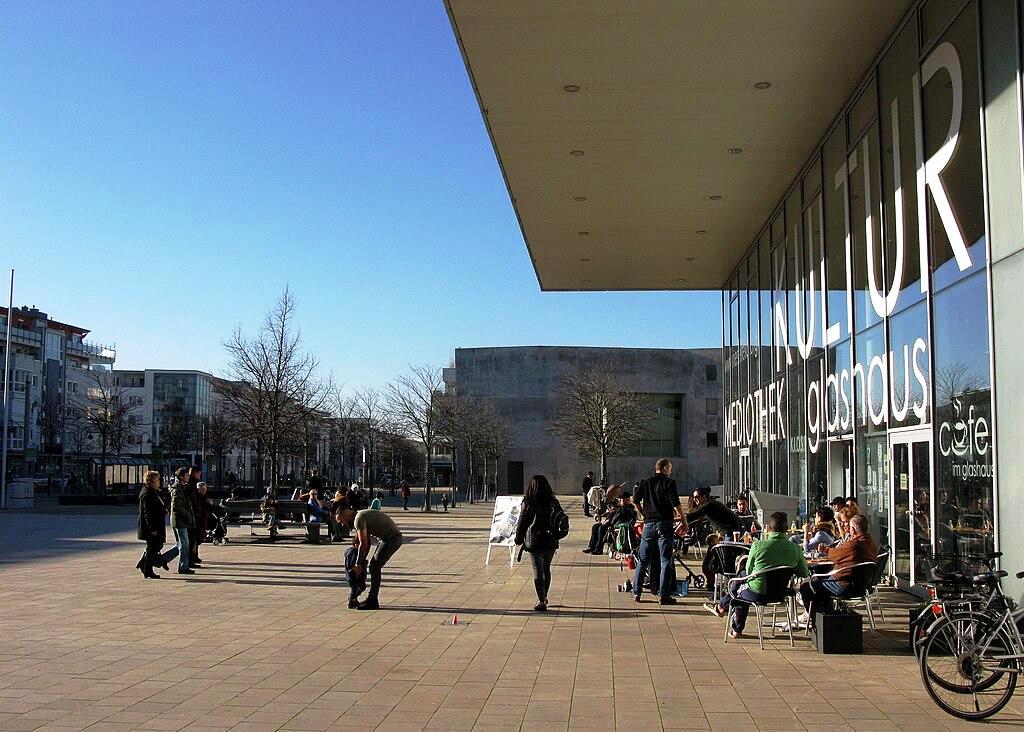
This relationship becomes particularly visible around the Glashaus on Maria-von-Rudloff-Platz.
The building brings together several social and cultural functions and serves as a central meeting point in the district.
Media library.
Association activities.
Café.
Events.
Neighbourhood work.
The proximity of these functions creates an infrastructure that goes beyond the provision of services.
It increases opportunities for encounter.
A place does not become cultural only because programmed events take place there.
It also becomes cultural because different uses can coexist there repeatedly over time.
Neighbourhood memory develops through this repetition of presence.
From Rieselfeld to Dietenbach: carrying experience forward
The conversation with Bernd Kulow also opens a perspective towards Dietenbach, the new district being developed nearby.
The comparison is particularly useful.
Rieselfeld now allows us to observe, with several decades of hindsight, how an urban-planning project gradually became a social space.
Dietenbach poses the same question in the future tense.
How can conditions be created for residents to meet?
What role should public squares play?
Where should neighbourhood meeting spaces be located?
How can a district become legible enough for residents to gradually make it their own?
Planning can provide centres and facilities.
The experience of Rieselfeld shows, however, that their physical existence alone is not enough.
A meeting place becomes truly central only when it is used, recognised and integrated into everyday routines.
Passing on experience without turning it into a model
Rieselfeld can easily be described as a “model” for other districts.
The term should be used cautiously.
Urban experiences cannot simply be reproduced.
Populations change.
Economic conditions differ.
Public policies evolve.
Needs are not identical.
What Rieselfeld can pass on to Dietenbach is therefore not a formula.
It is an experience.
Among other things, it shows that the social construction of a neighbourhood needs to be supported over time and that relational infrastructure can be as important as physical infrastructure.
The podcast as archive
Wir sind Rieselfeld therefore acquires a second life beyond its anniversary context.
By recording these conversations, K.I.O.S.K. is gradually creating an audio archive.
This archive differs from administrative documentation.
Planning files describe designs.
Minutes preserve decisions.
Statistics describe populations.
Photographs document spaces.
Oral testimony allows us to hear how someone experienced particular transformations.
None of these sources replaces the others.
They complement one another.
The podcast adds an especially important layer to the district’s history: lived experience.
Memory should not become a single narrative
Archiving residents’ testimonies also raises questions.
Who speaks?
Who does not?
Which generations are represented?
Which trajectories remain absent?
A participatory project does not automatically become representative of the entire population.
This limitation does not reduce its value.
It reminds us that collective memory is always built from a selection of traces.
The strength of the series therefore lies less in producing “the” story of Rieselfeld than in preserving several stories side by side.
Documenting the ordinary
One of the most valuable aspects of the project is its attention to everyday life.
Public archives more easily preserve major projects, decisions, inaugurations and exceptional events.
Yet neighbourhood life consists largely of experiences that never become official events.
Taking the tram.
Going to the market.
Accompanying a child.
Meeting someone in a square.
Watching a street change.
Taking part in an association.
Such practices are difficult to preserve.
Oral narrative gives them a temporary documentary form.
Memory as cultural participation
The project also demonstrates that memory work does not need to begin in a museum or public archive.
It can emerge from a neighbourhood association.
In this context, telling one’s story already becomes a form of cultural participation.
A resident is not simply consuming a programme.
They contribute part of the material through which the neighbourhood represents itself.
This logic fits K.I.O.S.K.’s history.
Since its beginnings, the organisation has sought to create conditions in which residents can participate in shaping Rieselfeld’s social and cultural life.
The podcast extends that principle into the field of memory.
Conclusion
At first sight, Wir sind Rieselfeld may appear to be an audio series created to mark an association’s anniversary.
Its significance extends well beyond commemoration.
The series documents a particular moment in the history of a relatively young neighbourhood: the point at which a first generation of experiences begins to become memory.
Rieselfeld was planned.
Buildings were constructed.
Facilities opened.
But the district was also produced by the practices, encounters, commitments and narratives of the people who lived there.
By giving some of these experiences an audible form, K.I.O.S.K. makes accessible a dimension that conventional urban archives struggle to capture: the gradual transformation of built space into lived territory.
The podcast therefore does not only describe what Rieselfeld is.
It also contributes to how the neighbourhood may later remember what it has been.
Editorial note — This article is based on a text by Blaise Puala originally published on Ciel-Bleu.org on 9 October 2022 drawing on the “Wir sind Rieselfeld” audio series by K.I.O.S.K. im Rieselfeld e.V. It has been revised, verified and re-edited for the Kultur Insights library in order to preserve its documentary value while deepening the analysis of resident memory, participation and the social construction of a neighbourhood.