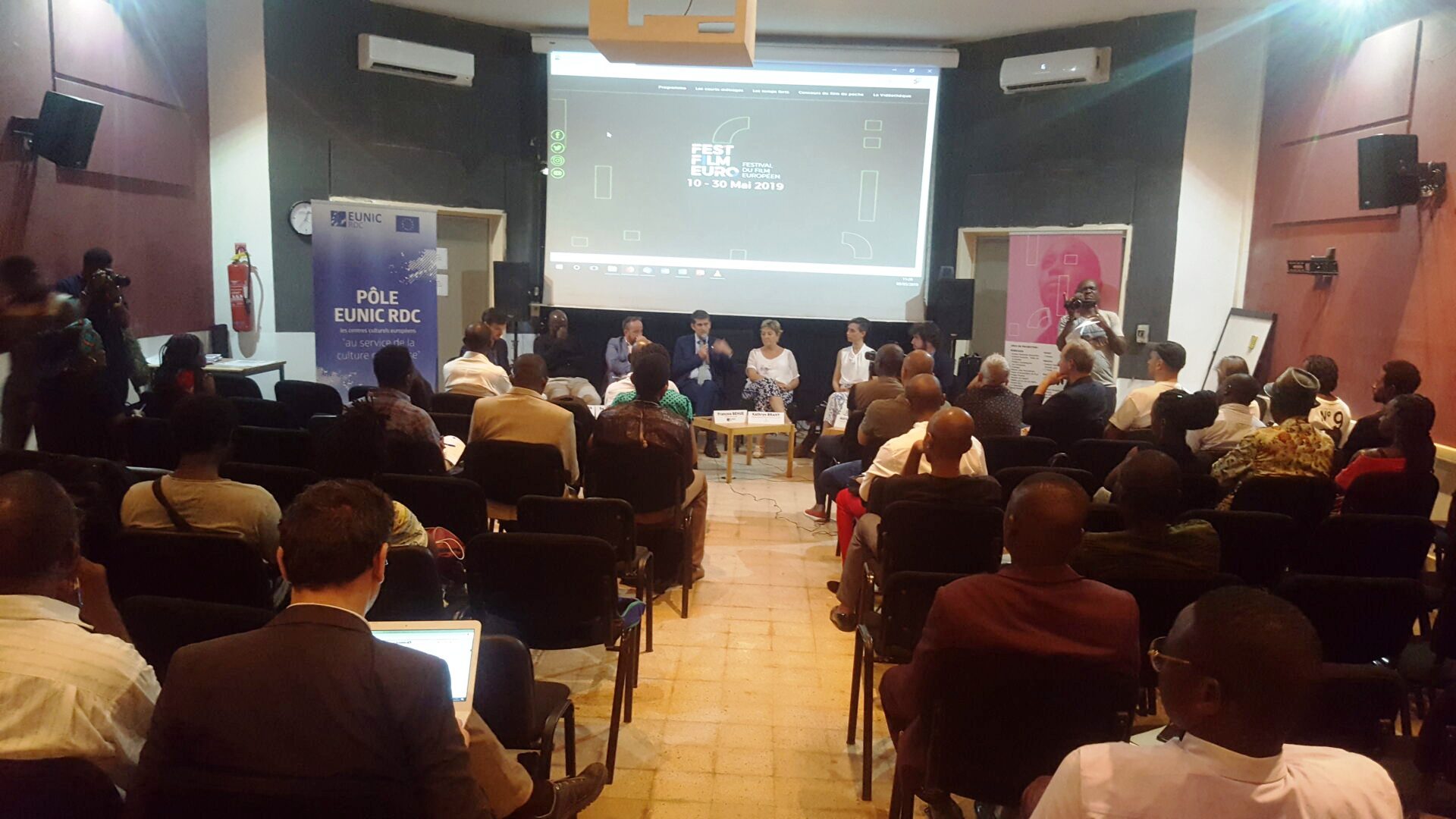
In May 2019, the third edition of the European Film Festival in the Democratic Republic of the Congo announced around 200 film screenings across several cities in the country.
Thirty-two European feature films.
Fifteen Congolese short films.
Cultural centres.
Schools.
Invited filmmakers.
Professional encounters.
Masterclasses.
And a competition inviting participants to create a short film using a mobile phone.
Taken separately, these elements might appear to form the ordinary programme of a film festival.
Considered together, they reveal something else.
The festival was conceived as a temporary infrastructure of cultural circulation.
Films were intended to travel.
Filmmakers were expected to move between different spaces.
Audiences were to be reached beyond conventional screening venues.
Schools were to become temporary sites of film exhibition.
Local cultural organisations were to participate in a wider distribution network.
European and Congolese productions were to share a common programme.
The significance of this arrangement therefore extends beyond film programming alone.
It raises a broader question:
What needs to be built for a cultural work, a professional and an audience to encounter one another across a territory?
A festival conceived beyond Kinshasa
The presentation of the 2019 edition took place in Kinshasa.
But the festival was not designed to remain in the capital.
The programme was expected to circulate across approximately ten cities in the Democratic Republic of the Congo.
Kinshasa.
Matadi.
Muanda.
Kikwit.
Goma.
Bukavu.
Kisangani.
Lubumbashi.
Kananga.
And other locations within the cultural network involved in the programme.
This geography fundamentally changes the nature of the event.
The festival is no longer simply a place to which audiences are expected to travel.
The festival itself becomes mobile.
Making films circulate
The first form of circulation concerns the films themselves.
A film produced in a European context can be screened in Kinshasa and subsequently in another Congolese city.
A Congolese short film can enter the same programme.
A work therefore leaves its original environment of production and distribution to encounter new cultural settings.
Such movement may seem natural when discussing cinema.
Yet it is far from automatic.
Films do not travel on their own.
They require screening rights.
Copies or digital files.
Equipment.
Venues.
Programmers.
Schedules.
Technical resources.
And people capable of organising screenings.
Cultural circulation always depends on infrastructure.
The festival as a network rather than a single venue
This characteristic becomes particularly visible in the planned 2019 edition.
The programme was designed to involve several cultural venues and educational institutions.
The event therefore did not rely on one central space from which every activity would take place.
It depended on a series of local connections.
A cultural centre hosts a screening.
A school provides a venue.
A local organisation facilitates access for its audience.
Partners coordinate the schedule.
The festival becomes a temporary network.
Its coherence no longer depends on bringing every activity into a single location.
It depends on maintaining relationships between different activities within a shared programme.
Decentralisation as practical work
It is easy to declare that a festival aims to reach wider audiences.
Putting that ambition into practice is considerably more complicated.
Decentralisation requires venues.
Local contacts.
Technical equipment.
People responsible for coordination.
Communication resources.
And solutions adapted to different material circumstances.
Cultural decentralisation is therefore not simply a matter of including several cities on a festival poster.
It is a process of organisation.
Kinshasa does not represent the entire cultural territory
This approach also draws attention to an important reality of the Democratic Republic of the Congo.
The country’s cultural life cannot be reduced to Kinshasa.
The capital concentrates a significant share of its institutions, media and cultural infrastructure.
Other cultural scenes nevertheless exist.
Goma.
Bukavu.
Kisangani.
Lubumbashi.
Matadi.
Kananga.
And many other cities.
Making a programme circulate means recognising this territorial plurality.
Circulation does not mean equal access
This ambition must nevertheless be examined carefully.
Taking a festival to several cities does not eliminate the differences between those places.
Not all cities have comparable screening venues.
Or equivalent technical equipment.
Or the same professional networks.
Or similar media coverage.
Or established audiences with the same opportunities to participate.
Circulation can reduce certain distances.
It does not make them disappear.
A festival’s geographical network should therefore be understood as an attempt to establish connections, not as evidence that cultural conditions have become equal across the territory.
European and Congolese films within the same programme
The name European Film Festival might initially suggest an event devoted exclusively to films produced in Europe.
The 2019 programme was more complex.
Alongside European productions, Congolese short films were also included in the announced selection.
This presence matters.
It partly changes the relationship between international programming and local film production.
Audiences were not expected to encounter narratives from elsewhere alone.
Works produced within the Congolese context were also to occupy space within the festival.
Beyond a one-way understanding of Europe–Africa exchange
This coexistence challenges an overly simple interpretation of cultural circulation.
A festival supported by European institutions in Africa can easily be understood as a one-way movement:
European works are brought to African audiences.
The 2019 edition suggests a more nuanced configuration.
European films were expected to circulate.
Congolese films were included in the programme.
European and Congolese filmmakers were to participate in encounters.
Students and professionals were invited to exchange experiences.
This does not establish that every participant had equal influence over programming or access to the same resources.
But cultural circulation cannot be described exclusively as importation.
Institutions establish the framework
This distinction does not diminish the determining role of institutions.
A festival has a programme.
Selection criteria.
Partners.
Budgets.
Editorial decisions.
Distribution arrangements.
Not every available film is screened.
Not every filmmaker is invited.
Not every territory is included.
Cultural circulation is therefore organised.
It results from decisions.
Who makes what circulate?
This question becomes central.
Which films travel?
Who decides which works are selected?
In which cities are they screened?
Which audiences are being sought?
Which professionals are invited?
Which local partners become part of the network?
Circulation is never merely the physical movement of a cultural work.
It also produces a geography of visibility.
Filmmakers circulate as well
The festival was not intended to move films alone.
Filmmakers were also expected to participate in encounters and masterclasses.
Their presence changes the nature of a screening.
Audiences no longer encounter only a completed work.
They can meet someone involved in its production.
Ask questions.
Listen.
Discuss.
Understand a creative process.
The circulation of a film is then accompanied by the circulation of professional experience.
From exhibition to mediation
This dimension distinguishes a simple film screening from a framework of cultural mediation.
Screening a film makes a work accessible.
Organising a discussion afterwards adds another layer.
An interpretation can be challenged.
A context explained.
A working method discussed.
Different experiences shared.
Mediation begins when the work becomes the starting point for a relationship.
Masterclasses as spaces of knowledge exchange
The planned masterclasses for students and audiovisual professionals reinforced this dimension.
The festival was therefore not intended exclusively for cinema audiences.
It also addressed the professional environment.
How is a film directed?
How is it produced?
How is a narrative constructed?
How does a film circulate?
How does a professional trajectory develop?
The answers to these questions cannot be contained within a single masterclass.
But such an encounter can create a temporary space for the exchange of knowledge between people with different professional experiences.
Schools as places for cinema
One particularly interesting feature of the edition was the announced inclusion of screenings in educational institutions.
This arrangement changes the location of cinema.
A classroom or school space can temporarily become a screening venue.
Audiences do not need to be regular visitors to a cultural centre.
Instead, the festival enters another environment.
This change of location also transforms cultural mediation.
Reaching audiences who might not otherwise attend
A cultural event organised exclusively within an established institution often attracts people who are already familiar with that institution.
By introducing activities into schools and partner venues, a festival changes its relationship with potential audiences.
It no longer asks only:
Who will come to the festival?
It also asks:
How far can the festival go towards its audiences?
This reversal is significant.
Audiences as part of the infrastructure
Audiences are not merely the passive endpoint of a distribution process.
Their participation also influences how the entire system functions.
A venue must know how to reach people.
A school coordinates the participation of its students.
A cultural centre communicates with its local environment.
A screening may lead to discussion.
The circulation of films therefore also depends on social infrastructure.
The pocket-film competition
The 2019 programme also included a competition devoted to the pocket film.
Participants were invited to produce a short film lasting no longer than two minutes, using a smartphone, around the theme of documenting everyday life.
This proposal introduced another kind of transition.
The spectator could become a producer of images.
From audience to creator
A film festival generally places audiences in front of works selected by others.
The competition changes that relationship.
It invites participants to create something themselves.
Choose a subject.
Film.
Construct a sequence.
Edit.
Tell a story.
This transition from reception to production is significant.
It connects with a broader question encountered in other cultural initiatives:
What happens when an institution does not simply present works, but also creates conditions in which new narratives can be produced?
The smartphone as a tool of access
The choice of mobile phone matters.
It does not remove technical inequalities.
Not all devices offer the same capabilities.
Not all participants possess the same skills or access to editing tools.
Nevertheless, a smartphone can lower certain barriers compared with film production that immediately requires professional camera equipment.
Creative work can begin with a device already embedded in many people’s everyday lives.
Documenting everyday life
The competition’s theme also deserves attention.
Documenting everyday life means looking closely at what is nearby.
A neighbourhood.
An activity.
A person.
A gesture.
An ordinary situation.
The festival’s international circulation thus meets an extremely local scale.
On one side, films move between countries and cities.
On the other, a participant is invited to create two minutes of images drawn from their immediate environment.
Both movements coexist.
The local and the international are not opposites
This relationship is particularly interesting.
An international festival is not necessarily meaningful because it takes audiences away from their own context.
It can also encourage them to return to that context with a different perspective.
Watching other films.
Encountering other narratives.
Then looking differently at one’s immediate surroundings.
Cultural circulation is not only about receiving what comes from elsewhere.
It can also change the conditions under which people tell stories about what is close to them.
A festival as temporary infrastructure
For a limited period, the European Film Festival was intended to connect a range of elements.
International institutions.
The Institut français.
Local cultural centres.
Schools.
Filmmakers.
Films.
Professionals.
Students.
Audiences.
Digital tools.
These elements exist independently of the festival.
But the festival’s programme brings them into a temporary relationship.
This is what makes it possible to understand the event as infrastructure.
Temporary does not mean without consequences
Much of this infrastructure disappears when a festival ends.
Screenings stop.
Guests leave.
The programme closes.
Yet certain elements may remain.
A film discovered.
A professional contact.
A working method.
A discussion.
A possible relationship between organisations.
Experience in programming.
An archive.
It is nevertheless important to remain cautious: the available 2019 documentation does not make it possible to assess these longer-term consequences systematically.
The announced edition and the event as experienced
The original article was published on Ciel-Bleu.org on 9 May 2019, following the public presentation of the festival.
It therefore documented primarily an announced programme.
Planned screenings.
Participating cities.
Selected films.
Scheduled activities.
This distinction is important.
An announcement describes a projected organisational structure.
It does not, by itself, establish that every activity subsequently took place exactly as planned.
A field archive of a press presentation
The photographs taken on that occasion have a particular documentary value.
They record the moment when the festival was publicly presented.
Organisers.
Partners.
Participating filmmakers.
The festival’s visual identity.
Its institutional setting.
They do not document the festival in every participating city.
They document the moment when its proposed structure became publicly visible.
Communication as a stage of circulation
The press presentation itself belongs to the festival’s infrastructure.
Before audiences can attend a screening, they must know that it exists.
Media outlets receive information.
Journalists publish reports.
Programmes circulate.
Partners communicate schedules.
A film can therefore begin to circulate before it is screened.
It circulates first as information.
Ciel Bleu as an observer of this infrastructure
In 2019, Ciel Bleu documented this moment from Kinshasa.
The original article served an immediate journalistic purpose.
Announcing the event.
Presenting the programme.
Informing readers about the planned cities, films and activities.
Read today, the material has another function.
It makes it possible to examine the cultural infrastructure behind the announcement.
From cultural news to a question of circulation
This change of function is precisely what justifies recovering the article for Kultur Insights.
The question is no longer:
Which films were scheduled to be screened between 10 and 30 May 2019?
It becomes:
How does a festival create the conditions for works, professionals and audiences to circulate between different territories?
This shift transforms time-bound cultural news into an object of analysis.
Documentary continuity
Later Ciel Bleu archives indicate that the European Film Festival continued to receive coverage across subsequent editions.
The 2019 edition was therefore not an isolated event within the organisation’s documentary history.
It nevertheless provides a particularly useful case for examining the festival’s geographical and institutional structure.
For Kultur Insights, it is not necessary to republish every edition.
The 2019 edition can stand as a case study.
Connecting different fields of observation
This archive occupies a particular place within the Ciel Bleu Kultur corpus.
It documents cinema as a practice of circulation.
Works travel.
Audiences encounter new narratives.
Institutions organise.
Professionals exchange knowledge.
Territories are brought into relation.
Later observations in Freiburg offer opportunities to examine cinema within other institutional, urban and social settings.
The aim is not to construct an artificial historical continuity between different events.
It is to recognise the recurrence of a question:
Which infrastructures allow images, narratives and audiences to enter into relationships?
Conclusion
The third edition of the European Film Festival in the Democratic Republic of the Congo allows us to understand a festival as more than a succession of screenings.
Its underlying structure lies in the relationships it was intended to organise.
Between a film and a venue.
Between one city and another.
Between a filmmaker and students.
Between a cultural centre and an audience.
Between an international programme and Congolese productions.
Between watching a film and the possibility of producing one using a smartphone.
Cultural circulation is therefore not simply movement.
It is a construction.
It requires institutions.
Local intermediaries.
Venues.
Cultural mediators.
Equipment.
Programming decisions.
And people capable of organising encounters.
The documentation from 2019 does not demonstrate that inequalities in access to cinema were eliminated or that every relationship established through the programme endured.
It does, however, reveal something more precise:
How a festival can be designed to transform a dispersed collection of venues, works, professionals and audiences into a temporary cultural network.
It is through this relationship between film circulation, territorial networks, cultural mediation and cultural infrastructure that the archive finds its place within Kultur Insights.
Editorial note — This article is based on a text by Blaise Puala originally published on the historical Ciel-Bleu.org website on 9 May 2019 following the public presentation of the third edition of the European Film Festival in the Democratic Republic of the Congo. Blaise Puala attended the presentation and documented it through his own photographs. The text has been fully reviewed, revised and re-edited for the Kultur Insights library to preserve its value as a field archive, distinguish activities announced at the time from their subsequent implementation and refocus the analysis on the circulation of films and filmmakers, the geographical network of screening venues and the cultural infrastructures supporting film mediation.