Encounters between different musical traditions are often described through the language of fusion.
Instruments from different contexts come together, styles mix and a new common form emerges.
This description can be useful for certain musical processes.
It is not sufficient, however, to understand every form of cultural circulation.
Some musical practices do not seek to eliminate differences between repertoires, instruments or ways of playing. Instead, they create spaces in which those differences can enter into relation while remaining perceptible.
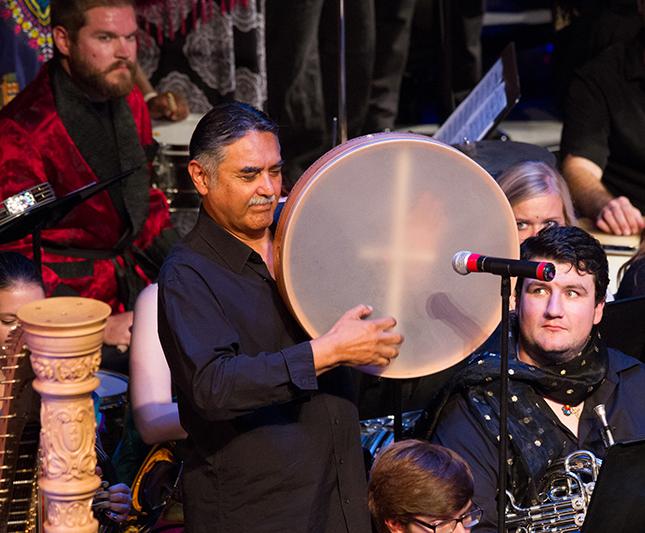
The artistic trajectory of percussionist Murat Coşkun and the collaborations developed around his work provide a useful starting point for examining this alternative logic.
In Freiburg, where he has lived and worked for many years, his practice has been connected to different ensembles, educational projects and musical collaborations. In 2024, the City of Freiburg awarded him the Reinhold Schneider Prize in the music category. A concert with several guests was announced for December of that year to mark the distinction.
The significance of this context, however, extends beyond the award itself.
It opens a broader question: what happens when musicians from different traditions, training backgrounds and repertoires construct a shared musical space without necessarily seeking to create a fully unified language?
Circulation does not necessarily mean fusion
Musical traditions never remain entirely static.
Instruments circulate.
Musicians move.
Repertoires are adopted, adapted, studied or placed in relation with other practices.
Musical forms are consequently transformed as they enter new contexts.
But circulation and fusion are not the same thing.
Fusion often implies the emergence of a new form in which several elements are combined.
Circulation can work differently.
An instrument can enter a new environment while retaining some of its techniques, timbres and references.
A musician can engage with another without seeking to erase the differences between their practices.
A composition can bring several musical languages into relation without making them interchangeable.
This distinction allows musical collaboration to be understood not as the gradual disappearance of boundaries, but as a situation in which different ways of playing become temporarily compatible.
The musician as mediator
In this kind of configuration, a musician’s role goes beyond interpreting a score or reproducing a repertoire.
It also involves organising a relationship.
This may happen through listening, improvisation, rhythmic adjustment, the search for common ground or the deliberate decision to preserve a difference.
Mediation therefore takes place within musical practice itself.
It does not necessarily need to be expressed through explicit discourse about cultural dialogue.
It can emerge through the ways musicians respond to one another.
A percussionist has to determine how a rhythm can relate to a melodic instrument.
Musical traditions with different temporal structures need to identify where common points of connection are possible.
A musician entering a less familiar repertoire may need to listen before intervening.
The ability to establish relationships thus becomes a musical competence in its own right.
Translating without seeking equivalence
The idea of translation can help describe this process, provided it is not understood too literally.
Musical translation obviously does not involve replacing one word with another.
It is better understood as the construction of partial correspondences.
A rhythm can respond to a melodic phrase.
One instrument can take up a structure proposed by another.
Improvisation can temporarily create shared ground.
But these correspondences do not necessarily produce equivalence.
Two instruments retain their timbres.
Two techniques remain distinct.
The musical histories they evoke do not become identical simply because they are performed on the same stage.
Musical translation can therefore preserve a degree of distance.
It enables relation without demanding the disappearance of difference.
Instruments also carry histories
This becomes particularly visible when the instruments themselves are considered.
An instrument is not merely an object used to produce sound.
It is associated with techniques, uses, repertoires and sometimes specific social or ritual contexts.
When it circulates, that history does not simply disappear.
It can, however, be transformed.
A percussion instrument associated with one tradition may enter a contemporary composition.
An instrument with a long historical repertoire may be placed in an improvisational setting.
A musician may develop new techniques from a gesture learned within another environment.
Musical circulation therefore involves more than the movement of people or objects.
It transforms the contexts in which sounds become intelligible.
Avoiding the transformation of instruments into identities
This perspective also requires caution.
An instrument does not automatically represent an entire culture.
A percussion instrument described as “Oriental” does not summarise a homogeneous set of traditions.
Likewise, bringing instruments from several regions together on the same stage is not in itself evidence that “intercultural dialogue” has occurred.
That conclusion would be too quick.
More concrete questions are needed.
How do the musicians work together?
Which elements are adapted?
Which are maintained?
Which references are mobilised?
What role does improvisation play?
Who establishes the musical framework?
The diversity of instruments becomes analytically meaningful only when it is connected to the practices through which they are actually brought into relation.
The stage as a space of musical negotiation
The stage plays a particular role in this process.
For a limited period, it brings together practices that may have different histories.
The piece being performed provides a framework.
But that framework does not necessarily eliminate differences.
Musicians continually adjust their positions.
Listen.
Wait.
Respond.
Temporarily take the lead.
Leave space for another instrument.
Return to the ensemble.
The musical relationship is therefore dynamic.
It depends less on a final state of equilibrium than on a succession of adjustments.
This makes it possible to speak of mediation without assuming that perfect harmony must be the goal.
Mediation may also consist in making coexistence possible.
Improvisation as a form of listening
Improvisation makes this dimension particularly visible.
When everything is not fixed in advance, musicians have to interpret one another’s actions in real time.
Listening becomes a condition of action.
Mastery of one’s own instrument is not enough.
One also has to perceive what the situation allows.
This listening does not necessarily lead to imitation.
A musician may answer through contrast.
A rhythm may accompany a melody without reproducing its structure.
A dissonance may be maintained because it forms part of the musical relationship being created.
Improvisation therefore shows that relation does not necessarily require similarity.
It can be constructed through differences that remain deliberately present.
The audience and multiple frames of listening
Musical circulation does not concern musicians alone.
It also involves audiences.
A listener does not necessarily know the history of every instrument, rhythm or musical tradition present on stage.
They may therefore encounter sounds that cannot be immediately classified.
This can produce different responses.
Some elements may feel familiar.
Others may require more attention.
Still others may remain difficult to identify.
Listening itself then becomes a form of mediation.
The audience enters a musical relationship without necessarily possessing all the categories required to explain it.
This shift matters.
A cultural experience does not need to be completely translated in order to become accessible.
A degree of unfamiliarity can remain.
Freiburg as an infrastructure for musical circulation
The local context also matters.
Encounters between traditions do not take place in an abstract space.
They depend on venues, institutions, festivals, professional networks and audiences capable of making such encounters possible.
Freiburg forms a significant context within Murat Coşkun’s artistic trajectory.
For many years, his musical activity there has been connected to different ensembles and collaborations as well as to Tamburi Mundi, the international frame-drum festival.
Such infrastructures enable musicians working in different contexts to meet, rehearse, perform together and present their work to audiences.
Cultural circulation therefore also depends on material and institutional conditions.
Without venues, programming, funding, networks and time for collective work, musical encounter remains an abstract possibility.
Collaborations rather than an undifferentiated global culture
Speaking of the international circulation of music can sometimes suggest that cultural boundaries are gradually disappearing into a single global language.
Actual practices are often more complex.
Collaborations may produce new forms while retaining recognisable stylistic affiliations.
Musicians can move across several musical worlds without having to choose definitively between them.
Some references may be shared.
Others remain specific.
This coexistence prevents circulation from being reduced to homogenisation.
It encourages us instead to examine how practices change through contact while continuing to preserve differences.
“Intercultural” as a question rather than a conclusion
In this context, the word “intercultural” can remain useful.
But it should not function as an automatic conclusion.
Calling a concert intercultural does not yet explain how its musical relationships are constructed.
The term becomes more useful when it opens questions.
What circulates?
What is translated?
What remains different?
Which actors organise the encounter?
Which contexts make this circulation possible?
And how does an audience engage with musical forms that do not rely on a single frame of reference?
Interculturality then becomes less a property of the concert than a way of examining the relationships it produces.
Institutional recognition and what it makes visible
The awarding of a cultural prize to a musician such as Murat Coşkun adds another dimension.
Institutional recognition does not concern an individual trajectory alone.
It can also make certain practices more visible within the cultural space of a city.
Approaches developed over many years across different traditions, ensembles and networks may acquire more explicit public recognition.
Such recognition does not create the practices it acknowledges.
It follows years of work.
But it can change their position within the local cultural narrative.
An artistic trajectory becomes more extensively documented, narrated and incorporated into the institutional memory of the city.
The award therefore also participates in a process of visibility.
From an announced event to a field of analysis
The concert announced in Freiburg in December 2024 was the immediate subject of the original article.
With greater distance, its documentary value can be repositioned.
The event primarily opens a reflection on the conditions under which musical collaborations become possible and intelligible.
The material does not justify the claim that music resolves cultural differences.
It does, however, allow a more precise question to be asked: how can several musical practices build a relationship without having to become identical?
That question extends beyond the event itself.
It concerns broader forms of contemporary musical circulation.
Conclusion
Music can create spaces in which different traditions encounter one another.
But such encounters do not necessarily need to be understood as fusion.
They can operate through partial correspondences, adjustments, improvisations and maintained differences.
Musical translation does not erase those differences.
It organises their relationship.
Murat Coşkun’s trajectory in Freiburg offers a concrete starting point for observing this logic: a musician whose collaborations, instruments and projects move across several repertoires while remaining embedded in a local cultural infrastructure.
The stage therefore becomes less a space in which several cultures miraculously produce unity than a space in which different practices temporarily learn to coexist.
This shift matters.
It allows cultural mediation to be understood not as the elimination of difference, but as the creation of conditions in which differences can become audible to one another.
Editorial note — This article is based on a text originally published on Ciel-Bleu.org on the occasion of the announcement of a concert dedicated to Murat Coşkun in Freiburg in December 2024. It has been revised, verified and re-edited for the Kultur Insights library in order to preserve its documentary value while placing it within the current editorial framework of Ciel Bleu Kultur.