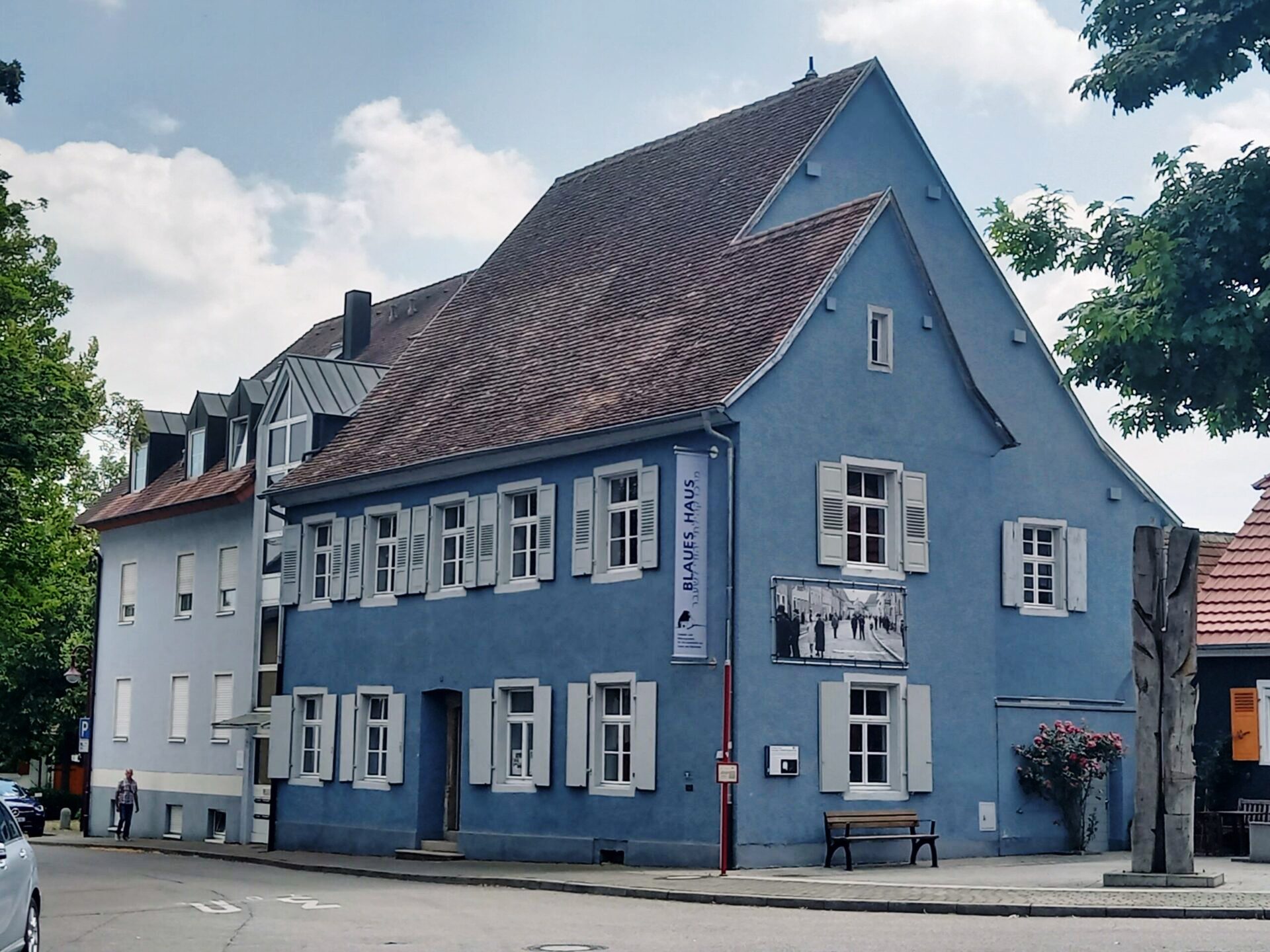
In Breisach am Rhein, on the German bank of the Rhine near the French border, a historic building preserves traces of several centuries of local history. Known today as the Blaues Haus, or Blue House, it once served as a Jewish school, a community centre and a residence for the community’s cantors.
Its history is closely connected to Jewish life in Breisach, the community’s social and religious presence, the persecution it suffered under National Socialism, and the efforts undertaken decades later to preserve the evidence of that past.
Today, the Blue House is a memorial, research and educational centre, as well as a place of encounter dedicated to Jewish history in Breisach and the Upper Rhine region.
It raises a question that extends beyond architectural preservation: how does a historic building become an infrastructure for remembrance and cultural transmission when the community whose history it embodies has been violently destroyed?
A building embedded in the city’s history
The history of the Blue House began long before its present role as a memorial institution.
A smaller building already stood near Breisach’s former town wall before 1691. Following its enlargement, the property operated for approximately 140 years as the St. Peter inn and belonged to Christian families.
In 1829, the Jewish community of Breisach acquired the building to establish a school for its children.
The school operated until 1876. For a period, the property was also used to provide assistance to impoverished Jewish residents.
Its functions subsequently changed.
The building became a centre of community life, serving as a meeting place and as accommodation for cantors and their families.
It was therefore more than a setting for religious or administrative activities.
It formed part of everyday life for people who lived, studied and maintained relationships within its walls.
The building’s present significance as a place of remembrance derives from these historical uses and the human lives associated with them.
Jewish history in Breisach predates the Blue House
Jewish history in Breisach reaches considerably further back than the community’s acquisition of the building.
Jewish settlement in the town can be traced to the Middle Ages.
Several Jewish communities emerged over the centuries, although their histories were repeatedly marked by persecution, expulsion and violent disruption.
During the fourteenth century, the first community was destroyed amid the anti-Jewish violence associated with the Black Death.
Another community was later expelled in the fifteenth century.
Jewish families began settling in Breisach again during the seventeenth century.
Their lives unfolded in a region whose political affiliations and territorial boundaries changed repeatedly.
For centuries, the Upper Rhine was a space of economic, family and religious connections between territories now belonging to Germany, France, Switzerland and Austria.
The experiences of Jewish families in Breisach cannot therefore be understood exclusively through the boundaries of today’s nation-states.
The Blue House provides an entry point into these wider historical relationships through the history of one particular place.
Remembering coexistence without idealising the past
The historical relationships between Jewish and Christian residents of Breisach require careful examination.
For extended periods, the two populations lived in geographical proximity. Economic exchanges, social relationships and shared aspects of urban life formed part of their everyday experience.
Yet proximity did not necessarily mean equality or uninterrupted peaceful coexistence.
Legal restrictions, social exclusion, antisemitic violence and repeated expulsions also shaped this history.
It would therefore be misleading to portray the past as a continuous model of harmonious coexistence that ended abruptly in 1940.
National Socialist persecution represented a profound historical rupture.
At the same time, it must be understood within the longer European history of antisemitism.
A memorial institution should not simplify these contradictions.
Its role is to provide the historical evidence and interpretive tools through which they can be examined.
This commitment to accuracy is fundamental to responsible remembrance.
Persecution, destruction and deportation
Following the National Socialist seizure of power in 1933, the Jewish population of Breisach experienced increasing discrimination, exclusion and persecution.
These measures progressively affected the community’s economic, social and religious life.
During the night of 9–10 November 1938, the synagogue in Breisach was destroyed amid the coordinated anti-Jewish violence carried out across Nazi Germany.
A prayer room was subsequently established in the former community building and remained in use between 1938 and 1940.
The house thus acquired particular importance.
It became one of the places where members of the persecuted community could continue aspects of their religious life.
Another decisive event occurred on 22 October 1940.
Jewish residents of Breisach were arrested and deported to the Gurs internment camp in southern France as part of the deportation of thousands of Jews from Baden, the Palatinate and neighbouring areas.
Some individuals were taken directly from the former community building.
The building is therefore materially connected to the history of persecution.
The deportations to Gurs also demonstrate that Nazi persecution extended beyond Germany’s borders.
The trajectories of those affected led from Breisach to France and, for many victims, to other sites of persecution and extermination.
The cross-border dimension of this history is not a contemporary institutional interpretation imposed upon the past. It emerges from the documented historical events themselves.
Dispossession, restitution and the preservation of the building
The history of the house did not end with the destruction of the Jewish community.
In 1941, the property was subjected to a forced sale to the Gugel-Werke company in Freiburg.
The company subsequently used the building as a workshop for military-related production.
In 1953, the forced sale was reversed through restitution procedures under French occupation law.
The property was returned to the Oberrat der Israeliten Badens, the representative body of the Jewish community in Baden.
In 1955, the organisation sold the building to Selma Ziehler, a Jewish survivor from Breisach who had been exempted from deportation together with her family.
These changes in ownership form an essential part of the building’s history.
They show that heritage preservation cannot be separated from questions of dispossession, property rights and restitution.
By the late 1990s, renewed attention was being directed towards Jewish history in Breisach and the preservation of the former community building.
The Förderverein Ehemaliges Jüdisches Gemeindehaus Breisach, founded in 1999, worked to secure its future.
In July 2000, the association acquired the property from a descendant of Selma Ziehler.
Restoration work and plans for its future role as a place of remembrance and encounter followed.
In June 2003, the restored building was officially inaugurated under the name Blaues Haus.
The former Jewish community house thus acquired a new public function.
It became a place where historical research, education, remembrance and encounters could be brought together.
From architectural preservation to historical mediation
Preserving a building does not automatically make its history understandable.
Historical sources must also be identified, examined, interpreted and made accessible to the public.
The Blue House therefore combines the preservation of its physical structure with an ongoing programme of research and cultural mediation.
Archival documents, photographs, family histories, personal recollections and biographical research form important foundations of this work.
These materials provide access to Jewish history in Breisach beyond a chronology of major events.
They allow individual lives to become visible.
Names, professions, family relationships and everyday experiences can be identified and placed within their historical contexts.
Persecution is no longer presented solely through dates and political decisions.
It can also be understood through the experiences of the people whose lives were disrupted or destroyed.
In 2019, a permanent exhibition was established in rooms formerly occupied by the Eisemann family and used by the Jewish community.
Interpretive texts, audio stations and selected objects introduce visitors to Jewish life in Breisach, particularly around the year 1931.
This curatorial approach is significant.
It does not portray Jewish residents exclusively through their later experience as victims of Nazi persecution.
It recalls that they had previously lived, worked, studied, maintained family relationships and participated in the life of the town.
Remembering persecution and destruction must not erase the history of the lives that preceded them.
Archives and biographies as foundations of remembrance
The history of a destroyed community cannot be reconstructed through a surviving building alone.
It requires research across sources that may be dispersed among institutions, families and countries.
Photographs, letters, administrative records, registers and personal testimony can help recover individual histories.
Connections with descendants of former Jewish families from Breisach are also important to this work.
Such relationships may reveal additional documents, clarify biographical details or establish connections between people and generations.
Remembrance is therefore not a completed undertaking.
It remains an ongoing process of research.
New evidence may emerge. Existing interpretations may need to be reconsidered. Biographies may become more complete.
At the same time, the limits of the surviving record must remain visible.
Some families left extensive documentation, while others left very little.
Certain testimonies were lost. Other experiences were never recorded.
Historical research should not fill these gaps with unsupported assumptions.
It must distinguish between documented facts, reasonable interpretation and missing evidence.
The question of who constructs historical narratives and which sources are available also arises, under fundamentally different historical circumstances, in our analysis of literature, memory and perspectives on the Rhodesian War.
This reference does not equate the historical events concerned.
It points instead to a shared methodological requirement: critically examining sources while acknowledging the limits of historical representation.
The Upper Rhine as a cross-border space of remembrance
The Blue House is deeply rooted in Breisach’s local history.
Its research and institutional relationships, however, extend well beyond the town.
In 2001, the association joined Alemannia Judaica, a network devoted to preserving and researching Jewish heritage across several regions of the German-speaking and cross-border Upper Rhine area.
Its geographical scope includes southwestern Germany, Alsace, northern Switzerland and Vorarlberg.
Encounters and research initiatives have also brought the institution into contact with partners from France and other countries.
In 2004, a trilingual international conference held at the Blue House examined the early history of Jewish families in Breisach.
Among the participants were Holocaust survivors and descendants of families whose roots lay in the town.
Such encounters demonstrate the importance of cross-border historical research and cultural transmission.
The history of a single town becomes connected to numerous other places through the experiences of its former residents and their descendants.
The Upper Rhine therefore appears not only as a contemporary European region of cooperation.
It is also a historical landscape shaped by migration, commerce, family relationships, changing borders, persecution and forced displacement.
Cross-border remembrance has a concrete meaning in this context.
It is grounded in documents, biographies and relationships between people and institutions in different countries.
Historical education and younger generations
Educational work is another central dimension of the Blue House’s activities.
Over the years, school pupils and young adults have participated in research initiatives, educational programmes and encounters addressing Jewish history in Breisach.
One example is the project Spurensuche Breisach–Gurs–Auschwitz, supported through the German federal programme Jugend erinnert.
The project focused on investigating the lives and experiences of Jewish residents of Breisach who were deported in October 1940.
Such activities change how younger generations engage with historical knowledge.
The past is not presented exclusively as a completed account to be learned.
It also becomes a subject of investigation.
Reading a document.
Identifying a former address.
Reconstructing a biography.
Tracing the stages of an individual’s life.
These activities develop historical understanding while demonstrating how knowledge is established and verified.
Young participants are therefore not simply recipients of an existing culture of remembrance.
They can also contribute to the research and transmission of historical experiences.
This approach connects remembrance with historical method.
Remembrance as a cultural and social practice
The Blue House defines itself as a place of remembrance and encounter.
The relationship between these two functions is important.
Remembrance does not consist solely of preserving historical objects or presenting events from the past.
It also involves bringing people together in the present.
Descendants of Jewish families, researchers, students, local residents and visitors can engage with the documented histories in different ways.
They do not necessarily share the same personal experiences or connections to the events concerned.
Historical evidence nevertheless provides a common point of reference.
The Blue House creates conditions in which questions can be asked, knowledge can be developed and different perspectives can be examined in relation to documented facts.
Remembrance thus becomes a cultural and social practice.
A related question about the transmission of local history appears, in a fundamentally different historical setting, in our publication on audio narratives and the construction of neighbourhood memory in Freiburg-Rieselfeld.
That publication examines the documentary recording of experiences associated with the development of an urban neighbourhood.
In Breisach, by contrast, the central concern is the preservation and investigation of the history of a Jewish community destroyed through antisemitic persecution.
The historical and moral dimensions of these contexts must remain distinct.
The connection concerns only the broader question of how cultural institutions and documentary practices make historical experiences accessible to subsequent generations.
Conclusion — Local history with cross-border significance
The Blue House in Breisach is more than a restored historic building.
Its significance lies in the relationship between several functions: heritage preservation, historical research, documentation, education and public encounter.
The building itself bears witness to Jewish life in Breisach.
Yet the public understanding of that history depends on the continuous work undertaken through archives, biographies, exhibitions and educational programmes.
Relationships with descendants of former Jewish families and institutions in other countries further extend this work beyond the town.
The Blue House demonstrates how a relatively small cultural institution can contribute to preserving and transmitting a history whose significance extends far beyond its immediate location.
Beginning with a single building in Breisach, it becomes possible to trace historical connections with Alsace, other regions of Germany, France and countries where descendants of former Breisach families now live.
These cross-border relationships are not based on an abstract claim of shared European memory.
They emerge from the documented lives and historical trajectories of the people whose experiences the Blue House researches and communicates.
For Ciel Bleu Kultur, this example raises a fundamental question concerning cultural institutions:
How can locally rooted organisations preserve and transmit knowledge whose historical and social significance extends beyond their immediate surroundings?
The answer does not lie solely in the physical conservation of heritage.
It also depends on the ability to connect surviving evidence, acknowledge gaps in the historical record and make reliable knowledge accessible to present and future generations.
Editorial note — This article is based on a text written by Blaise Puala and originally published on Ciel-Bleu.org on 28 July 2023. For the Kultur Insights editorial library, the original publication has been fully reviewed, revised and expanded from a historical and institutional perspective. This edition clarifies important aspects of the building’s history and that of the Jewish community in Breisach, while distinguishing documented historical facts from the present analysis of the Blue House as a place of remembrance, research and cultural transmission.