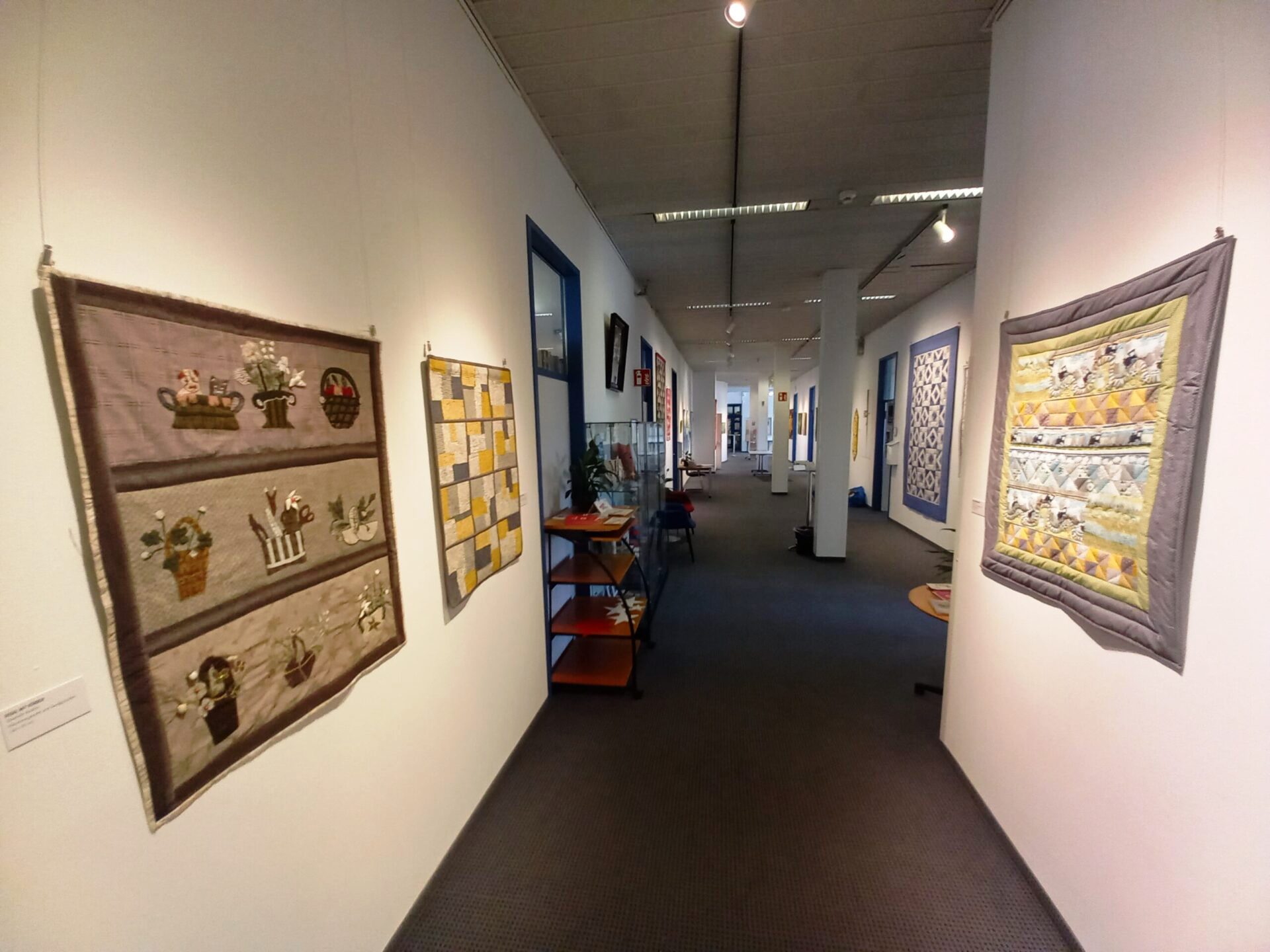
A textile exhibition may appear to occupy a modest place in the cultural life of a city. A few works hanging on walls, pieces of fabric assembled into geometric patterns, houses, trees or abstract compositions. Yet behind these objects often lies a practice extending far beyond the duration of the exhibition itself.
In Freiburg im Breisgau, the 2022 Quiltclub exhibition at the Carl-Schurz-Haus brought public attention to a collective textile practice that had developed over several decades. Founded in 1987, the club regularly brings together people interested in patchwork and quilting. Its members pursue individual projects, exchange techniques and experiences, and find in their meetings a stable environment in which to continue their work.
Held from 22 July to 1 October 2022, the exhibition followed two years during which the pandemic had significantly disrupted cultural activities. Beyond the works on display, it raised a broader question: how does a regular artistic practice developed largely within a small collective acquire a public cultural existence?
A practice that long predates the exhibition
The exhibition represented a visible moment within a much longer process. Freiburg’s Quiltclub had been active since 1987, bringing members together at the Carl-Schurz-Haus to work on their current projects and exchange knowledge.
These meetings allow participants to compare techniques, seek advice, discuss new ideas and observe how other people approach similar materials. An unfinished piece may become the starting point for a conversation, while a particular difficulty can create an opportunity to demonstrate a method or share experience.
Such regularity is central to the life of a creative community. Its continuity does not depend solely on exhibitions or exceptional occasions. It also emerges from repeated encounters, the gradual development of skills and the confidence that comes from working alongside others.
Over time, the group itself becomes an infrastructure that supports creative practice.
Textile as artistic practice
Quilting has a long history associated with the practical use of fabric. By assembling several layers of material, it can produce blankets and other functional objects. Contemporary textile practice, however, also encompasses a wide range of visual and artistic possibilities.
Colour, texture, pattern, composition and stitching techniques become elements of expression. The arrangement of fabrics can generate visual rhythms, contrasts and forms that extend beyond an object’s original function.
The works exhibited in Freiburg in 2022 reflected this diversity. Some drew on traditional structures, while others explored more contemporary compositions. Certain pieces retained a decorative or functional purpose; others approached the format of textile images designed to be viewed on a wall.
This variety challenges the assumption that textile practice can be understood through a simple distinction between artistic creation and skilled craftsmanship.
Art or craft: a limited distinction
Textile practices have often occupied an uncertain position within cultural hierarchies. Painting and sculpture are readily recognised as artistic disciplines, whereas sewing, embroidery, patchwork and quilting are frequently associated with craft, domestic activity or leisure.
The Quiltclub illustrates the limitations of these categories.
Producing a quilt may require extensive technical knowledge, but it also involves aesthetic decisions. Fabrics must be selected, colours brought into relation, shapes assembled and a composition developed. Even when a work serves a practical purpose, its visual organisation can express a distinctive artistic approach.
Technical precision and creative intention are therefore not competing qualities. They often develop together.
Rather than attempting to determine whether quilting should be classified exclusively as art or craft, the exhibition invites attention to the cultural conditions under which textile work is produced, shared and made visible.
Practising together without necessarily producing a collective artwork
The collective nature of the Quiltclub does not imply that every piece is created jointly. Many works remain individual projects, shaped by the choices and abilities of their makers.
What connects them is the environment in which those projects develop.
Members can observe one another’s progress, discuss difficulties, offer suggestions and demonstrate techniques. An individual work may therefore benefit from knowledge circulating throughout the group without becoming a collectively authored object.
This distinction is important for understanding cultural participation. Creating together does not always require several people to work directly on the same piece. It can also describe the conditions that allow individual creative practices to develop through shared experience.
In this sense, the Quiltclub functions as a setting for reciprocal learning while preserving the individuality of its members’ work.
Blocks as forms of relationship
The exhibition also revealed how textile production can carry a social meaning beyond the finished object.
The original account referred to works assembled from individual blocks and to pieces associated with members’ birthdays. Within such practices, fabric elements may become gifts, gestures of attention or reminders of relationships within the group.
A block is therefore not necessarily just a component of a larger composition. It can also refer to a person, an occasion or a shared experience.
This dimension makes visible a form of cultural production in which artistic activity and social relationships are closely connected. The value of a piece may lie partly in its visual qualities and partly in the circumstances of its creation and exchange.
Textile work becomes a means of expressing relationships as well as a material practice.
Learning through proximity
The Quiltclub provides an environment in which knowledge can circulate without necessarily following a formal teaching programme.
Learning may begin with a simple observation. One member watches another assemble fabrics or use a particular technique, asks a question and attempts the gesture themselves. Through repetition, practical knowledge becomes more familiar and gradually develops into an individual skill.
Experience is not distributed equally within a group. Some participants may have worked with textiles for decades, while others are relatively new to the practice. Yet this difference does not always produce a fixed division between teachers and learners.
Knowledge can pass in several directions, depending on the technique, the project and the experience being shared.
The result is a form of transmission rooted in proximity, exchange and sustained participation.
A community of practice
Seen from this perspective, the Quiltclub can be understood as a community of practice: a group connected by a shared activity through which knowledge, habits and references develop over time.
Members gradually acquire a common vocabulary and become familiar with particular materials, tools and techniques. They may exchange information about patterns, suppliers or approaches to composition, while also developing ways of discussing and evaluating one another’s work.
These forms of knowledge are rarely visible in an exhibition alone. Visitors encounter completed objects, but the skills and relationships behind them have usually developed through years of participation.
The club’s cultural significance therefore extends beyond the production of individual pieces. It also lies in the preservation and circulation of practical knowledge within a local community.
Thirty-five years in 2022
By the time of the 2022 exhibition, the Quiltclub had existed for thirty-five years.
Such longevity deserves attention because cultural initiatives are often assessed through their most public moments: an opening, an exhibition, a festival or an anniversary. The conditions that allow them to continue are usually less visible.
Regular meetings, access to a suitable space, members willing to organise activities and opportunities for newcomers to participate all contribute to the durability of a group.
These arrangements may appear ordinary, but they create the framework within which a cultural practice can be sustained.
The Quiltclub’s history thus reflects more than a lasting interest in quilting. It demonstrates the importance of collective organisation in transforming individual interests into a continuing cultural activity.
The pandemic as a break in continuity
The 2022 exhibition took place after a period of considerable disruption caused by the COVID-19 pandemic. The account published at the time referred to a two-year interruption in the club’s usual exhibition cycle.
For a group built around regular participation, such an interruption affects more than its public programme.
Meetings provide opportunities for informal learning, mutual observation and social exchange. Their disruption can weaken the routines through which members maintain contact and develop their work.
The return of the exhibition consequently represented an opportunity to restore public visibility to a practice whose collective rhythms had been interrupted.
It also drew attention to the fragility of cultural activities that depend on recurring encounters and accessible spaces.
From regular practice to exhibition
An exhibition changes the context in which textile works are encountered.
Within the club, a piece may be an unfinished project, a technical experiment, a personal object or a gift intended for someone else. When presented in an exhibition, it enters a different relationship with its surroundings.
Visitors who may know little about quilting can observe the work, compare it with other pieces and consider its visual qualities. The arrangement of objects within a shared space gives them a public dimension.
This movement from regular practice to exhibition is itself a form of cultural mediation.
The exhibition does not create the underlying artistic activity. Rather, it makes that activity accessible to people beyond the circle in which it normally takes place.
The Carl-Schurz-Haus as an interface
The Carl-Schurz-Haus occupies an important position in this process.
Known in Freiburg for its work involving German-American relations, language education, literature, public discussion and cultural events, the institution also provides space for regular clubs and groups.
These activities broaden the ways in which a cultural institution can contribute to the life of a city.
Its role is not limited to organising programmes for an audience. By providing meeting spaces, opportunities for exchange and possibilities for public presentation, the Carl-Schurz-Haus also supports activities developed by the people who use it.
For the Quiltclub, this institutional setting connects a sustained collective practice with a wider cultural environment.
The relationship illustrates how an established cultural institution can serve as an interface between small creative communities and the public.
Between private practice and cultural institution
The Quiltclub occupies a position between individual artistic activity and formal cultural presentation.
Its members develop personal projects, but they do so within a collective setting. Their work may remain within the group or become visible through an exhibition hosted by an established institution.
This intermediate position is significant.
Cultural life does not consist solely of private creative activity on one side and major public institutions on the other. Between them are groups, associations, workshops and recurring initiatives that connect personal engagement with shared spaces and wider audiences.
Such structures may operate with limited resources and without attracting extensive public attention. Nevertheless, they provide continuity, facilitate transmission and create opportunities for participation.
The Quiltclub offers a concrete example of this intermediate cultural infrastructure in Freiburg.
Freiburg translated into fabric
Some of the works exhibited in 2022 included motifs associated with Freiburg and its surroundings. Houses, trees, landscapes and references to the Black Forest appeared within textile compositions.
These elements do not make the exhibition as a whole a project devoted to urban history. They do, however, reveal how a familiar environment can become part of artistic expression.
A building may be reduced to a particular shape, a landscape reinterpreted through colour or a local feature transformed into a textile motif.
The city is consequently more than the geographical location of the activity. It can also provide subjects, images and experiences that enter the creative process.
Through fabric, particular perceptions of Freiburg are translated into another visual language.
Representing a place without creating an archive
A textile representation of Freiburg should not automatically be treated as a historical record of the city.
Such a work reflects choices made by its creator. It selects certain features, simplifies others and expresses a particular relationship to a place. Its purpose is not necessarily to document urban life in a comprehensive or systematic way.
Over time, however, these interpretations may acquire documentary interest.
They can reveal how particular people perceived their surroundings and which places, forms or landscapes held meaning for them at a specific moment.
Textile practice can therefore contribute to cultural memory without becoming an archive in the conventional sense.
Its value lies in the traces of individual and collective experience that the works may preserve.
A free and accessible exhibition
The 2022 Quiltclub exhibition was open to visitors free of charge during the opening hours of the Carl-Schurz-Haus.
This condition of access matters.
Cultural visibility depends not only on whether works are displayed, but also on the circumstances in which people can encounter them.
The Carl-Schurz-Haus serves different purposes. People may enter the building to attend a language course, use its library, participate in a discussion or take part in another activity.
An exhibition situated within such an environment can reach visitors who had not specifically planned to view textile art.
The institution thereby creates opportunities for encounters between activities and audiences that might otherwise remain separate.
Audiences are not always established in advance
A club already has a community of participants, but an exhibition can extend its visibility beyond that existing circle.
Visitors may discover an artistic practice they had previously overlooked. Some may become interested in the techniques on display; others may be drawn to the possibility of taking part in a group.
The article published in 2022 concluded with an invitation to people interested in sewing to attend the club’s monthly meetings.
That invitation reveals another function of the exhibition. Public presentation can create a path towards participation.
The relationship between the club and its audience is therefore not necessarily one-directional. Members produce work that becomes visible to visitors, while those encounters may generate new interest in the collective itself.
The quieter cultures of the city
Descriptions of urban cultural life often focus on the most recognisable institutions: museums, theatres, concert halls, galleries and major festivals.
These venues play an essential role, but they cannot account for every form of cultural activity taking place in a city.
Creative practices also develop within smaller groups, workshops, choirs, reading circles, photography clubs and other associations. Their activities may be sustained over long periods without becoming widely known.
The term amateur is frequently used to describe some of these practices. It should not, however, be confused with an absence of skill or artistic ambition.
For many participants, creative activity is meaningful without being linked to professional advancement or commercial production.
These less prominent forms of engagement are part of the cultural fabric of a city, even when they attract little public attention.
Practising without professionalising
Not every artistic practice needs to lead to professional activity.
A person may devote years to developing a technique without intending to sell their work, pursue an artistic career or participate in the commercial art market.
Such a commitment can nevertheless produce accomplished work, sustain relationships, transmit knowledge and contribute to the cultural life of a community.
The Quiltclub draws attention to this field of active cultural participation.
Between the professional artist and the person who only attends cultural events lies a broad range of people who create, experiment, learn and share their work.
Recognising this dimension makes it possible to understand cultural life beyond professional institutions and the market.
It also gives greater visibility to forms of creative commitment whose value is expressed through continuity and participation.
The cultural value of continuity
The Quiltclub exhibition invites consideration of the relationships that make the works possible.
An institution provides space. Members organise meetings and develop projects. Techniques circulate through exchange and observation. Some works become gifts, while others are prepared for public presentation. Visitors encounter the results, and new participants may discover the group.
These processes do not necessarily attract attention individually. Together, however, they sustain a creative community.
The significance of the exhibition therefore extends beyond the objects displayed on its walls.
It also lies in the continuity of the practice, the relationships maintained over time and the connection between a relatively small collective and the broader cultural environment of Freiburg.
Conclusion
The 2022 Quiltclub exhibition at the Carl-Schurz-Haus could be understood simply as a presentation of textile works created by people interested in patchwork and quilting. A closer examination reveals a more extensive cultural process.
Behind the exhibited pieces stands a club founded in 1987, sustained through regular meetings and the exchange of practical knowledge. Individual projects develop within a collective environment, and the resulting works may move between personal use, gifts and public presentation.
The Carl-Schurz-Haus contributes to this process by providing a setting in which a local creative practice can continue and become visible to people beyond its immediate community.
The Quiltclub consequently illustrates a dimension of urban cultural life that is easily overlooked. A city’s cultural vitality does not depend exclusively on major events or its best-known institutions. It also emerges from smaller structures that maintain practices, connect people and enable knowledge to circulate across time.
In Freiburg, the textile works exhibited at the Carl-Schurz-Haus offer a way of observing how an enduring collective practice contributes to local cultural life.
Editorial note — This article is based on a text by Blaise Puala originally published on Ciel-Bleu.org on 13 August 2022 during the Quiltclub exhibition at the Carl-Schurz-Haus Freiburg. The author visited the exhibition and documented it photographically. The text has been revised, verified and re-edited for the Kultur Insights library in order to preserve its documentary value while deepening the analysis of collective practices, knowledge transmission and the role of intermediate cultural infrastructures in local cultural life.